Democracy Noir · Slovakia
The Friend
Political Noir · Slovakia
By Torsten Schönberg
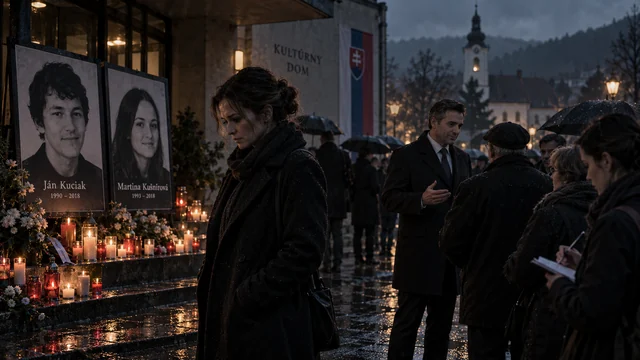
Back to the story collectionThe librarian had placed the photographs beneath the canopy of the cultural center so the rain would not soak them. Ján Kuciak on the left, Martina Kušnírová on the right, their names printed in the same size, and underneath them the date: February 21, 2018. Candles in red and white glass jars stood in front of the portraits. Zuzana Rybárová knelt to set hers among them and felt the hem of her coat wick up the water from the stone pavement. She nudged the jar a little farther back. The tiny adjustment bought her a few seconds before she had to return to the others.
Eight years had passed since the journalist and his fiancée had been murdered in their house in Veľká Mača. They had both been twenty-seven. By now Zuzana no longer remembered exactly where she had heard the news that evening—at the kitchen table or in the car—but she remembered locking her apartment door twice for several nights afterward. Veľká Mača was not far away. On television she had seen windows, fences, and front gardens that looked like the ones she passed on her own drives through the region.
Behind her, Viktor Haluška was testing the microphone. He wore the dark coat he also used when making birthday visits to elderly residents, and he waited until the librarian had read out the names. She mentioned Kuciak’s investigations into corruption and tax fraud and said that Martina Kušnírová had been an archaeologist. Zuzana was grateful for that. Too often Martina had faded, even in memory, into the second face in the photograph, as though a person could become a footnote after death.
Viktor spoke without notes. He said a municipality ought to be a place where no one is afraid to speak the truth. Then he thanked the organizers and assured everyone that the local administration would honor the memory of the two victims. He had a pleasant voice, one that carried all the way to the parking lot without ever turning loud. Zuzana had known that calm tone for nearly twenty years. After her divorce, he had offered to help her move—and had then actually spent a Saturday hauling her books up to the fourth floor.
Once the microphone had been turned off, he drew her under the canopy. He asked after her mother, who was recovering from hip surgery, and listened to the answer without glancing at his phone. Only when a woman with a notepad crossed the square did his expression change. Zuzana recognized Eva Bartošová from the small regional news site whose articles everyone in town read and publicly dismissed as unnecessary.
“She’s waiting for me again,” Viktor said. “Now she wants every advertising contract from the municipal companies, as if our staff had nothing better to do than make a newsroom’s life easier.” He pulled on his gloves and nodded toward an older man edging his way along a railing on the wet cobblestones. “Funny thing is, they didn’t write a word about the new kitchen in the kindergarten. But the moment one invoice goes missing, we’re a nest of thieves.”
Zuzana looked over at the candles. “You just said no one should be afraid of the truth.” Viktor gave her a tired smile and briefly touched her upper arm. “Not of the truth. But you’re still allowed to protect yourself from people who twist your words.” Then he went over to the older man and helped him down the steps. Eva waited at the edge of the square until they reached the car.
On the drive home Zuzana found herself thinking of a demonstration in Bratislava in the spring of 2018. Viktor had stood beside her in the crowd, shoulders hunched because his coat had been too light for the weather. Neither of them had known Ján or Martina. They had gone anyway, after work, without knowing when they would get home. When someone nearby asked for a light, Viktor passed his candle across the crowd, and for several minutes the glass jar traveled through unfamiliar hands before it came back to him.
Later they had coffee at a gas station. Viktor had not yet become deputy mayor, and he had complained that in their town everybody seemed to know which company would win the next contract before it had even gone out to bid. Zuzana had told him about a supervisor who had people sign off on inspections without sending the supporting documents along. They had talked for a long time while the woman behind the counter mopped the floor, and they did not leave until she wanted to stack the chairs. That evening it had felt entirely natural to Zuzana that they meant the same thing.
***
On Monday she was supposed to update the town’s digital infrastructure database. Her contract would end in late March; according to Viktor, all that was missing for an extension was one signature. She worked in what had once been a storage room next to the building department. The outline of a removed shelf was still visible on the wall. The janitor had brought her a second lamp because the ceiling light was not enough. Whenever someone in the next room used the printer, it flickered.
At the western edge of town her map showed a relief ditch running behind a row of low houses. It was supposed to carry rainwater into the collector channel before it spilled across gardens and into basements. The records showed two large culverts under the farm tracks and a renovated outlet. But on the aerial image the visible depression ended before the second track. Beyond it lay a meadow where tire marks ran straight across the route shown on the map.
Zuzana first checked the date of the image, then whether she had somehow opened an unfinished draft. Aerial photographs could be misleading; pipes were underground, ditches could grow over. But the older images did not look much different. In the project file she found the final invoice from autumn 2020: €186,400. Her name was on the as-built plan. Below the list of recorded structures stood a line that read: “Execution checked against on-site conditions.”
She read the sentence twice and drove out there before noon. Beyond the last houses, the paved road turned into a rutted track. Water stood in the wheel grooves, and the wind pushed the smell of wet earth through the vents. Zuzana left the car by the pump house and followed the ditch. One short section had been cleared, and fragments of concrete slabs lay on the embankment. Farther on the channel narrowed until it disappeared into the reeds before the second farm track.
The two ends of the supposedly renovated culvert should have been visible. Zuzana pushed aside the grass with her shoe and found a narrow clay pipe, half broken, barely wider than her forearm. She photographed it together with the track, the neighboring fences, and the spot where the outlet was supposed to be according to the plan. A woman in a quilted jacket stood at a garden fence watching her. A wool blanket hung from a line beside her, though the weather was no good for drying.
“Are you here about the water?” the woman asked. Zuzana explained that she was comparing the records with what was actually there. The woman pulled her zipper higher and pointed toward the track. “Then write down that it keeps pooling here. We’ve reported it often enough.” She opened the garden gate and led Zuzana to a basement stairwell. A brownish line ran along the wall above the third step; the plaster below it had peeled away in flakes.
Two years earlier, the woman said, the water had risen that high. The freezer had broken, and she had had to carry her mother’s chest of drawers out piece by piece. After she complained, Viktor Haluška had come with a pump and stayed past midnight. “A few days later he even brought us a dehumidifier,” she said. “But they never fix the ditch. Every time they tell us the system is fine and the rain was just too heavy.”
As Zuzana was leaving, the woman asked whether something would happen this time. Her name was Mária, she said; Zuzana could read the surname on the mailbox, and the town had all her letters anyway. Zuzana said she needed to review the records first. Mária nodded without saying goodbye and took the blanket from the line. Zuzana saw her carry it into the house along the damp basement wall, careful not to let the fabric brush the plaster.
Viktor had half an hour for her that afternoon. His office was warm. Two orchids stood on the windowsill, and a box of smoke detectors for the volunteer fire department sat beside the desk. He looked at her photographs without seeming surprised. Then he pushed a bowl of cookies toward her, which she ignored. “There were changes in that section,” he said. “I’ll have to pull the old records. We couldn’t build everything exactly the way it had been planned.”
“But it was billed that way,” Zuzana said. She laid the printout of the final invoice on his desk and pointed to the relevant items. Viktor brushed a crumb from the paper with his thumb. “We had a contractor who helped us out on other projects. Some things were folded together. You have to see it in context.” When Zuzana asked whether there was a revised invoice, he picked up his phone, then put it down again without dialing. “Let me look into it first. You were involved too, after all.”
She wanted to contradict him and felt, at the same time, that it was too early. Viktor was already at the door asking the secretary to give her access to the full project file. He did it kindly and loudly enough for the front office to hear. As she left, he said it was good that she had come to him first. Zuzana took the invoice from the desk and only realized in the hallway that she had absentmindedly pocketed one of the cookies.
***
At home she searched through her old emails. In September 2020 she had spent three months waiting to be paid; after the divorce, the installments on the apartment she had once shared with her ex-husband had still not been sorted out. She remembered the bank letters and remembered Viktor getting her the job with the infrastructure records. In her archive she found his message from September 17. The company had done everything, he wrote; all that remained was to finish the documentation so the town could close out the project.
Below it was her reply: “The southern section has not been checked. I’m also missing the image of the second culvert.” She had highlighted the area on the plan in yellow. Viktor had written back that the execution had been cleared with the site manager; she didn’t need to bill an extra field visit over every discrepancy. The next morning she had removed the yellow marking and signed the verification note. She still remembered how relieved she had felt when her fee finally arrived ten days later.
The rest of the evening she tried to remember a second phone call, a confirmation, something that might have happened between those two messages. She opened the attachments, looked through her calendar, and found a dentist appointment but no visit to the ditch. At half past ten she got up and threw the cookie from her coat pocket into the trash. It had crumbled among her keys, and she had to pick the fragments one by one from the lining.
Two days later Eva Bartošová met her at a café on the edge of town. The journalist had chosen a table from which she could keep an eye on her old car and slid a napkin under one leg of the table when she opened her laptop. Zuzana showed her the invoice, the photographs, and the as-built plan. At first she kept the email exchange in her bag. Eva listened for a long time before asking what Zuzana’s signature on the verification note actually meant.
“That I entered the data,” Zuzana said, hearing, to her own dismay, how much she sounded like Viktor. Eva turned the plan back toward her. “It says more than that. We need to know what you actually checked.” Zuzana looked at her signature, at the small flourish on her last name she had never outgrown since school. Then she pulled out the remaining printouts and laid them between the coffee cups.
Eva read them without looking up. Afterward she asked whether Zuzana had kept copies and whether anyone else could confirm her access to the originals. She did not want a dramatic retelling of the meeting with Viktor; she wanted dates, responsibilities, and the exact sequence of the original handover. “Your verification note is one of several attachments to the billing,” she said. “It doesn’t explain who got the money. But I can’t treat it as if your name ended up there by accident either.”
The following week they drove out to the ditch twice. A civil engineer Eva brought in confirmed, after comparing the site with the plans, that essential parts of the billed installation were missing. She did not want to estimate the value of the work that had actually been done without additional records. At first Zuzana was disappointed by that qualification, then relieved. For the first time in days she was dealing with someone who left a gap unfilled instead of rushing to fill it with a claim.
Eva found the clearest piece of proof in an old report on a construction site in another municipality. One of the photographs showed the same freshly concreted culvert that appeared in the completion documentation for their project. In the full image there was a yellow equipment shed and a leaning utility pole; both had been cropped out in the project file. The other municipality confirmed the location and the year. The contractor had worked on both projects. The same photograph might simply have been filed in the wrong place, Eva said. That would not explain why the culvert shown in the image did not exist at their site.
On Friday she sent her questions to the town administration and the construction company. That same afternoon Zuzana’s access to the project archive was revoked. A woman from the building department still let her into the storage room so she could collect her lamp and coffee mug. While Zuzana coiled the cord, the woman stood in the doorway with a stack of files against her chest. “The lamp belongs to the janitor,” she finally said. Zuzana set it back down, and both of them were grateful to have found something ordinary to talk about.
***
Viktor came to her apartment on Sunday. He had called beforehand, and she had agreed, though she did not know what was left to discuss. In the kitchen he set the kolaches he had brought on the table and took two plates from the cupboard. Zuzana let him. When she had moved in, he had installed the kitchen cabinets; one door had hung crooked ever since, and each time he visited he promised to bring a screwdriver next time.
This time he had come with a draft contract that would keep her employed through the end of the year. Beside it he placed a one-page statement titled “Clarification Regarding the Preliminary As-Built Documentation.” Her earlier confirmation of an on-site check was to be described as a transfer error. She could not, from personal observation, assess the condition of the installation at the time of billing. The second sentence was true. Zuzana read it for so long that she noticed how precisely that truth could make the first sentence sound believable as well.
“The company will correct the problem,” Viktor said. “I spoke to the owner, and we’ll cover the rest in the next budget. Nobody gains anything if we rip this all open now and end up paying back money that’s long gone.” He pushed the contract closer to her. “You told your journalist what you saw. Now you can also tell her where you got it wrong.”
Zuzana asked why the town should pay a second time for work that had already been billed. Viktor drew the plate toward himself and broke apart a kolache. Back then, he said, the same company had also repaired the roof of the sports hall quickly and without requiring the town to pay everything up front. When she asked whether there had been an agreement to that effect, he looked impatient for the first time. “Some things work because people know each other. Not every favor fits neatly into your spreadsheets.”
“The roof was paid for,” Zuzana said. Eva had already found that invoice too. “Half a year later. It wasn’t a gift.” Viktor let the pastry fall back onto the plate. She could see him calculating how much they knew. Then he said that without that company they would never have finished the hall before the election. The mayor had already promised the opening; the sports clubs had been pressing for it. “What am I supposed to tell people—that their children can’t play sports because a contractor didn’t meet my moral standards?”
Zuzana went to the window and looked down at the trash bins in the courtyard. She had expected that at some point he would admit that the false invoice had been needed to cover something else. But now even the supposed favor had its own invoice. Municipal money had remained with a company, and Viktor was explaining why everyone ought to be grateful. She turned back to him. “You drove out to Mária’s place with a pump. Did you already know then that part of the installation was missing behind her house?”
He was silent long enough that she no longer needed his answer. Finally he said that after the storm, twenty basements had flooded at once; at that moment he had more pressing things to worry about than old invoices. “But you got her complaints,” Zuzana said. “You had someone tell her the system had been built properly.” Viktor stacked the documents and tapped their edges on the table. “You’re acting as if I’m the only person here who put my name to something.”
Zuzana sat down again. The radiator knocked in the wall, and for a moment both of them listened as if someone in the next room might take over the conversation. She thought of the sentence beneath her plan and the yellow marking she had deleted. Viktor did not need to invent her guilt. He only had to offer to rename it together until nobody asked about her share of it anymore.
“Why did you come to the memorial?” she asked. He looked up, apparently relieved to be speaking about something else. Because he respected Ján Kuciak’s work, he said, and because the murder of him and Martina had been appalling. He had felt that way then and still felt that way now. “You believe me on that, don’t you? I stood beside you in Bratislava.”
“Yes,” Zuzana said. “And yesterday your municipal website accused Eva of harming the town for money.” Viktor leaned back. That had been a question about the interests behind the reporting, not a threat; a newsroom should be scrutinized just as a mayor should. He paused and gestured toward the papers. “You can’t equate a murdered journalist with every person who shows up with a list of accusations.”
Zuzana remembered the way he had talked at the gas station years ago about public contracts. He had wanted to know where the money was going and who was responsible. That was all Eva wanted now. Still, Zuzana waited a moment longer for the old friend to trip over his own sentence. But Viktor only took the draft contract off the table again and looked at it as though they were merely discussing business.
“I signed off on an inspection I never carried out,” she said. “Eva will get the emails and the signed plan. Not just the parts that speak against you.” Viktor slowly pulled open the zipper of his briefcase. He asked whether she had any idea what that could mean for her. Zuzana nodded, though she knew only part of the answer. The clarification statement remained lying between the plates until he packed it away as well.
At the apartment door he paused. He said he had not come only because of the documents; she should tell her mother he had asked after her. It sounded neither mocking nor like another threat. Zuzana even believed him, and that made it harder to close the door. The plates were still on the table in the kitchen. She put his in the sink and sat down in front of her own without eating.
***
Eva insisted that Zuzana speak to a lawyer before handing anything to the authorities. The conversation took longer than she had expected. It was about her contract, the wording of the note, and what she had known, and when. No one promised that disclosing her own role would shield her from consequences. When she came out of the office, she had to stand by the car for a while before she could fit the key into the lock.
In the days that followed she kept her phone beside the bed at night, though she usually left it in the kitchen. Twice she got up because a door had slammed in the stairwell. It irritated her that every unknown number made her think of the two photographs beneath the canopy. She had no reason to think Viktor capable of murder. And yet the fact that Ján Kuciak and Martina Kušnírová had been murdered could not be confined to the minutes of a memorial service. It stayed with her at night too, in an apartment where someone was waiting for an investigation to be published.
The article appeared on a Wednesday in March. It showed the planned route of the ditch, the photographs of the missing structures, and the two versions of the construction-site image. The responses of the municipality and the company appeared beside them. The company spoke of a filing error and differing construction phases; Viktor rejected the suspicion of deliberate deception. Zuzana’s verification note and her earlier warning were documented as well. Eva had blacked out private contact details but, at Zuzana’s explicit request, not the name beneath the signature.
Zuzana read the article first on the computer and then on her phone, as if the narrower screen might somehow alter the content. In a separate paragraph it stated plainly that she had certified work she had not properly checked. The sentence was factual. It contained nothing about divorce, unpaid bills, or a friend one wanted to trust. She put the phone down and picked it up again a few minutes later.
That afternoon Viktor published a statement of his own. A former contractor was trying to damage the municipality after the end of their collaboration, aided by a politically biased outlet. He would not allow himself to be distracted from continuing to work for the citizens. Beneath the text there was a photograph of him in front of the renovated sports hall. One commenter wrote that at least this man got things done; another asked why, if that were true, the ditch still did not work.
Eva did not call until evening. A former municipal employee had gotten in touch and offered copies of the complaints, complete with incoming dates and internal routing, which meant it would now be possible to establish who had known what, and when. Eva sounded tired but not discouraged. Before hanging up, she asked Zuzana about a parcel number on the site plan, and Zuzana explained which property it referred to.
The following week the full documentation was handed over to the prosecutor’s office. There was still no decision about what would happen next. Zuzana’s contract was not renewed, and a neighboring town she had sent a proposal to stopped responding as well. She wrote more proposals, paid the lawyer, and let her mother believe that a change in her schedule had simply given her more time to drive her to physical therapy.
On a Friday she drove out to see Mária once more. She had called ahead because she wanted to copy the earlier complaints and mark the places mentioned in them on a map. A low mist hung over the fields, and water stood between the same clumps of grass by the farm road as on her first visit. She remained beside the car for a moment. Since the article had appeared, she had caught herself expecting some visible change, as though the landscape itself ought to know by now.
Mária let her into the entryway and fetched a plastic sleeve filled with letters. Zuzana had printed the article, but Mária waved it away; her son had shown it to her. She laid the complaints on a narrow shoe cabinet and smoothed them flat. Then she took the as-built plan Zuzana had brought and ran a finger down to the signature at the bottom.
“How long have you known something was wrong?” she asked. Zuzana started to explain that only a few weeks earlier had she seen how much was actually missing. Mária kept her finger on the paper and waited. Zuzana stopped trying to separate the different kinds of knowledge from each other. “In September 2020,” she said, “I knew I had not checked that section. I signed it anyway. I should have come here then.”
Mária lifted her hand from the plan. For a moment there was only the hum of the refrigerator from the kitchen. Then she asked whether Zuzana could write that down for her, with the date of the original note and her full name. She wanted to add it to her file. Zuzana took a sheet from her folder and wrote on the shoe cabinet, slowly enough that the tip of the pen would not cut through the paper.
When she was done, Mária read the statement, slipped it into the sleeve with the complaints, and smoothed it flat with the palm of her hand. Then she opened the front door. Zuzana put the pen in her pocket and stepped outside while Mária held the documents close so they would not get wet.