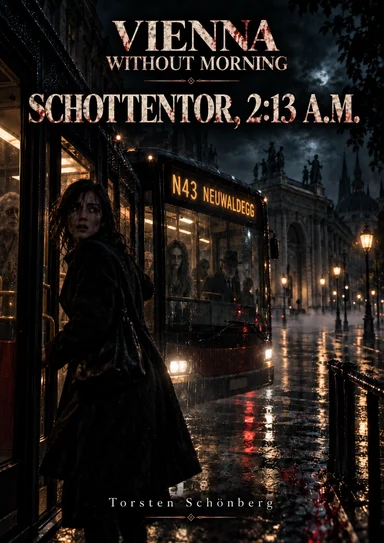
Vienna Without Morning
Schottentor, 2:13 A.M.
By Torsten Schönberg
Horror · Mystery
Back to Vienna Without MorningAt 2:13 a.m., Nora Fellner boarded the N43 at Schottentor, headed for Neuwaldegg. She had been on her feet for eleven hours, rain had soaked through her shoes, and after her phone quoted her a cab fare to Hernals that she refused to pay on principle, all she cared about was getting home as quickly as possible. The bus was already at the stop, its doors open, the route number and destination glowing above the windshield. Through the glass Nora could make out half a dozen passengers. Nothing looked strange enough to justify standing in the rain for the next one.
Her valid ticket was in her coat pocket. She paused beside the driver, an older man with close-cropped gray hair and a dark uniform jacket. “Does this go along Hernalser Hauptstraße?” she asked. He didn’t look at her. He closed the doors and pulled away. Nora waited for an answer that never came, then took a seat in the second row. She texted her sister that she was on her way. The message wouldn’t send. She put the phone away; she could worry about reception later.
At first, the route reassured her. The bus passed the Landesgerichtsstraße stop and continued toward Alser Straße. Nora knew the sequence well enough that she didn’t need to watch every display. It took several minutes before she realized there were no cars waiting at the intersections. No taxi came toward them, no cyclist drew a blinking trail through the rain. Vienna wasn’t dark—the traffic lights worked, a few windows were lit—but the streets belonged to their bus alone.
Nora looked back. An old man sat with both hands resting on a cane. By the window sat a woman in a red scarf. Two rows farther back, a young man had earbuds in beneath his hood. A man in a suit occupied the last row, and across the aisle a woman in pale hospital clothes leaned against the glass with her eyes closed. No one was on the phone or watching the stop display. They didn’t look sleepy; they looked as if they were waiting.
At Alser Straße, Nora stood and went to the front. When she asked again whether he was really going to Neuwaldegg, the driver raised his eyes to the mirror and said yes. She was about to turn back when he made a turn where she had expected the N43 to continue straight. A narrow street ran between tall buildings ahead of them. Nora searched for a bus-stop sign and found none. She stayed beside the driver’s cab. “You don’t usually go this way. Is there a detour?”
“Please sit down.” His hands remained steady on the wheel. Nora looked outside but couldn’t place the street. A few turns were enough to make even a familiar district feel strange. She waited for the next intersection. When she finally turned around, the young man had taken out one earbud and was watching her.
He asked where she had gotten on. When she told him, he briefly closed his eyes. He looked to be in his early twenties, perhaps younger; the dark shadows under his eyes made him look exhausted. “I got on at Westbahnhof,” he said. Nora held on to a pole beside his seat and told him he was on the wrong bus. His expression didn’t change. “More than an hour ago. We’ve been back there twice since then.”
Nora waited for him to grin. Instead, he looked toward the front, where the display above the driver went dark. Until then it had shown N43 and Neuwaldegg. The panel stayed black for several seconds before two words appeared:
KARL HUBER
Nora didn’t know the name. The old man with the cane did. He lifted his head and pulled his feet in under his seat, though there was no one in the aisle. “No,” he said, gripping the handle of his cane. The color had drained from his face before the bus even began to slow.
They stopped in a small square with no bus stop. A woman in a thin summer coat stood outside the open door, clutching a shopping bag to her chest with both arms. Her hair and clothes were completely dry despite the rain. Only when she stepped aboard did Nora see the depression above her right temple. The skin had caved inward as if the skull beneath it had given way. The woman walked past Nora and stopped in front of Huber.
“Dad.” She didn’t bend toward him. The old man slid backward until his shoulders pressed into the seat and begged her to leave him alone. His daughter waited until he stopped talking. “You said you’d come back.”
Huber said he had meant to get help. “You went home,” she replied without touching him. Nora looked at the young man, who gave the faintest shake of his head. She stayed where she was and listened as Huber insisted that he had gotten help after all. Later. His daughter didn’t answer. Behind her, the bus door remained open, and Nora could hear rainwater dripping from the roof onto the square.
At last Huber pushed himself to his feet with the cane. His face was wet, and he wouldn’t look at his daughter. “I thought you were dead,” he said. Only then did she step aside to let him into the aisle. “I wasn’t. Not yet.” He made his way to the door and stopped on the bottom step. Nora thought he would turn back. Then he planted the cane on the pavement and stepped down. His daughter followed him.
As soon as the doors closed, Nora moved to the window. The square was empty in the rain. She searched the building entrances and the edge of the glass for the two of them as the bus pulled away and the display switched back to N43 — NEUWALDEGG. “Where did they go?” she asked the young man. By then he had taken out both earbuds, but he had no answer.
“I’m Milan,” he said when she turned back to him. He nodded toward Huber’s empty seat. “When the regular display goes out and a name comes up, that person’s next.” Nora asked what he meant. Milan rubbed his thumb over the earbud in his hand. “Someone shows up. Some people know them. Some say they don’t. Then something happens.”
“And then they get off?” Nora glanced again at the closed door. Milan said only, “Not always.” She took out her phone to see if her message had finally gone through. The time read 2:14. That was impossible; the stop in the square alone had lasted longer than a minute. Milan noticed her expression and held out his own phone. It also said 2:14. He said he had turned it off and back on. It made no difference.
Nora didn’t sit down again. She stayed in the aisle while the bus moved back onto wider streets. For a few moments she recognized the Gürtel. A taxi had to turn up somewhere, she thought, or a police car—anything that would make this an ordinary Vienna night again. When the display went black again, Milan looked up immediately. Nora followed his gaze.
NORA FELLNER
She read her own name twice before looking out the window. The bus was slowing in front of an intersection she had avoided for five years. Even in daylight she took a parallel street when she rode her bike. The pharmacy on the corner had a different sign now, the café across the street had been renovated, but she recognized the traffic island. Beside it, at the edge of the sidewalk, stood Stefan Marcher.
Before the accident she had seen him only for an instant; she learned his name later. Now he wore the same gray jacket and held his bicycle helmet under one arm. His face was uninjured. Nora stared at it so long that she didn’t notice Milan getting up until he was already beside her. “He’s yours,” he said. She shook her head. Milan pointed to the display, where her name was still glowing.
The doors opened. Stefan didn’t step inside. He remained on the sidewalk and looked at her through the front entrance. When he said her name, Nora moved back behind a handrail. The driver glanced into the mirror. “You can get off.” When she asked why she should, he didn’t answer. Stefan only waited.
Nora felt Milan watching her. She wanted to tell him to stay out of it, but instead she heard herself explaining that she had ridden into the intersection against a red light. A delivery van had swerved to avoid her. “And hit me,” Stefan added from outside. Nora tightened her grip on the pole. “I called emergency services. I didn’t just ride away.”
“Three minutes.” Stefan said it so quietly she had to lean forward to hear him. Nora saw him again on the pavement. He had been unable to sit up, but his hand had reached toward hers while she knelt beside him. She had listened for a siren, for any sound that would let her hand the responsibility to someone else. Then she had stood, taken her bicycle, and left. No one had told her to go.
“I panicked,” she said. Stefan nodded. “So did I.” Nora looked at the driver, still motionless behind the wheel. The doors remained open. She asked Stefan what he wanted from her, but he made no move to come and get her. “You can go,” he said. Nora waited for the rest. At last he lifted the helmet slightly. “Or you can stay.”
She heard an engine behind him. At the far end of the street, a white delivery van turned the corner; the damaged right headlight was the same as it had been back then. Nora backed away from the open door. She was about to shout at Stefan to get out of the road when she realized he was standing safely on the sidewalk. She hadn’t noticed the woman lying in the street.
The woman was sprawled beside the traffic island with only one shoe still on. When she raised her head, blood ran from a wound on her forehead down to her mouth. “Please,” she called toward the bus. Nora stepped back to the exit. She could still stay inside. She looked at Milan, but he gave her no sign of what she was supposed to wait for or what she should fear. The van kept coming while the woman tried and failed to push herself upright.
Nora stepped onto the sidewalk. The doors closed immediately behind her. Her shout for the driver to wait vanished beneath the sound of the bus pulling away; she saw Milan’s hand against the window, then the bus turned the corner. By the time she faced the street, the van was almost at the intersection. Nora ran to the woman, hooked her arms beneath her shoulders, and dragged her toward the curb.
The woman screamed as soon as her right leg scraped over the pavement. It was twisted under her coat and wouldn’t take any weight. Nora kept pulling, got the woman’s shoulders closer to the sidewalk, and slipped on the wet stones herself. She looked up, straight into the one bright headlight, and knew she wouldn’t make it. There was still enough time for her alone. All she had to do was let go and jump aside.
The woman caught hold of Nora’s coat. Nora crouched behind her and pulled one last time until pain burned through both shoulders. The injured leg was still in the road. She couldn’t get it clear. All she could do was pull the woman against her and turn her own back toward the van. Nora squeezed her eyes shut as the engine swallowed every other sound.
The impact never came. When she opened her eyes, the street was empty. Nora was still holding the woman and waited for the engine noise to return behind them. It didn’t. She bent over the bloodied face, spoke to the woman, and with shaking fingers searched for a pulse she couldn’t find. Across the street stood Stefan. Now his face looked the way it had after the accident, the right side caved in, the collar of his jacket soaked in blood.
“You stayed,” he said. Nora was about to answer when tires hissed through a puddle behind her. A taxi crossed the intersection, followed by another car; a cyclist waited at the light. She looked back toward Stefan, but the sidewalk was empty. The woman was gone too. Nora was kneeling on the asphalt with her arms still outstretched when her phone vibrated in her coat pocket.
The message to her sister had been sent. Above it, the time read:
2:15 A.M.
Nora pulled herself onto the traffic island. She sat there until a taxi stopped at the curb and the driver rolled down his window. When he asked if she was all right, she almost said yes. Instead, she stood, walked over to him, and told him she needed help.
* * *
Milan Petrović didn’t know what had happened to Nora. When the bus left her at the intersection, he had stood at the window watching her until the bus turned the corner. After that he didn’t sit down again. Above the driver, the display once more read N43 — NEUWALDEGG. His phone still said 2:14. When the display went dark, Milan gripped the nearest pole and waited for the name.
MILAN PETROVIĆ
The bus slowed. Milan raised his eyes to the street where they were about to stop. He still didn’t know who would be waiting for him.