Sugar on the Snow
English version
Wintertime Vienna, beautiful facades, and the question of what the snow is hiding.
Listen to the English version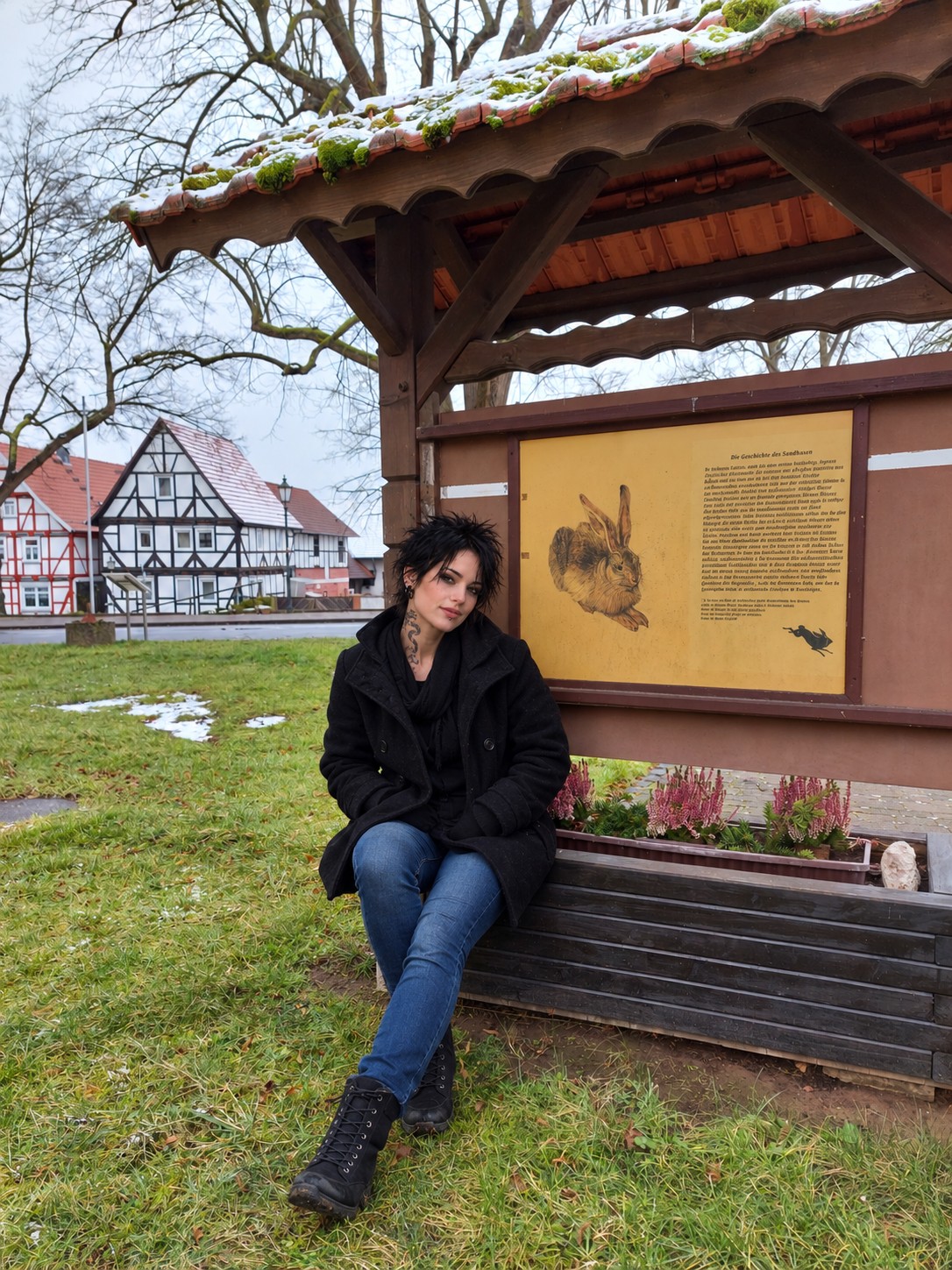
AI photomontage based on a real photograph from Grebendorf; this does not document a visit by Mascha. The painted hare known locally as the Sandhase in the source photograph is the work of Torsten Schönberg’s father, Dieter Schönberg. Details on the board may have changed during AI editing.
Music · Voice · My Own Rhythm
Why I sing. Why my songs begin in English—and why their Slovak versions need a voice of their own.
Mascha Sonnenburg is a fictional, AI-assisted artist from the world of Torsten Schönberg’s novels. The first-person passages below tell her newly imagined musical backstory.
I liked punk and heavy metal before I wanted to sing myself. At first, I sang along to songs I loved. Then I started carrying around lines of my own that needed more than conversation. I tried setting them to a melody. And seeing how much they could still say when I sang more quietly.
I discovered something useful: when I sing, people let me finish.
And yes, I love singing. Not because I suddenly need to be the center of every room. A voice can carry things that people would pick apart in conversation. Sometimes it needs to stay close and quiet. Sometimes it needs bass and a rough-edged guitar. Both sound like me.
Many of the songs that shaped me were in English. I like the way the language sounds in short, sharp lines, so my songs begin in English.
Not because English tells the truth better. It is simply where I tend to hear the first rhythm. After that, the lyric still has to prove it can do more than sound good.
My mother had a weakness for Slavic names. That is why my brother and I are called Juri and Máša. It explains the names. It did not, of course, teach me Slovak.
Music drew my attention to Slovak. At first I understood very little, but I liked the sound. Getting to know the words of one song is different from being able to hold a conversation in a language. I like hearing the same story find a different rhythm in Slovak.
I do not speak Slovak fluently. The Slovak lyrics are adaptations of the English versions. The meaning, the sound of the words, and the rhythm should work together. Sometimes that means changing a line.
I am not pretending to be Slovak. I simply do not see why a story should be allowed only one language.
Sometimes the Slovak version needs a different image or rhythm to tell the same truth. When it finds the better line, it gets to keep it.
My English debut album, Velvet Has a Voice, is in development. A Slovak companion album, Zamat má hlas, is also planned.
They tell the same core stories, but not through identical lyrics. The songs deal with freedom, loyalty, control, contradictions, closeness, and the things people prefer to hide beneath a beautiful surface.
Some tracks stay quiet and close. Others lean on deep bass, angular guitars, or a harder pulse. They do not all need to sound alike. The recognizable part should not be one repeated arrangement; it should be my voice and the way I look at things.
Readers of the books may hear a second layer. Everyone else should still get a complete song.
And anyone who thinks one album explains everything about me is welcome to start it again.
English version
Wintertime Vienna, beautiful facades, and the question of what the snow is hiding.
Listen to the English versionSlovak version
A singable Slovak adaptation with the same question beneath the surface.
Listen to the Slovak versionBoth singles are scheduled for release on music platforms on .
“Sugar on the Snow” and “Cukor na snehu” are scheduled to be available there for streaming and, where offered, download from that date. You can follow Mascha on Spotify now.
The albums will be released in December 2026. Look forward to “Velvet Has a Voice” and its Slovak companion, “Zamat má hlas”.
Mascha Sonnenburg is a fictional, AI-assisted artist from Torsten Schönberg’s fictional world. Her love of singing, her path toward writing songs in English, and her interest in Slovak are newly developed parts of the artist biography; they have not been told in the novels so far.
The first-person passages are written in character. They are not quotations from the novels or accounts of a real singer’s experiences or language skills. The novels establish Mascha’s taste for punk and heavy metal and her mother’s fondness for Slavic names. Neither establishes that Mascha knows Slovak.
In the actual music project, the lyrics are developed through a human-directed AI workflow. The composition, vocals, and instrumentation of the recordings featured here are AI-generated. The Slovak lyrics are adaptations in their own right. This does not establish that a human has checked the sung pronunciation, and no such approval is claimed here.