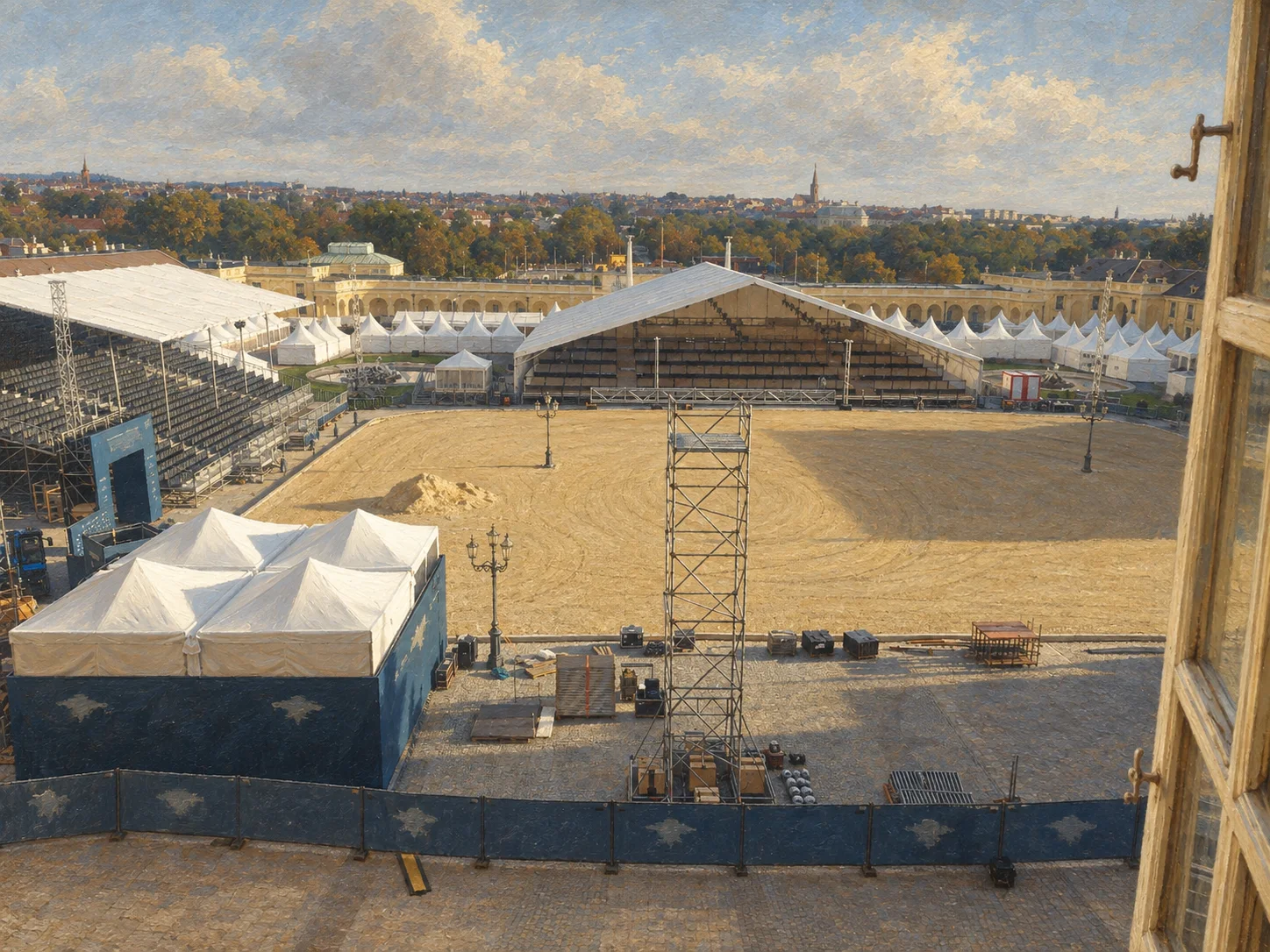
I was lying face down in the dirt of the Ehrenhof. Someone was pressing my head down. My hands were folded behind my back, with a knee bearing down on them. I tried to push myself up. The knee objected.
A small stone lay in front of my nose. As a geologist, I would have liked to examine it more closely. For that, though, I would have needed a little distance.
I groaned and turned my head far enough to see the crane. Two men were dragging George out of the cab. He clung to the doorframe and explained something with great conviction. Then he landed on the ground as well. His excursion into his dream profession was over.
Only moments earlier, the fully loaded Euro pallet had swung toward the Lord High Steward’s window. I remembered the shattering glass, a jolt to my shoulder, and a dull thud. After that, I had only seen the courtyard from very close range. Now the load hung motionless. The office window was destroyed. A piece of the white frame dangled outward. There was no sign of the Lord High Steward.
Instead, Oberinspektor Stippschitz was looking through the opening. He was in civilian clothes and wearing his coffee-brown shearling leather jacket. I recognized him even from where I was. He pointed down and shouted something. I would have liked to wave, but my hands were otherwise occupied.
Then I turned my head the other way.
A man lay only a few steps from me. Blood clung to his temple and ran down his cheek. I saw the walkie-talkie beside his hand, the dusty jacket, and finally his face.
Sebastian.
I waited for him to open his eyes. For him to yell at us because we were lying around on the ground while the grandstands still weren’t finished. One paramedic knelt beside him. Another went to get a blanket.
I felt cold. I hadn’t liked Sebastian. I wouldn’t have minded if they had transferred him to another construction site. But not this.
The pallet must have hit him after smashing through the window. At that moment, I couldn’t explain it any other way. I hadn’t seen it happen. I had landed in the dirt just in time to miss the decisive part, but unfortunately not early enough to look uninvolved.
I swore and tried to get up again. The knee lifted off my hands. Someone grabbed me under the arms and pulled me upright. I found myself facing a woman with pale blue eyes. Red hair spilled out from beneath her hard hat. Dust clung to her cheek. She held on to me for another moment until I was steady on my feet.
That woman had thrown me to the ground? I looked from her to my hands and back again. She asked whether I felt dizzy. I had a few questions for her, but one of the security guards was already reaching for my arm. Behind us, the paramedics covered Sebastian.
The redhead stepped aside. Her work ID carried the same program designation as mine: The German Integration Scheme. One of us, of all people. I would have liked to discuss that. Instead, we were taken to a site office. George came in behind me, insisting that they should at least have let him shut down the crane properly. Nobody wanted to have that discussion.
Inside the site office, a table stood between two rows of chairs. A map of the Ehrenhof hung on the wall. My name and George’s were written on a sheet beside it. We had been assigned to build the grandstands that day. There was even a box where someone was supposed to rate our performance. I hoped it was still empty.
Stippschitz came in and placed his notebook on the table. He said he had been with the Lord High Steward when the pallet hit the window. They had been discussing our future work assignments. The Lord High Steward was unharmed, was now in the adjoining office, and did not wish to receive us for the time being.
I could understand that.
The Oberinspektor sat down. He wanted to know who had given George permission to operate the crane. George explained that he had only wanted to make the work easier. The metal parts had belonged in the designated area beside the grandstand. He hadn’t driven toward the window or toward Sebastian. At least not deliberately.
Stippschitz wrote something down. Then he informed us that we were being investigated on suspicion of premeditated murder.
I stared at him. Murder? George had wanted to operate a crane. The fact that he only checked the limits of his abilities after starting it was a problem. But it was hardly a murder plan.
Apparently, we had complained about Sebastian all morning. We had criticized his instructions, grumbled constantly, and repeatedly demanded that someone rid us of him. There were witnesses. Stippschitz looked at George over the top of his notebook. The Carinthian did not deny the grumbling. He merely wanted to clarify that it had not been limited to the morning.
I kicked his shoe under the table.
Of course we had complained. Sebastian had made us carry the heavy parts back and forth several times. You didn’t need to be a potential murderer for that. You only needed to have a back. And George wasn’t violent. Well. He wasn’t always violent. While defending my best friend, I had to be careful not to trip over my own argument.
I told the Oberinspektor that George was not a murderer. Stippschitz countered that I had been seen waving earlier. Apparently, I had been directing George. I tried to explain that I had pointed to the empty space beside the grandstand. Not at Sebastian. Not at the window. The empty space would still be empty. He could check.
Stippschitz lifted his pen from the paper and looked at us for a long time. He couldn’t keep getting us out of trouble, he said. We were not yet good Austrians. If the suspicion proved true, we had no future here. In our case, the immigration police weren’t waiting for another opportunity. They were already collecting them.
George lowered his head. Beneath the table, he placed his shoe beside mine. He nudged me briefly, this time without malicious intent. I left my foot where it was.
Until the sequence of events had been clarified, we were not allowed to leave Schönbrunn. We had to remain available for further questioning at all times. We were to have nothing more to do with machinery, effective immediately. Because of the damaged window and the unauthorized use of the crane, the Lord High Steward had also assigned us a special task. That task would have no effect on the investigation.
I had hoped we would have to clean the window. There wasn’t much glass left.
Stippschitz placed a second sheet of paper on the table. It concerned the smell of horses.
The big equestrian festival in the Ehrenhof was a show-jumping tournament. The horses had to jump over obstacles while their owners made sure that as little as possible got in their own way. Particularly wealthy owners received a great deal of attention at court. In our case, that attention had produced a written directive.
According to the paper, modern luxury horses no longer smelled enough like horses. They were washed, groomed, and treated with expensive perfumes until they seemed more suited to a reception hall than a stable. Apparently, their loaded owners were afraid they might smell like animals after petting their animals. I could even understand that to some extent. But then I wouldn’t have bought a horse.
An authentic atmosphere was desired for the equestrian festival. The horses were supposed to feel at home. The good Austrians were, too. That was why the typical smell had to be distributed throughout the Ehrenhof before the tournament began.
George pointed through the site-office window at a Fiaker. It had two employees who had mastered that task from birth.
Stippschitz refused to be distracted. The Lord High Steward wanted an even, controlled horse scent. No random smells. We were to follow the plan and thoroughly treat the areas assigned to us. If we failed at this as well, no one would be able to help us.
Fifteen minutes later, we were standing outside the site office. Each of us held an oversized bottle in his arms. The coat of arms of the Habsburg court state was emblazoned on the glass. A small double-headed eagle decorated the gold-colored spray nozzle. The label read “Eau de Hof – Horse.”
I pressed carefully. A fine mist drifted through the air in front of me. George leaned into it curiously and immediately recoiled. It smelled like a stable whose residents had decided to take care of the cleaning themselves. Without success.
We weren’t allowed to damage the bottles. They were worth more than everything we were wearing. We were supposed to distribute their contents generously, however. I pointed to the map of the courtyard. George wanted to start on the right; I wanted to start on the left. We agreed to start together. I could not afford another accusation that I had given him the wrong directions today.
The area around the damaged window had been cordoned off. The forensic team was working there. We kept our distance. Sebastian had been taken away by then. I didn’t look at the place where he had been lying. Neither did George.
We began our new task at the grandstand. I sprayed beneath the rows of seats. George took the aisles. A light breeze carried the scent to a man tightening a brace above us. He straightened up, sniffed, and checked his shoes. Then he spotted us.
I held up the work order. George held up the bottle. That was unfortunate, because another burst of spray escaped in the process.
We received very precise instructions about where we should go with our bottles. That place was not marked on the map of the courtyard.
At the next stack, a worker wandered into George’s cloud of scent. The man took off his gloves and came toward us. I explained the Lord High Steward’s order. He wanted to see it. I pointed to the coat of arms and then to the document. He read it, shook his head, and handed it back to me. I thought his objection that we did not necessarily have to perform this task during his coffee break was reasonable.
We waited until he had taken a sip.
That was not right either.
George was now trying to adjust the size of the spray cloud with the pressure of his thumb. Small bursts for small areas, large ones for large areas. He took the job seriously. After the crane, he apparently needed a device that did what he wanted. I was glad the bottles didn’t have an operator’s cab.
After a while, people started shouting at us from a distance to stay where we were. Windows were closed. A delivery driver got back into his vehicle and rolled up the window. I understood his reaction. During the night, I had closed our window because of people like him. Now our roles were reversed.
By late afternoon, the Ehrenhof lay beneath a cloud of horse scent. Jakub stood beside the floor panels, holding a cloth over his mouth. Usually, we heard him before we saw him. Now he wasn’t even singing quietly. The working conditions had become unacceptable for Karol Duchoň as well.
We had completed the marked areas. Only one mark behind a stack of materials remained on the plan. George looked at me. I looked at him. Then we gave that spot two bursts of spray as well. Our residency status depended on this crap. Artificial crap, to be precise.
We found an empty bench outside the Wagenburg. I carefully placed the bottle between my shoes and sat down. George dropped onto the bench beside me. For a while, neither of us said anything. From there, we could hear the construction work without having to carry anything ourselves. I leaned my head against the wall and closed my eyes.
When I opened them again, the red-haired woman was coming toward us.
I sat up straight. The corners of my mouth moved upward without any help from me. George looked at me. I cleared my throat and tried to regain control of my face. I succeeded only in part.
The woman stopped a short distance from the bench. Her name was Shani, and she wanted to apologize. She had been rather rough earlier. She pointed to my cheek. I wiped it with the back of my hand and came away with a little more of the Ehrenhof.
Then she explained why she had knocked me down.
There had been a red laser dot on my forehead.
I stopped grinning.
She had grabbed me by the shoulder and forced me to the ground. When I tried to get up again, she had held me down. Only then had the security guards arrived. She hadn’t known where the dot had come from. But she hadn’t wanted to wait and see whether someone pulled the trigger either.
I ran my hand over my forehead. There was nothing there. Of course there was nothing there. I still had to check. While I had been watching George operate the crane, someone might have been aiming at me. And I had cursed the woman who had prevented me from being properly hit.
I thanked her. It sounded a little awkward. Shani smiled briefly and put her hand on my shoulder. My thoughts had to decide what to deal with first. The laser dot would have been the sensible choice.
She asked us not to tell anyone. Especially not that the observation had come from her. She needed her job. As a participant in the German Integration Scheme, she was sent all over the country to work at events, mostly to help build grandstands. Anyone who caused trouble quickly received trouble in return. She hadn’t seen a shooter. If her warning turned into a statement to the police, she might ultimately have to prove that she hadn’t imagined the whole thing.
Unfortunately, I understood that very well. Even so, I did not nod right away. George frowned. Someone might have been aiming at me. That was not a minor detail you simply kept quiet out of consideration for someone else. But Shani looked at me so seriously that I promised not to drag her into it. I did not yet know how I was supposed to manage that.
She looked at both of us and asked whether we really were the leaders of the Rebel Piefkes. People had heard about us outside Vienna as well. Stories about us were told on construction sites.
George turned red all the way to his ears. He rubbed a hand over his stubble and explained that he was the technical leader. What had happened with the crane that day was in no way representative of his usual standard of work.
I could have said something about that. Instead, I tried to explain my role as strategic leader in a complete sentence. I had to start twice. Shani waited patiently. That did not make it any easier.
Finally, she pointed to the bottles between our feet. Was that already part of the resistance?
I explained that this time, at the court’s express request, we were bringing the government into disrepute. George nodded. Shani laughed. I immediately decided we should have conversations like this more often. Without bottles. Perhaps over coffee.
She put on her hard hat and started back to work. After a few steps, she turned around once more. There was something else. She had heard that several horse owners had already been asking about the Rebel Piefkes before the event. Whether the group was active at Schönbrunn, too. The Lord High Steward was said to have laughed out loud about it.
Then she briefly raised her hand and left.
I watched her go. Until the laser dot, I had believed our biggest problem was sitting in a crane cab. Now people we didn’t even know were apparently interested in us. People who could afford horses whose shampoo probably cost more than our lunch for an entire month.
George touched my arm and gestured toward Stippschitz with his chin.
The Oberinspektor was coming toward us. For a moment, he watched Shani walk away and nearly ran into one of the historic lampposts. He corrected his course, straightened his leather jacket, and stopped in front of our bench. I decided not to mention the lamppost. We might still need a favorable decision from him.
He did not have one.
He held a printed photograph in his hand. It showed me beside the crane with my arm raised. George was sitting in the cab. A witness statement now confirmed that I had deliberately directed him. Our complaints about Sebastian were also on record. To his colleagues, it added up to an unmistakable picture.
I explained once more what I had been pointing at. Stippschitz put the photograph away. The details would be checked. For the time being, we were under arrest. George was considered the Ehrenhof murderer, and I was his accomplice. The immigration police would be notified of our deportation.
George stood up. I held on to his sleeve. Enough had already happened that day.
A few clues were still missing, Stippschitz said. Then the case could be closed. What worried me most was how little those missing clues worried him. I drew breath to tell him about the red dot.
Shani was climbing onto the grandstand. Her hard hat appeared between two braces. I thought of her face when she had asked us not to drag her into it. And I thought of the man in front of me, who had a photograph of my outstretched arm in his pocket and already saw a murder plan in it.
I remained silent. It was not a good decision. I simply did not have a better one ready.
We were also no longer allowed to distribute the scents, the Oberinspektor added. There had been complaints. George looked at the bottle. The one job we had actually performed according to instructions that day had now earned us another reprimand.
Stippschitz took the bottles from us and placed them outside the site office. Then he escorted us into the palace. We would be confined to our staff apartment for the time being. No walks, no visitors, no trips into the Ehrenhof. The continuing investigation and the preparations for our deportation would proceed in parallel. He expected to find us there whenever he came.
The three of us stood in the elevator. The Oberinspektor edged closer to the door. George stared at the ceiling with exaggerated innocence. This time, the smell really was not coming from him alone.
On the third floor, Stippschitz opened the door to our apartment. A guard was to remain outside the stairway. We were allowed to wash, he informed us. It sounded less like permission than an urgent request.
Then we were alone.
George sat down on my bed and stared at his hands. He had not wanted to kill Sebastian, he said. I had not heard him speak so quietly in a long time. I sat down beside him. I knew. I nudged his shoe briefly with my foot.
We sat like that for a moment. Then he stood up and climbed into his bed above mine. The wood creaked. I went to the window and stood to one side behind the frame.
Construction continued below. I searched between the rows of seats for the red hair beneath the hard hat. Shani moved confidently across the still-unfinished grandstand. She took a part from a coworker and showed him where it belonged. I hoped she would look up. Then I could at least have given her a little wave. With no crane nearby.
A man walked past the stacked floor panels. He wore a beige hat and carried a long rifle case. I followed him with my eyes. He stopped as though he had to decide which way to go.
Then he turned around and looked directly at our window.
I took my hand off the iron bar.
I knew that man. Stippschitz had told me he had been suspended from duty and was being treated at the Narrenturm on Kahlenberg. I had relied on that information.
Chief Inspector Paradeiser.
To be continued.