Chief Inspector Paradeiser.
I knew that hat.
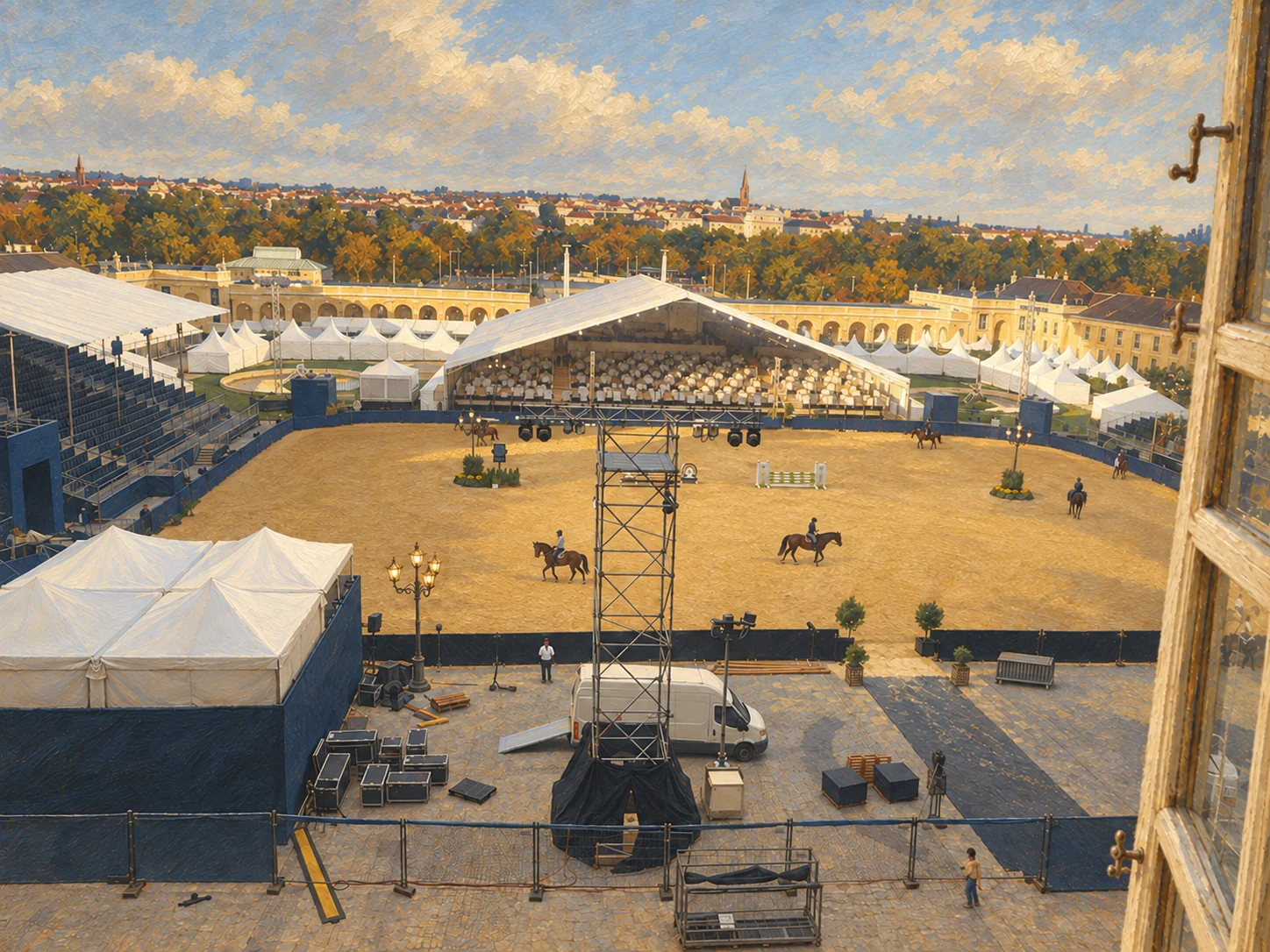
Beige, with a narrow dark brim. Beneath it was a face I would rather not have seen even from three hundred yards away. The man stood between the stacks of floor panels in the Ehrenhof, holding a long black case in his hand. Then he turned his head and looked straight up at our window.
I took a step back.
Paradeiser was an old acquaintance. George and I had already had the dubious pleasure of making his acquaintance during the Stamp Killer case. He had made our lives difficult enough back then. Afterward, his own career had not exactly continued on a steep upward trajectory either. Whenever I saw Paradeiser, someone was usually dead, we were under suspicion, or both.
This time Sebastian was lying dead in the Ehrenhof.
That was not a good sign.
The bed above me creaked. George had woken up and wanted to know why I was staring so intently out the window. The moment I mentioned Paradeiser's name, his morning indifference disappeared. He sat up, rubbed the stubble on his face, and climbed down.
Together we looked into the Ehrenhof again.
Paradeiser was gone.
The space between the stacks of materials was empty. No beige hat. No black case. Only a worker pulling a small cart loaded with cable reels across the courtyard.
George thought I might have dreamed it. I thought he might have slept too much. We did not agree. That was hardly unusual for us.
Since yesterday I had known that someone had seen a red laser dot on my forehead. Shani had thrown me to the ground because of it. Without her, I might not have ended up with my face in the dirt but with a hole in my head. She had asked me not to tell anyone, and I had given her my word.
It was one of those promises that started to feel like a mistake only a few hours later.
George remembered that Paradeiser was actually supposed to be in the Narrenturm. I remembered that too. He had supposedly spent several months there as a patient. Whether patients from the Narrenturm were allowed to go for walks carrying rifle cases, I did not know. With Paradeiser, I was unwilling to rule anything out.
Then the doorbell rang.
When you were under suspicion of murder, a doorbell sounded different. Louder. More determined. Almost official. I was probably imagining that.
Inspector Stippschitz stood outside. He was wearing his coffee-brown sheepskin leather jacket and had a thin file tucked under one arm. I let him in. George sat down on my bed. Once he was awake, he generally used his own bed only as an observation post from above. For the technical leader of a resistance movement, the concept of private property seemed to be remarkably flexible.
Stippschitz had news from the medical examiner.
Sebastian had not been killed by the Europallet.
For a brief moment I felt relieved. George even more so. The Carinthian was already interpreting the news as a complete acquittal and looked as though he might congratulate himself. Stippschitz brought him back down to earth quickly.
Sebastian had received a massive blow to the head shortly before the pallet accident. The injury had been fatal. Only afterward had his body been caught up in the accident. The additional injuries had initially created the impression that the swinging load had killed him.
That changed a great deal.
Unfortunately, not enough.
George was still a suspect. So was I. The fatal blow had been delivered only a few minutes before the crane accident. During that time we had both been in the Ehrenhof, had complained about Sebastian, and had then sent a heavy pallet through the air. I had also been plainly visible giving George hand signals.
Stippschitz had already heard my explanation several times: I had merely been pointing at an empty space beside the grandstand. The fact that the space was still empty continued to leave him unimpressed.
The police were now looking for a narrow, heavy, angular object. On a construction site containing several tons of metal, that was about as helpful as looking for a beer drinker in a Viennese tavern.
At least our immediate deportation had been suspended.
We were allowed to leave the apartment again.
For work.
The schedule of The German Integration Scheme remained in force. Suspicion of murder was apparently not a recognized form of incapacity for work. That also clarified the relative importance of the presumption of innocence compared with Austrian employment policy.
Stippschitz banned us from cranes, vehicles, and fragrances. George did not understand the last point. I did. By the previous afternoon, the Ehrenhof had acquired a certain resemblance to a poorly ventilated stable. Even Jakub had stopped singing Karol Duchoň. That was probably the moment the court administration had discovered the limits of authentic atmosphere.
Instead, we were to help with the final work on the grandstands. No machinery. No chemicals. No private investigations.
The last point was clearly aimed at me.
Before Stippschitz left, I asked as casually as possible about Paradeiser. I was supposedly only interested in the well-being of an old acquaintance. Stippschitz believed me for roughly as long as it took me to mention the beige hat.
When I finally admitted that I had seen Paradeiser in the Ehrenhof only a few minutes earlier, Stippschitz became serious. According to what he knew, Paradeiser was still undergoing treatment. My mention of the black case did nothing to improve his mood.
I kept quiet about the red laser dot.
For the moment.
*
An hour later George and I were standing in the Ehrenhof and working.
At least that was how it looked from a distance.
I held a list and checked the numbers on the crowd-control barriers. George tested whether they were secure. The work was not difficult. The Lord High Steward had probably decided that two murder suspects should not be given anything that could be used as a weapon.
That severely limited the range of jobs available during the event setup.
Everywhere around us people were screwing, carrying, and hammering. The grandstands were nearly finished. The riding arena was taking shape. Men were pulling cables through narrow channels while others aligned the barriers. Large transport vehicles for the horses were already parked in the rear section.
I kept looking for a beige hat.
Nothing.
Instead, I spotted red hair.
Shani was standing on one of the lower tiers of the grandstand, fastening a cover. She was wearing her construction helmet. I could see only part of her face.
The corners of my mouth moved all by themselves.
George noticed immediately. The Carinthian did not need to solve murder cases to make an inconvenient observation at exactly the right moment.
Shani came down and checked on my cheek. There was no trace of yesterday's dirt left. I had washed twice, just to be safe. She herself looked as if the entire incident had already become part of a normal working day.
Then she turned serious.
She wanted to know whether I had told Stippschitz about the laser dot.
I had not.
That relieved her. It did not relieve me.
But she had seen something else.
Shortly before George had climbed into the crane, Sebastian had argued with a man. The man belonged to that class of good Austrians who usually stood around explaining to other people how to work. There were plenty of those in the Ehrenhof.
Then she mentioned the coffee cup.
I knew immediately whom she meant.
The good Austrian who had explained to us in the morning how to lift heavy parts properly from the knees while never once touching anything heavier than his coffee.
Sebastian had been carrying a black folder. Shani had been too far away to understand everything, but the argument had been about invoices. Sebastian had also made it clear that the Lord High Steward was going to see the documents.
The man with the coffee cup had tried to take the folder away from him.
Then Shani had moved on.
I could understand why she had not mentioned the observation the previous day. A dead man, a laser dot on my forehead, security staff, and an out-of-control crane were enough to distract even an observant participant in The German Integration Scheme from making a proper witness statement.
She still did not want to make an official statement.
The German Integration Scheme sent her to events all over the country. Anyone who caused trouble at every assignment eventually stopped getting work. The system that forced us to work expected us at the same time to be grateful for being allowed to work.
I would have liked to disagree with her. Unfortunately, I knew the principle very well.
Shani left us with her observation and returned to the grandstand.
I watched her go.
George did not need to say anything. His face was enough.
I told him about the argument with Sebastian.
The Carinthian remembered the man immediately. He had made us move the same materials several times the day before. For George, that alone was enough of a character reference.
*
Several pallets of materials stood behind the grandstand. Beside them was a small storage area enclosed by temporary fencing.
That was where we found the bottles.
Eau de Hof.
I had hoped never to see those things again.
The oversized glass containers bearing the coat of arms of the fictional Habsburg court establishment had now been packed into wooden crates. A white label was stuck to each crate. I bent over one of them.
George prudently reminded me not to touch anything.
It was a reasonable warning.
I touched something anyway.
The label showed a delivery number and, beneath it, a date.
The shipment had arrived the day before the crane accident.
That could not be right.
At least not if the story we had been told was right.
Our horse-scent punishment was supposed to have been a spontaneous idea by the Lord High Steward after the window was broken. The bottles needed for that punishment, however, had already reached Schönbrunn beforehand. Either the Lord High Steward could see into the future or someone had retroactively turned an already planned job into a punishment.
The second option seemed more likely.
A copy of the delivery note was tucked inside a clear plastic sleeve. George reminded me that paper was also an object and that therefore I was very much touching something. I ignored the technical distinction.
The order was larger than I had expected.
Not just stable.
There were also leather, hay, and damp earth among the different scent profiles.
Damp earth.
I tried to imagine which good Austrian had decided that dry earth did not smell authentic enough for an international horse show.
At the bottom of the delivery note was a field for project coordination. I could not make out the signature. Next to it was an abbreviation.
We put the sheet back.
Behind us someone began to sing.
Jakub.
For the first time since the scent cloud, I heard Karol Duchoň in the Ehrenhof again. The air must have improved considerably.
Jakub confirmed that the crates had been delivered two nights earlier. He could not name the man who had accepted the shipment, but he mimed holding a coffee cup to his mouth.
That was enough.
Sebastian had also been there when the delivery arrived. The two men had argued. Jakub had understood only isolated German words.
Invoices.
Money.
Sebastian had been angry.
We suddenly had two people who had independently observed the same argument.
Unfortunately, neither of them wanted anything to do with the police.
Everyone wanted the murder solved.
No one wanted to be a witness.
That did not make things easier.
*
We handed in the rest of our barrier checklist at the materials station.
The man with the coffee cup was not there.
Neither was Shani.
Instead, at the far end of a side passage, I saw a beige hat.
I stopped.
George nearly walked into me.
The hat disappeared behind a container.
Stippschitz had expressly forbidden us to follow Paradeiser.
So we simply happened to walk in the same direction.
The container stood between two technical areas. Behind it, a narrow path led to a service access road.
Paradeiser was standing there.
The black case lay on a wooden crate.
At first he had his back to us, but he noticed us very quickly. His expression suggested that he was about as pleased to see us as we were to see him.
Outwardly, he looked better than during some of our earlier encounters. The beige hat sat neatly on his head, his coat was buttoned, and he did not look like someone who should actually have been staying in a psychiatric hospital.
That did not reassure me.
Paradeiser made it clear that he was still investigating. He apparently regarded his suspension as more of a recommendation than a binding condition. Stippschitz seemed to him to be a man assuming powers that did not belong to him.
I was mainly interested in the case.
When Paradeiser opened it, there really was a rifle inside.
I knew very little about weapons. That was George's department. But even I recognized the small device mounted on top.
A laser sight.
Paradeiser demonstrated it on the side wall of the container.
A red dot appeared.
My mouth went dry.
I thought of Shani.
Of my forehead.
George moved slightly in front of me. It was sometimes reassuring to have a technical leader who understood his responsibilities in more than a theoretical sense.
Whether Paradeiser had aimed at me the previous day remained unanswered. He explained nothing that could later be used against him. He had probably learned that during his years on the police force.
Then we heard footsteps.
Stippschitz rounded the container with two members of security.
His eyes went first to the case, then to us.
He had expressly instructed us not to approach Paradeiser.
On the other hand, we did have a work assignment involving crowd-control barriers. The fact that the relevant barriers were on the opposite side of the Ehrenhof weakened our argument somewhat.
The atmosphere between the two police officers immediately became the kind that develops when two men are simultaneously convinced that they are in charge of the situation.
Paradeiser invoked his rank.
Stippschitz invoked Paradeiser's suspension.
Paradeiser regarded the suspension as temporary.
Stippschitz regarded the psychiatric treatment as insufficiently complete.
For once, I kept out of it.
The rifle concerned Stippschitz far more than the question of who was entitled to give whom orders. Paradeiser assured him that it was unloaded. He described the laser sight, quite accurately, as a sight.
What it was supposed to be used for remained unclear.
Eventually Stippschitz took possession of the case.
Paradeiser was to go to the main gate, where a vehicle was waiting to take him back to Kahlenberg.
He did not like that at all.
Before the security men escorted him away, he looked at me one more time. His message was simple enough: the Stamp Killer had only been the beginning. I apparently attracted murders.
I thought that was unfair.
I really could not help it.
When the beige hat disappeared behind the grandstands, Stippschitz stayed with us.
Naturally, he wanted to know whether Paradeiser had aimed at me the day before.
I did not know.
That was even true.
All I knew was that Shani had seen a red dot on my forehead.
Stippschitz also wanted to know whether anyone had observed anything.
Now I had to lie.
Not that I knew of.
Stippschitz looked at me for a long time. He probably did not believe me. That was his job.
I thought about Shani's job.
About her pale blue eyes.
About the possibility that my promise to her might eventually become a very large problem.
Stippschitz warned me not to conceal anything from him if doing so might put someone in danger.
I kept my answer to myself.
Instead, George and I told him about the scent bottles, the delivery date, and Jakub's observation.
We left Shani out of it.
Stippschitz listened carefully. When he asked for the name of the man with the coffee cup, George and I had to look at each other.
We did not know it.
That was embarrassing for a resistance movement with strategic and technical leadership.
Stippschitz pointed out that we supposedly were not investigating and yet had already collected delivery dates, project responsibilities, and witness accounts.
I preferred to think of us as observant.
He preferred to think of us as a nuisance.
Both could be true.
*
By evening the Ehrenhof had changed.
The construction site had become an event.
Where crates, cables, and floor panels had been lying around the day before, there were now barriers, planters, and neatly aligned signs. The grandstands were almost complete. The last tarps were being stretched into place. Behind the scenes, someone was polishing metal that would probably be dirty again by the following day.
The first horses had arrived.
I had never understood why people voluntarily bought an animal that required more care than George and me put together. The horses shone. Some had braided manes. Their owners and grooms moved through the Ehrenhof carrying blankets, brushes, and bags as though they were checking into a five-star hotel.
A horse snorted.
I smelled nothing.
No stable.
No manure.
Perhaps the Lord High Steward had been right.
Or perhaps our scent operation had permanently driven the natural smell of horse from the Ehrenhof for the next several weeks.
George and I were still allowed to remain on the grounds. Our permitted radius consisted of the service apartment, the Ehrenhof, and the work areas. House arrest with a view.
Shani came over to us once more in the early evening.
The corners of my mouth reacted faster than my brain again.
George noticed that too.
Shani had learned that Stippschitz had spoken with Jakub. She herself had still said nothing. When I told her that Paradeiser had been collected and that the black case had in fact contained a rifle with a laser sight, her expression turned serious.
Her observation from the previous day suddenly carried a different weight.
The red dot had not been imaginary.
We still did not know whether Paradeiser had been responsible for it.
Shani now thought it might be sensible to tell Stippschitz.
I reminded her that she could do the same.
That made us even.
We postponed the truth.
Not a particularly good strategy for the strategic leader of The Rebel Piefkes.
*
The following morning the Ehrenhof was barely recognizable.
Spectators were coming through the entrances and looking for their seats. Staff hurried between the grandstands and the riding arena with walkie-talkies. The final cables disappeared beneath protective covers. Obstacles were checked and aligned one more time.
The big horse show began.
George and I were issued vests.
Not particularly good vests.
German Integration Scheme vests.
That way everyone could see at a glance who was watching and who was working for the people who were watching.
Our job was to keep the side aisles of the grandstand clear and make sure nobody left materials there. George considered the work beneath his technical qualifications. I was satisfied. The less responsibility we had, the lower the chance of ending up under suspicion of murder again.
Shani was working farther up the grandstand. From time to time I could see her red hair between the spectators.
Then the event started.
Music came over the speakers. The spectators applauded. A horse was led into the arena. The animal moved calmly, its coat gleaming, the rider sitting perfectly upright in the saddle.
George was primarily interested in the obstacles. For him, the horse had suddenly become less interesting than the structure it was supposed to jump over. The technical leader had finally found an equestrian event he could enjoy without being interested in horses.
I looked toward the restricted area beneath the grandstand.
A man was walking there.
He was not carrying a coffee cup.
I recognized him anyway.
The good Austrian from our first day of work.
The man who had explained to us how to lift properly.
The project coordinator.
A black folder was tucked under his arm.
I drew George's attention to him.
At that moment Shani came down the grandstand steps. She was about to pass us when she stopped.
Her gaze followed the man.
She grabbed my arm.
It was him.
The man who had been with Sebastian shortly before his death.
The project coordinator opened a narrow door beneath the grandstand and disappeared into an area closed to spectators.
In the arena, the first horse approached an obstacle.
For a moment the Ehrenhof fell silent.
Then the horse jumped.
Applause erupted.
Shani was still holding my arm.
If her memory was right, the man who had argued with Sebastian about invoices shortly before his death was now moving beneath a fully occupied grandstand.
With a black folder.
George and I had received one clear instruction from Stippschitz.
We were to stay out of it.
That had never gone particularly well before.
To be continued.