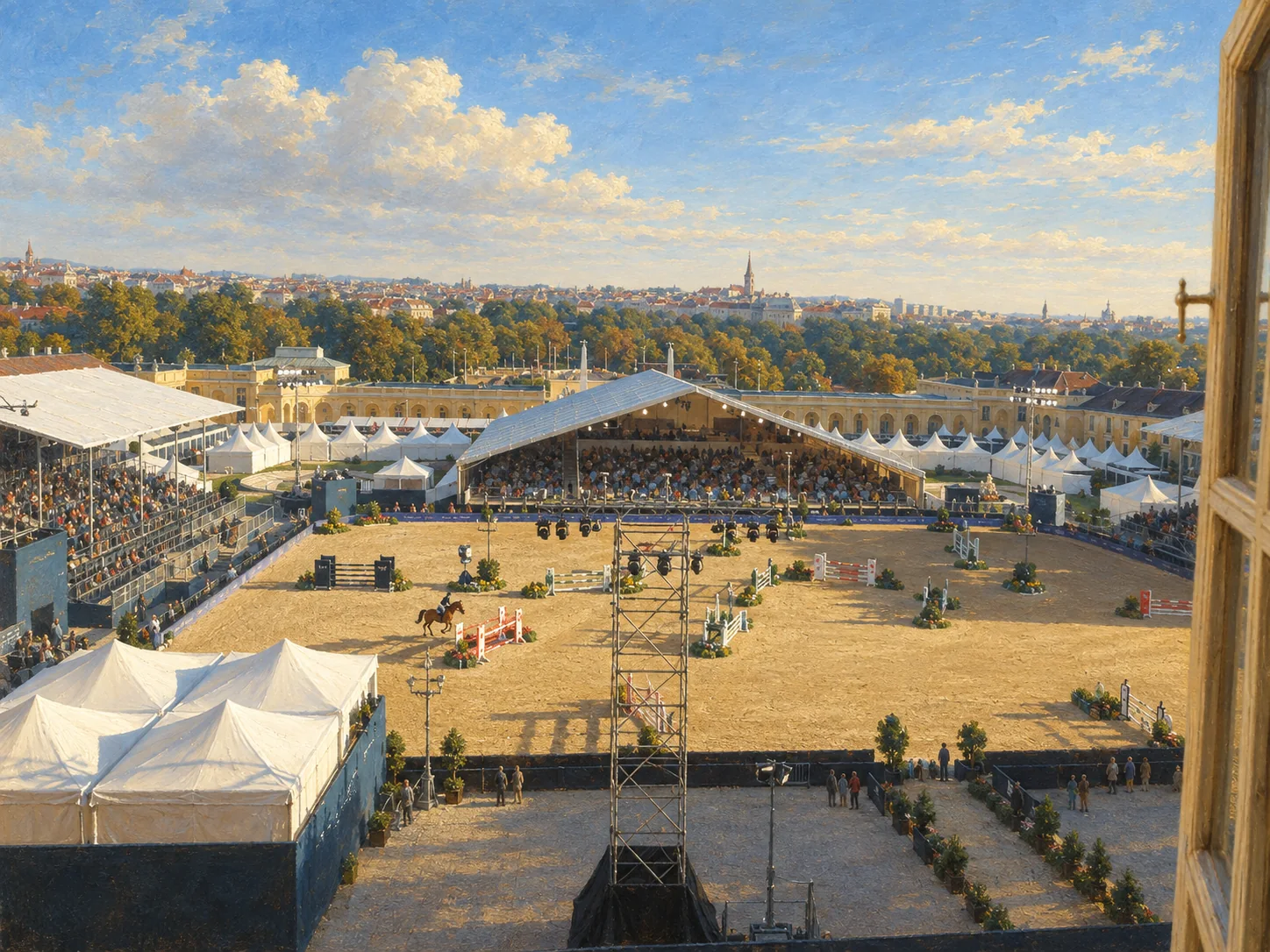
The applause rolled from the grandstands across the Ehrenhof and bounced off the yellow palace façades. For the spectators, the horse show had only just begun. The first horse had cleared the obstacle cleanly, the rider had barely seemed to gather the reins, and a few seconds later the entire place was filled with that bright, cheerful noise people made when they were allowed to forget for a few hours that the world outside a fenced-off event area was more complicated.
I heard almost none of it.
Shani had grabbed my arm and was staring at the narrow door beneath the grandstand. The man she had seen with Sebastian on the day of his death had just disappeared through it. The good Austrian with the coffee cup. The man who had explained to George and me how to lift heavy construction parts properly from the knees while never touching anything heavier than his coffee. This time he was not carrying a cup. A black folder was tucked under his arm.
The fact that I still did not know his name was moderately embarrassing for the strategic leader of a resistance movement. With a murder suspect, it was additionally inconvenient.
George had recognized him too. I did not have to explain anything. The Carinthian looked first at the door, then at me, and finally up toward Shani. We all knew what Inspector Stippschitz had ordered us to do. We were to stay out of the investigation, complete our work assignment, and otherwise do as little as possible that might occupy a police station, the Lord High Steward, or the immigration authorities. It was a sensible instruction. That was precisely why it fit so poorly with our life in Vienna so far.
Shani knew the grandstand better than we did. She had spent days working on it and knew where the technical passages ran, which stairways led beneath the seating tiers, and which narrow doors were reserved for staff. George had also become quite familiar with the structure by now. I mainly knew the consequences of what happened when George found technical equipment too interesting. Even so, for a brief moment something resembling actual division of labor emerged. Shani went back upstairs so she could watch from the grandstand and see where the man moved beneath us. George took a side entrance leading into a technical corridor. I stayed below and walked along the crowd-control barriers as if I were still doing the job assigned to me by The German Integration Scheme.
Above me, the next horse approached a jump. For a few seconds the crowd went quiet. Then I heard the dull thud of hooves landing in the sand, followed immediately by another burst of applause. The vibration passed through the steel structure of the grandstand and into the ground beneath my feet. An unpleasant thought occurred to me: under these seating tiers, someone could probably beat a man to death without a single spectator turning their head in the wrong direction.
The door through which the project coordinator had disappeared stood slightly open. Of course it did. A closed door might still have given me time to think about Stippschitz's instructions. A half-open door, on the other hand, felt like a personal invitation to my worst decisions.
I pushed it open and went inside.
Beneath the grandstand, the world changed. The open Ehrenhof with its light, horses, and elegantly dressed spectators remained only a few yards behind me, but down here it smelled of metal, wood dust, rubber, and cable insulation. Thin shafts of light fell through narrow gaps onto the steel supports. Above my head, people moved across the seating rows. Every footstep, every stamp, and every fresh round of applause traveled through the framework as a dull tremor. A narrow passage ran between the supports, past stored floor panels, cable reels, and equipment crates.
I moved slowly. Not because I was particularly cautious, but because I constantly had to make sure I did not trip over a cable and save my opponent the effort by taking myself out in a workplace accident.
Then I heard paper.
Not much. A faint rustling, half swallowed by the noise of the event.
A few yards farther on, the project coordinator was standing in front of an open storage cabinet. The black folder lay on a crate. He had taken out several sheets and was sorting through them frantically. Some disappeared into his jacket. Others he tore up and stuffed into an open trash bag. Beside the folder, inside a clear plastic sleeve, lay a long steel alignment bar of the kind used for positioning heavy structural parts. It was hardly longer than my forearm, but it was solid, angular, and heavy enough to make me think immediately of Stippschitz's description.
The police were looking for a narrow, heavy, angular object.
I should have turned around.
Instead, I took half a step backward and put my foot on a cable. The plug struck a steel support. It was not a loud sound. Under normal circumstances, someone might have ignored it. Beneath a grandstand where a man was destroying incriminating paperwork, it was enough.
He turned.
We looked at each other.
At first there was surprise in his face. Then something else. Not panic. More the quick realization of a man who had understood that his problem had just changed from paper into a living witness.
His hand moved toward the steel bar.
My strategy at that moment consisted of a single point.
Run.
I turned and ran.
The passage seemed narrower than it had on the way in. My shoulder brushed a support, I stumbled over a cable cover, and barely caught myself. Metal crashed behind me. Above us another horse approached a jump. For a moment the grandstand fell silent, then the animal cleared the obstacle and the cheering broke out. I could barely hear my own footsteps, but I knew the man was behind me.
At the next junction I could go left toward the front of the grandstand or right into a small storage area. I chose right because I hoped he would expect me to go left.
That was strategic thinking.
Unfortunately, the corridor on the right ended at a fence.
I had run into a dead end.
One should not overestimate one's special skills.
When I turned around, the project coordinator was walking slowly toward me between the supports. He no longer needed to run. The steel bar hung from his right hand as if it were just another tool he intended to put back into a crate. The fence pressed into my back. With every step, the man in front of me grew larger.
All at once I could picture very clearly how Sebastian had died. It did not require an elaborate murder weapon or extraordinary strength. You only had to swing that solid piece of steel properly once.
He raised his arm.
At that moment something moved above him. A head of red hair appeared between the seating rows. Shani had found me and was leaning over the structure as far as the grandstand allowed. The project coordinator instinctively looked up.
It was only a second.
It was enough.
I ducked and threw myself sideways. The steel bar slammed into the fence where my head had been moments earlier. Metal struck metal, loud enough that I heard it even through the thunder above us. The man grabbed my jacket as I squeezed past him. The fabric stretched across my shoulder, held for a moment, then tore with a dry rip.
I was free and ran back toward the junction.
This time I went left.
George was coming toward me.
He had a large wrench in his hand. With anyone else that might have worried me. With George, I was extremely glad to see it. The technical leader of The Rebel Piefkes did not need a long explanation to understand why half my sleeve was hanging off and why a man carrying a steel bar was coming up behind me.
The project coordinator stopped. George did not have to raise the wrench very high. He was Carinthian, had three-day stubble, and with a tool in his hand generally looked as if a bad decision by the other person was already part of his schedule.
The man backed away.
Behind him Shani came down a narrow metal staircase.
For one moment he was trapped between us. I genuinely thought it was over. Then he hurled the steel bar at George.
The Carinthian ducked. The tool struck a support, bounced off, and clattered to the ground. In the same instant, the project coordinator shoved an equipment crate aside, jumped over a low barrier, and disappeared into a second passage.
George went after him immediately. Shani headed back up the stairs to cut him off from the other side.
I stayed behind with the steel bar.
It lay in the dust between two cables. On one edge I saw a dark discoloration. That was enough for me. I was a geologist, not a forensic pathologist, and I had no ambition to rub at a possibly bloodstained tool to expand my professional expertise.
The black folder still lay beside the open equipment crate.
I picked it up.
It was full of invoices. A lot of invoices. Grandstand components, transport, technical services, crowd-control barriers, storage, and finally several pages containing one phrase that made me stop.
Scent concept.
So the Ehrenhof had not only had a murder. It had also had a scent concept.
The invoice for Eau de Hof was high enough that you could probably have bought an actual stable, horse included. Several items appeared twice, some three times. Services had been invoiced that, as far as I could remember, had never taken place. The same supplier appeared again and again, whether the subject was structural parts, transport, or artificial damp earth. If the company had offered funerals too, Sebastian would probably already have been fully processed.
Among the invoices were handwritten notes. I did not know Sebastian's handwriting, but his name appeared on several pages. Beside it were figures, question marks, arrows, and the same project-coordination initials over and over again. Sebastian had done the math. The young man had apparently discovered that someone was treating the setup of the horse show as a private source of income.
That gave his ambition a new meaning too. Sebastian had wanted to rise quickly within the court establishment. If he could prove to the Lord High Steward that money was disappearing from a major prestige project, it would probably be as useful to his own career as it would be damaging to the project coordinator's.
A shadow fell across the folder.
I flinched.
Stippschitz was standing in front of me.
Two security officers were coming up behind him. His gaze traveled from my torn sleeve to the black folder, then to the steel bar, and finally back to my face. As it did, his expression grew calmer and calmer. With other people, calm was reassuring. With Stippschitz, it usually meant that quite a lot had to be cooled down beneath the surface.
I quickly explained that we had of course not been investigating. We had merely followed the project coordinator beneath a grandstand, found a possible murder weapon, and nearly been beaten to death in the process.
Even I noticed that this description probably did not match his definition of not investigating.
He put on examination gloves, took the folder, and ordered the steel bar secured. Then he wanted to know where the man had gone.
For the first time that day, George's technical fascination with the grandstands could actually make our lives easier.
There were three practical exits from beneath the seating tiers. One led back into the open Ehrenhof, one into a fenced technical area, and one into a narrow service lane directly beside the riding arena. The first was already occupied by security. The technical area ended at a locked gate. Unless the project coordinator planned to live among cable crates, he had to head for the service lane.
George had apparently worked that out already.
When Stippschitz and I reached the exit, the riding arena lay directly in front of us. Only a low barrier separated the service lane from the course. A horse was galloping through the sand. Farther to the right, the project coordinator was running.
George was coming at him from the other side.
Above us, Shani was moving along a narrow stairway.
The man was almost surrounded.
He realized that too and made a decision I had not expected.
He jumped over the barrier.
Straight into the riding arena.
At first, the spectators apparently thought it was part of the show. Some of them even applauded. Perhaps they assumed it was a new discipline. Escape from The Rebel Piefkes. International level.
The project coordinator ran across the sand. A horse came from the opposite direction. The rider reacted immediately, pulled the animal outward, and prevented a collision. For a moment, I forgot to breathe. Then I had had enough of merely watching.
George was already climbing over the barrier.
I followed him.
Stippschitz stayed behind.
That was the difference between a trained criminal investigator and us.
From inside the arena, the obstacles looked very different than they did from the edge. They were higher, wider, and placed close enough together that while running you constantly had to decide which side to take. The project coordinator reached one of the rails, ripped it from its support, and threw it at George. The Carinthian threw himself aside. The lightweight rail struck the sand.
Shani had meanwhile gone around the outside and reached the horse exit before the fugitive. He had to turn again. Stippschitz was now entering the Ehrenhof with several security men. To the right were the grandstand and barriers, to the left the exit. George was behind him.
For a brief moment, the escape seemed over.
Then the project coordinator saw me.
Naturally, he chose the route that ended with me.
I tried to jump aside, caught my foot on the rail he had thrown at George, and hit the sand before I had even understood what was happening.
Again.
The ground of the Ehrenhof was gradually becoming a place I knew more intimately than some people.
The project coordinator jumped over me. As he did, a set of keys fell from his pocket. I grabbed them, more out of reflex than strategy. If I was going to spend another pursuit lying on the ground, I wanted at least to contribute something useful.
By the time I got back up, he was already behind the grandstand.
George was after him. So was Shani.
I ran behind them.
My knees objected. My lungs did too.
Behind the grandstands were transport boxes, cable carts, and equipment crates. Several of the Eau de Hof containers had not yet been cleared away. One crate stood open.
The project coordinator reached into it.
I expected a weapon.
He pulled out a bottle.
For a moment none of us understood what he intended to do with it.
Then he pressed the spray head.
A dense cloud of artificial horse odor shot between the crates. I took it full in the face. My eyes watered, my nose burned, and suddenly I smelled so intensely of stable that even a carriage horse would probably have kept its distance. George started coughing beside me. Shani covered her mouth and nose with her sleeve.
The project coordinator kept spraying.
It was the most absurd defensive weapon I had ever encountered.
We were chasing a suspected murderer through an international horse show and were being driven back by synthetic horse smell. If someone at the men's shelter had told me this story, I would have confiscated his Doppler for health reasons.
The man used the cloud and disappeared among the stacks of materials.
I could see only a shadow.
Then I heard a startled cry and immediately afterward a dull impact.
When the scent cloud thinned, the project coordinator was lying on the ground.
Jakub stood beside him.
He was holding a broom.
Apparently the Slovak foreman had used the most practical tool of the day at exactly the right moment and swept the fugitive's legs out from under him. Jakub did not look particularly proud. More as though he had finally been given the chance to take revenge for the horse-scent cloud from the previous day.
The security officers reached the man seconds later. They rolled him onto his stomach and brought his hands behind his back.
The sight looked familiar.
Except this time someone else was getting an intimate view of the Ehrenhof.
*
The horse show resumed after a brief interruption.
The spectators got their horses back, the horses got their obstacles back, and the Ehrenhof got its applause back. Most people in the grandstands probably had no idea why a man had just run across the course. Later, someone might write that there had been a technical delay.
We got Stippschitz instead.
He took George, Shani, Jakub, and me into the same container where we had sat after Sebastian's death. This time there were no handcuffs on the table. In front of Stippschitz lay the black folder and the steel bar sealed in clear evidence wrapping.
The first findings matched what we had seen beneath the grandstand. In shape and weight, the bar was capable of causing Sebastian's fatal head injury. Traces had been secured from one edge. The laboratory still had to provide final confirmation.
The documents in the folder were already clear enough.
Sebastian had spent some time collecting invoices and comparing them with one another. The project coordinator had repeatedly billed deliveries through a company connected to him. Materials had been charged twice, transport more than once, and services appeared on invoices even though they had either never been performed or had been provided on a much smaller scale.
Eau de Hof was part of it too.
The scent bottles had never been ordered as a punishment for George and me. They had been part of the event concept from the beginning. Our punishment had simply had the advantage of using up materials that were already there. Useful was a generous term in that context.
Sebastian had discovered the irregularities and recognized his opportunity. He intended to present the documents to the Lord High Steward. His ambition undoubtedly played a role. A young man who exposed fraud in a prestigious court project could expect his career to benefit.
For the project coordinator, the same discovery threatened the end of his business.
On the day of the crane accident, the two men had argued between the stacks of materials. Shani had seen the black folder. Jakub had heard parts of the argument. Sebastian had refused to hand over the documents.
In a narrow area behind the stacked construction materials, the project coordinator had reached for the steel alignment bar and struck him.
One blow was enough.
Sebastian collapsed.
Then something happened that the killer had not planned.
George climbed into the crane.
I stood below giving frantic hand signals. The Europallet was already hanging in the air and had begun to swing. The project coordinator apparently realized within seconds what kind of opportunity had opened up. Sebastian was initially difficult to see behind the materials. The killer dragged the motionless body to the edge of the swinging load's path and disappeared back into cover.
The pallet kept moving.
The Lord High Steward's window shattered.
Construction parts and the swinging load struck Sebastian as well.
Afterward, everything looked exactly the way it was supposed to look.
An out-of-control crane.
A dead supervisor.
A Carinthian in the cab.
A Piefke below giving hand signals.
And several witnesses who had heard George and me complaining about Sebastian all morning.
It had not been a perfectly planned murder. In a way, it was worse. The project coordinator had recognized a sudden opportunity and within seconds turned a killing into what looked like a workplace accident. George and I had supplied the rest without knowing it.
He had taken the black folder and hidden it beneath the grandstand. Once the tournament began, he intended to retrieve it, destroy the incriminating documents, and disappear.
Then we came along.
Again.
Perhaps our greatest talent really was getting in other people's way at the worst possible moment.
Stippschitz finally made us tell him the whole story about the red laser dot.
Shani confirmed that she had seen it on my forehead. I had to explain why I had withheld that information. Stippschitz was impressed neither by my promise nor by the romantic component of my decision-making.
Paradeiser's rifle had meanwhile been examined. It had not been loaded. The laser sight, however, worked perfectly. Paradeiser insisted that he had merely been conducting observations. Why an observation required a rifle with a laser sight remained his personal interpretation of professional police work.
According to the investigation so far, he had nothing to do with Sebastian's death.
The beige hat had therefore been a false lead.
An extremely unpleasant false lead.
Stippschitz informed us that Paradeiser would for the time being remain somewhere where specialists could observe his future observations more effectively.
I could live with that.
*
Late in the afternoon I sat at the edge of the Ehrenhof and watched the horses.
The tournament continued as if the murder had only been a technical problem that had been dealt with during a short interruption. Horses cleared obstacles, the grandstands held, and George inspected the structures with the satisfaction only a technical leader could feel when a structure had neither collapsed nor killed anyone.
Jakub was singing again.
V dolinách drifted quietly between the work areas. The man had recovered his good mood. It probably helped that the artificial horse smell had finally cleared from the Ehrenhof.
Shani sat on a low barrier in front of the grandstand. Her helmet lay beside her. For the first time I saw all of her red hair in the afternoon light. I sat down beside her while George, several yards away, inspected a barrier that had been finished for days.
I allowed him that version of discretion.
Shani's assignment at Schönbrunn ended the following morning. The German Integration Scheme was sending her on. She did not yet know exactly where. Some event. Some grandstand. Some good Austrian who would explain to the people on the construction site how to do their jobs.
I would have liked to ask whether we would see each other again.
I did not.
Maybe I was a coward. Maybe after the last few days I had simply had enough of questions whose answers could change my life.
Shani watched me for a while. Then she leaned toward me and kissed me briefly on the cheek.
Nothing more happened.
Nothing more needed to.
She picked up her helmet and walked back across the Ehrenhof. After a few steps, she did not turn around again. Her red hair disappeared among the grandstands and the people still working there.
That was the end of something that had barely begun.
Perhaps that was better.
In my life, relationships rarely lasted longer than murder investigations.
George came over after Shani had disappeared. He did not say anything. His face was enough. I was probably grinning stupidly again.
This time I did not care.
*
By evening the Ehrenhof was emptying out.
The tournament was over for the day. Spectators streamed through the exits, workers collected trash, and horses were led back to their areas. The grandstand lights remained on and made the structures look like a construction site again.
George and I walked slowly toward our entrance beneath the Ehrenhof staircase.
We were free.
Not completely, but considerably freer than we had been that morning.
No murder suspicion.
No handcuffs.
No scent bottles.
No Paradeiser.
For a single day, that was remarkable progress.
Stippschitz was waiting by the door.
He was wearing his coffee-brown sheepskin leather jacket and had another file tucked under his arm.
I was starting to dislike those files.
This time he began with good news.
We were not going to be deported to Germany.
George threw up both arms in relief. I felt the tension of the last few days finally begin to leave my body. For a moment, I genuinely believed it was over.
Then came the second part.
We were still going to leave Austria.
Just in the other direction.
The German Integration Scheme division had revised our schedule for the coming weeks. After the events in the Ehrenhof, it considered a cross-border integration measure appropriate.
The phrase cross-border alone was enough to pull my good mood back into custody.
Our destination was Slovakia.
Levoča.
An old town in the Spiš region. Historic, beautiful, and far enough from Germany that at first I saw no immediate reason to panic.
Then Stippschitz explained why we were going.
In the middle of Levoča's historic square stood a sixteenth-century pillory. In earlier times, people had been exposed there to public ridicule for minor offenses.
The German Integration Scheme apparently considered that educational tradition timeless.
George and I were to be exhibited there for a week.
Officially, we were being loaned out.
Unofficially, we were being deported, just not far enough away to get rid of us.
Stippschitz had a list of reasons. Unauthorized crane operation, damage to a window belonging to the imperial court establishment, unauthorized investigation into a murder case, repeated disregard of police instructions, and finally large-scale odor pollution in the Ehrenhof.
I would have liked to protest the last point.
The horse-scent operation had been ordered.
Stippschitz knew that.
The German Integration Scheme knew it.
It was on the list anyway.
There was probably a minimum point requirement for being placed in a pillory.
George was mainly interested in whether the assignment would be paid.
Naturally, it would not.
I was mainly interested in whether Levoča had beer.
I assumed it did.
That helped.
A little.
Stippschitz handed me the new work schedule. We were to leave Vienna at the beginning of October. One week of public presentation at the historic pillory, followed by further duties on site. What those duties involved was not written down.
That made me suspicious.
Very suspicious.
I looked across the Ehrenhof one last time. At the grandstands, the riding arena, and the Lord High Steward's window, which had already been temporarily boarded up. Somewhere behind the structures, a horse snorted. Jakub's singing was only faintly audible now.
Shani was long gone.
I folded the work schedule and slipped it into my pocket.
One week in the pillory.
What could possibly go wrong?
THE END
Juri Sonnenburg and George return in October.
Next case: Levoča.