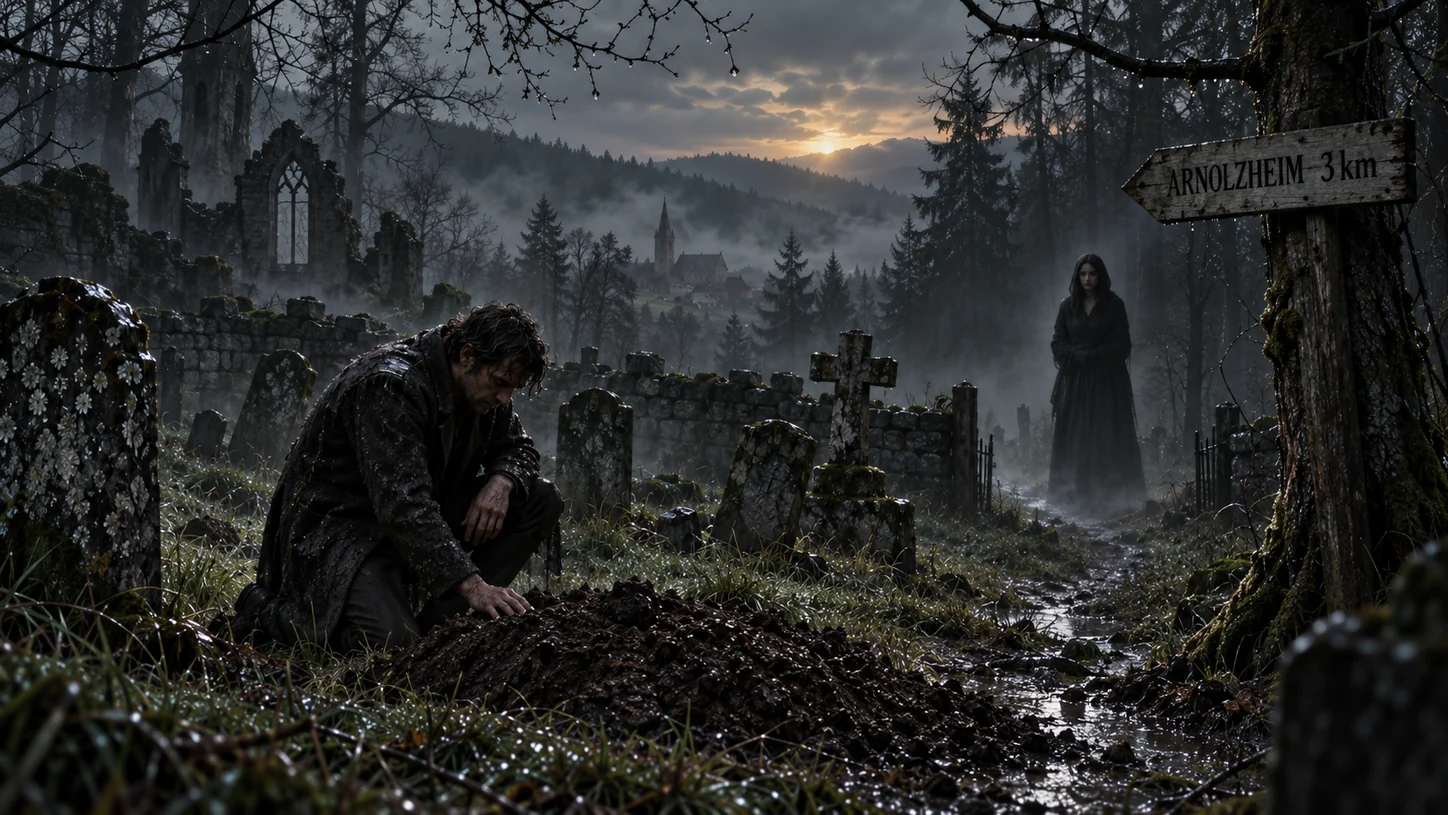
The handwriting was his; Leonhard Kern had no doubt about that. He knew the angular K, the tightly crowded letters, and those slightly overlong strokes across the sevens, a habit he had not broken until years later. Three decades might be enough to blur faces, voices, and whole stretches of a life; one's own handwriting, by contrast, had something disturbingly permanent about it.
The field notebook lay on his desk in Vienna between his open laptop and a cup of coffee that had long since gone cold. Written in black marker on its yellowed cover were the words »Waldviertel Mapping, 1995«, with his name beneath them. Leonhard had not held the notebook in years, perhaps even decades. It had disappeared into a box in the basement along with topographic maps, slides, rock samples, an old compass, and that geologist's hammer, a box he had taken with him every time he moved because, supposedly, such things might come in handy again someday.
Now they actually had. A cross-border project was to link historic paths, local place-names, and abandoned settlements with modern geospatial data, and Markus Heller had recommended him for the field verification. For their meeting in two days, they planned to examine three old stream crossings that appeared in different places on the overlaid maps. Heller would not approve the new path layer until Leonhard had inspected the banks; on an earlier assignment, he had once spent an entire morning following a neatly drawn line that ended at a bridge that had been dismantled. Ever since, Leonhard had been given the cases where a convincing display on a screen was not enough.
He had agreed before Heller even mentioned the fee. Ever since the request, he had been thinking about the Thaya, Dobersberg, and the remote paths he had spent weeks walking as a twenty-five-year-old. Now the field notebook lay open before him, and he began by looking for the places Heller had marked on his map.
At first there were ordinary working notes, in the concise form he still used today. Rock names, measurements, sketches of outcrops, and occasional references to the weather brought back images with surprising speed; Leonhard could almost feel the heat of particular days again, the dust on his boots, and the weight of the hammer on his belt. On August 17, he had described a heavily weathered amphibolite north of Dobersberg, and a day later a pegmatite dike beside the Thaya. Under August 19, all he had written was »Slavonice, evening«, as though dinner in town had mattered more than anything he had examined beforehand.
That line made him smile. He remembered the drives across the border, which had only recently opened then, the Czech beer, the dumplings, and the relief of finally sitting in a chair after ten hours in the field. Even more than today, the area had felt like the edge of Europe. On either side were woods, ponds, and small villages, and on the Czech side the landscape that had already been known back then as Česká Kanada, Bohemian Canada. Leonhard had always thought the name somewhat exaggerated; to him it had not been some romantic Canada, but an area to be mapped.
Between the geological surveys he had noted the abandoned settlements of Reichers, Romau, and Althütten. On older maps, those names still had streets, houses, and property boundaries, while on the ground there were often only collapsed cellars and untended fruit trees. Sometimes it was only on the way back that he noticed the scattered stones among the leaves formed a straight line; once he recognized it, he could no longer miss the outline of a house. He had followed those traces even when they had nothing to do with his thesis.
In the evenings, he had sometimes imagined who had lived in those houses, who had sat at their tables, and who had planted those fruit trees that were still blossoming in the middle of the woods decades later. Turning the pages, he first found more geological observations, neatly dated August 24. It was not until the next page that the tone changed: »Aug. 25 — Althütten. R. wants to leave tomorrow.«
Leonhard paused, for he could not connect the single letter with anyone he remembered. He read the line a second time, wondering whether it referred to a colleague or a casual acquaintance; as he recalled it, he had mostly been alone during his mapping work. Farther down, undated and written with greater pressure, were the words »Cemetery — fresh earth«.
Leonhard placed his finger on the line. A cemetery might well appear as a landmark in a field survey. Fresh earth, on the other hand, was not a geological observation, at least not in this context. Beneath the note, he had drawn a stream, a path, and an arrow pointing north. At the end of the arrow was »ARNOLZHEIM — 3 km«, followed by three question marks.
He said the name softly to himself, but it stirred nothing, not even the vague feeling of having heard a word somewhere before. On the laptop, Leonhard searched a current map first, then historical maps, and finally tried different spellings. Reichers appeared, as did Romau and Althütten. Arnolzheim remained missing.
Only now did Leonhard notice that the next page was gone. A ragged edge of paper ran close to the binding; the sheet had not simply fallen out, but had been torn out. The following page was also missing, and so was the one after that. The next surviving entry was dated August 29, 1995, and began with a geological measurement, as though nothing worth mentioning had happened between August 25 and August 29.
Of course Leonhard could not remember every single day of the summer of 1995, nor would he have expected to be able to after more than three decades. Yet this gap felt different, because when he thought about August 26, 27, and 28, not a single road, room, or even memory of the weather came to mind. Three days were entirely missing between the surviving entries, and even what he had written on August 25 remained unfamiliar. It was as though he were searching a house for a room he was certain existed, although no door anywhere led into it.
He took a pencil and wrote »Arnolzheim« on a slip of paper, followed underneath by »Althütten — cemetery — R. — 3 km«. As he was about to set the paper beside the laptop, he heard a sound in the quiet room. At first Leonhard thought it was the kitchen faucet, but everything there was turned off. The sound continued: not dripping, but the steady, distant rush of a small stream running over stones.
Leonhard stood and took a few steps across the room. At that very moment, the water fell silent. Traffic noise came through the closed windows, and somewhere in the building a door shut. When he returned to the desk, he discovered a dark patch on the open page of the field notebook. The paper was damp, but only in one small spot directly beneath the word Arnolzheim.
Leonhard wiped his finger on his pants and looked at the closed kitchen door. “If the floor starts getting wet too, I'm calling the building manager,” he muttered, before checking the underside of the notebook for more spots. He left it open and changed his room reservation in Slavonice. The confirmation came almost immediately; he moved it into the project folder and began gathering his things for the following morning.
The next morning, Leonhard left Vienna behind and drove north, past Horn and Geras to the Thaya. He recognized individual bends before the places they belonged to; outside Dobersberg, he eased off the gas because an inn had once stood beyond a curve. The driveway was still there, but now it led to a new building, and he drove on without stopping.
He reached Slavonice shortly after noon and took his luggage up to the room he had reserved. From the window he could see the facades around the square, which in the old days he had usually noticed only in the evening, hungry and with dusty shoes. Over a cup of coffee, he opened the map beside the field notebook; Althütten was close enough for him to be back before evening. He took his rain jacket, left the rest of his suitcase unpacked, and returned to the car.
Beyond Staré Město pod Landštejnem, the roads narrowed, and in places branches reached out over the pavement. Meadows and dark ponds opened up between patches of woodland before the next bend blocked the view again. Leonhard looked for the turnoff he had memorized on the map, and initially drove past it because all he could make out between the trees were two grass-covered tracks.
His modern map marked Althütten as a vanished settlement. He would have to cover the last few kilometers on foot. He parked beside a forest road, put on sturdy shoes, and took the small backpack from the rear seat. Inside were water, his rain jacket, a GPS unit, a flashlight, the old field notebook, and a copy of his 1995 map.
The woods smelled of damp earth, mushrooms, and wet wood. At first Leonhard checked the GPS regularly, but after half an hour he realized he had long been making the turns without it. He would see a path and know he had to take it, without being able to say what that knowledge rested on.
At a fork, Leonhard stopped because the two directions did not feel equally familiar. The broad forest road to the right appeared on the map, while a narrow trail to the left disappeared among young trees. He checked the position of the ruins once more, yet chose the left-hand path, whose first bend he thought he recognized.
Perhaps ten minutes later, an image appeared abruptly in his mind. A black bicycle leaned against an apple tree, a cloth bag hung from its handlebars, and mud clung to its rear wheel. The memory was so distinct that Leonhard slowed his steps. The apple tree was actually there, old and half wild, wedged between younger trees. There was no bicycle to be seen.
Leonhard placed his hand against the bark. The image remained for a moment, and with it came a woman's voice, bright and impatient: “Leonhard, come on.” When he took his hand away, the memory vanished as abruptly as it had appeared. Nothing moved between the trunks.
A little later, he reached the first remnants of Althütten's walls. Grass and ferns concealed sunken cellars, while among the younger trees he could still make out the regular spacing of a row of fruit trees. Leonhard stopped beside a half-buried doorway and checked the house's position on his map, but the street shown there lay a few steps away from the hollow he could trace in the ground.
The cemetery lay outside the former settlement on a gentle slope. A low wall enclosed it, already collapsed in several places. Even before Leonhard reached the entrance, the uncomfortable feeling that had accompanied him since Vienna returned. It was not yet real fear, more the hard-to-explain sense that somewhere, someone was waiting for him.
Tall grass stood between the graves, draped around leaning crosses and fallen stones. Oval porcelain portraits had survived on a few of the monuments, and Leonhard photographed the legible inscriptions, several of which bore the name Hadrava. He spent a particularly long time studying the picture of a narrow-faced man with dark hair and a serious gaze. The inscription beneath it named Josef Hadrava and the years 1898 to 1946.
On the phone, Josef's face looked brighter because a narrow gap had opened in the clouds. Leonhard held the screen beside the porcelain portrait and could not decide why the gaze in the photograph seemed different. He put the phone away without taking another picture and walked on among the headstones.
At the far edge of the grounds, he discovered the fresh earth. The grave was immediately unlike all the others. Where grass and moss grew on the other mounds, here lay dark, loose soil, as though someone had set a shovel aside only hours before. A plain wooden cross stood on it, without a name, flowers, or a candle.
At first Leonhard kept several meters away. The line from the field notebook appeared in his mind: »Cemetery — fresh earth«. Slowly he moved closer, knelt, and took a little soil between his fingers. It was cold and damp, but unquestionably freshly turned. Clay still clung to a stone at the edge of the grave.
After photographing the grave and the nameless cross, Leonhard pointed the camera toward the edge of the woods once more. He was about to put the phone away when a dull sound came from beneath his feet, so faint that at first he thought it was earth settling. Perhaps a root had shifted under the weight of the wet ground; even so, he remained motionless and involuntarily held his breath.
When the sound came again, a root was harder to accept as an explanation. It sounded as though someone were striking wood with the flat of a hand, the noise muffled by a heavy layer of earth. Leonhard jerked upright and backed across the narrow path to another headstone, catching his jacket on a rusty point. He tore himself free and stared at the mound while his heart pounded so fiercely that for a moment he could hear nothing else.
From where he stood, he looked for an animal moving among the graves and listened for rustling beneath the ferns. A hollow under damp earth could carry sounds that seemed different at the surface; he ought to have checked instead of standing there imagining things. Yet when he moved away from the headstone, he headed for the exit.
At the rear exit, a narrow path began among ferns and young trees, leading in the direction of the arrow in the field notebook. Leonhard took the notebook out again and held the sketch so that the cemetery and the edge of the woods lay ahead of him. He only wanted to see whether the path continued beyond the first bend before going back to the car.
Before Leonhard reached the first trees beyond the cemetery wall, it began to rain. At first there were only scattered drops, then a fine, steady rain that darkened the colors of the woods. Water gathered on the leaves and ran in little rivulets across the path. The GPS still worked and showed his position reliably, although the path Leonhard was following did not exist on his modern map.
At the edge of the woods, still within sight of the cemetery, Leonhard discovered an old wooden post with a weathered sign hanging from it. It clearly read »ARNOLZHEIM 3 km«, and for a moment he felt almost relieved. Perhaps it was a forgotten local place-name or a designation that had never made it onto the official maps; at any rate, the mysterious entry now had a counterpart in the actual landscape.
Leonhard took out his phone and photographed the sign. When he checked the image, his smile faded. The post was there, along with the woods, the path, and the wooden sign, but the lettering was missing. A second photograph gave the same result. In front of him, »ARNOLZHEIM 3 km« was unmistakable, while the screen showed only a blank wooden surface.
Below the sign, Leonhard discovered cuts in the wood. He brushed his fingers over the damp moss until letters appeared beneath it: »YOU HAVE BEEN HERE BEFORE«. Something tightened in his stomach. As he ran his fingers along the grooves, the memory came not as a vague intimation, but with terrifying clarity. He saw his own left hand holding the post while his right worked a pocketknife, slowly cutting the blade into the wet wood.
Leonhard snatched his hand away and stumbled a step back from the post. The image of his own fingers on the knife remained so vivid that he had to look at his empty hand before he could lower it again. “I wrote that,” he said quietly into the rain, unable to understand why this certainty frightened him more than the unfamiliar name.
A branch cracked behind him, and when Leonhard turned, a woman stood on the path whose footsteps he had not heard. She might have been in her late fifties, though her age was difficult to judge in the dim light. Dark hair streaked with gray fell to her shoulders, and she wore a long skirt, a pale blouse, and sturdy shoes darkened by the wet ground. Water ran through her hair, but she made no attempt to shield herself from it.
The woman studied him with the quiet attention of someone seeing a familiar face after a long absence. Leonhard greeted her and pointed to the sign, trying to turn the encounter into an ordinary request for directions. “Do you know that place back there? I'm looking for an old settlement, and I seem to have strayed farther from the forest road than I intended.” She did not answer his question, but went on looking into his face.
“You've grown old, Leonhard,” she said at last, her gaze passing over his forehead and wet jacket. He felt the skin at the back of his neck tighten and asked how she knew his name. Even as she came closer, another image overlaid her face: the same woman, much younger, on a bed in summer sunlight. She was tying back her hair and laughing at him for watching her while her hands were occupied with the ribbon.
The memory vanished as soon as Leonhard tried to make out the room around her. He had to steady himself against the post and turned to the woman on the path, whose face now troubled him even more than before. “Please, at least tell me your name. I think we know each other, but I can't remember how.”
“I'm Maria, and we met here, the summer you were drawing your maps.” She stopped an arm's length away without touching him, although her hand had already risen a little. Leonhard watched her fingers close again and felt a pain at that withheld touch that he could not explain.
Maria's name brought back another image: her hand on a table, very close to his, and light spilling through an open doorway. When he tried to picture the person standing in it, two faces merged. Leonhard looked at the woman before him again and held on to the post until the pressure in his head eased.
“Then it was 1995,” Leonhard said, trying to hold on to the image of the room. “I remember your face and a table, but not what happened between us. Why did I forget you?” Maria looked past him toward the cemetery, and when she turned back, she seemed more exhausted than before.
“Because I helped you,” she answered, without turning his question into an explanation. “At the time, I thought it was the only thing I could still do for you.” Leonhard waited for her to go on, but Maria merely brushed the wet hair from her face and studied the knife marks in the post.
“Come to the mill. We can talk there, and you won't have to stand in the rain.” Maria turned toward the slope while Leonhard pointed at the sign and explained that he had come because of Arnolzheim. For the first time, something unmistakably like fear appeared in her face. “We're not going there today, Leonhard. I'm asking you to trust me at least enough to come into the village with me.”
A bell sounded beyond the trees. A single, deep toll traveled through the woods and slowly died away among the trunks. Leonhard checked his watch, but the display was black; the GPS no longer responded either. At the second toll, a dog began barking farther down the valley, followed shortly by another. Children's voices became audible through the rush of rain, and somewhere a wagon rattled along a path on which Leonhard had not seen a single wheel track that afternoon.
Where only remnants of Althütten's walls had stood a few hours before, a window was lit. Smoke rose from several chimneys, and a man crossed a meadow before disappearing behind a house. Leonhard said nothing more. Maria waited until the third toll passed through the valley, then asked him to come with her now.
This time Leonhard followed without another question. They had gone perhaps a hundred meters when a muffled thud reached them from the cemetery behind them. The rain and the distance swallowed almost all of it, but Leonhard recognized the sound at once. After a long pause came a second, then a third. It was the same noise he had heard beside the nameless grave.
Maria kept walking without looking back toward the cemetery, and Leonhard kept his eyes on her back. As long as he could see her footsteps ahead of him, he did not have to decide whether the sound behind them really came from the earth. Below the trees a door opened, spilling warm light onto a path that had still been overgrown with nettles that afternoon.