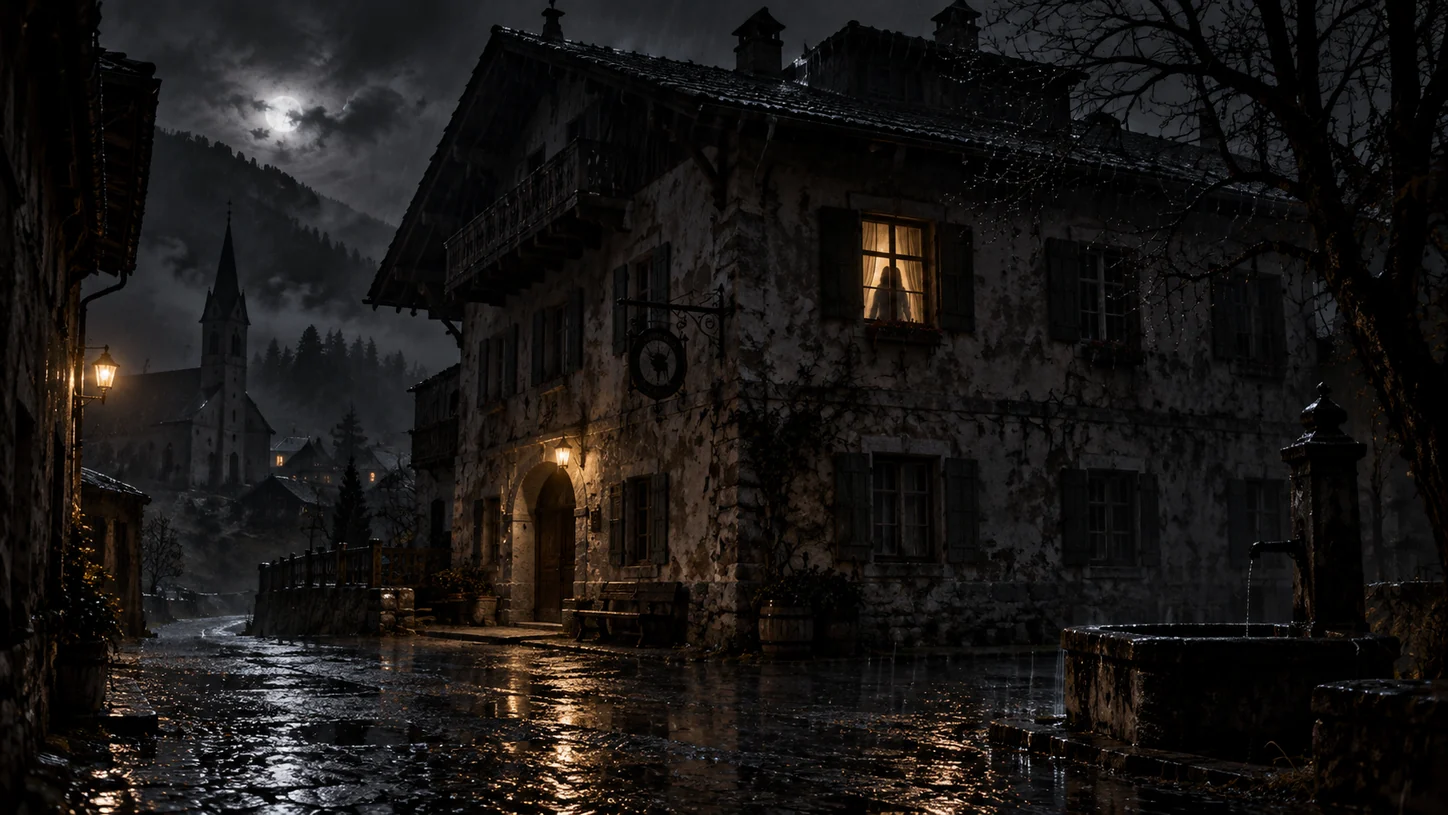
On the staircase, the step creaked whose peculiar sound Leonhard had remembered when he first saw the mill. Maria put out the lamp and drew him back from the kitchen doorway so he could no longer see the bottom of the stairs. In the faint light from the window, she held her head slightly tilted, listening for the next sound.
“Perhaps Josef has come back and didn't hear us,” Leonhard whispered, trying to lean past Maria toward the doorframe again. She pushed him back with her forearm and pointed to the heavy bolt she had slid across the front door. Then she turned her head toward the staircase again, where the wood gave once more.
“Maria, I want to talk to you,” called a woman's voice from the stairs, its familiar sound silencing Leonhard at once. He thought of Rosa in the cemetery and the cold skin of her arm while Maria's fingers tightened around his forearm. “She didn't walk past us, Leonhard, and Rosa doesn't climb through the roof of my house.” Even as she spoke, wood creaked above them again, as though someone had stopped on the landing.
Now the voice asked Leonhard himself to come into the hall, putting the same impatience into his name that he had heard beside the apple tree. He had to force himself to stay where he was, though nothing held him there but Maria's hand. “If you want to speak to me, stay where I can see you,” he said at last to the empty doorway. No answer came for so long that Leonhard began to believe he had frightened something off.
After the next step, Leonhard heard his own voice from the hall, with the slight Hessian accent that had stayed with him despite all his years in Vienna. Maria felt along his forearm until she found his fingers and clasped them tightly. He wanted to tell her that he was standing beside her, but the next sentence was already coming from the darkness.
“You don't have to look at me, Maria. You know who's standing outside your door.” Leonhard opened his mouth to drown out the familiar sound, but Maria squeezed his fingers so hard that he looked at her. Light fell from the window onto the wall in the hall, yet no shadow could be seen between the doorpost and the stairs.
“You let me in back then too, and I haven't changed.” The voice was quieter now, almost patient, while Maria drew a sharp breath and pulled Leonhard backward toward the table. He asked what back then meant, but she covered his mouth with her hand, as if even his question might invite something in. A final, barely audible whisper came from the threshold: “This time you shouldn't do it again.”
Maria pushed Leonhard toward the back door and pressed the backpack against his chest so he would not have to return to the table. Outside it was as dark as the hall, but the narrow path beside the stream remained visible for a short distance from the kitchen window. “We'll go to the Hirschen together and stay together, even if someone calls us,” she said as she opened the door. Leonhard knew she was disregarding her own warning about the night, but he could see no way of staying any longer to wait for whatever stood in the mill.
They took the narrow stone steps down to the stream and followed the water to the village path. Leonhard looked back several times, but nothing moved in the mill, and that very stillness made him clench the backpack strap so hard his fingers hurt. In answer to his question, Maria explained that there had been voices like these since his return in the summer of 1995. “I'm not telling you nothing can happen out here,” she added. “But whatever is in there is waiting for your answer, and it isn't going to get it tonight.”
The Zum Hirschen inn stood near the village square. A dark metal sign bearing the silhouette of a stag hung above the entrance, while warm light from the small windows fell across the wet path. Maria led Leonhard inside, where a sturdy man with a gray beard stood behind the bar, drying glasses. He showed no surprise when he recognized Leonhard.
The innkeeper put down a glass and greeted Leonhard as if he had been expecting him after a long absence. His name was Anton, he had a gray beard, and he held on a moment longer than Leonhard liked when they shook hands. “Your room upstairs is still vacant if you don't want to go back to the mill tonight,” he said with a glance at Maria. Leonhard replied that until now he had not known he had a room at this inn at all, and Anton released his hand without smiling.
Maria asked Anton to give Leonhard something warm to eat, then turned back toward the door. Leonhard stepped in her way; he did not want her going back alone to whatever had just stood on the staircase. “I know where I can lock myself in my own house,” she said, looking past him into the lane. “You don't even know where all the doors are.” She slipped past him and left before he knew whether to hold her back or follow her; Anton came to stand beside him at the window, and they both watched her go.
Leonhard sat at the bar and accepted the beer Anton set before him. Only after a few swallows did he tell him about the cemetery, Rosa, and the faceless figure that had followed him to the mill. Anton listened closely. His expression changed only when Leonhard mentioned the footsteps upstairs and his own voice.
“Then it's recognized you,” Anton said when Leonhard described his own voice on the stairs. The innkeeper glanced at the two men playing cards at the back table, whose hands had not moved for a while. “Sometimes the valley repeats things that happened here; the trouble is, no one knows whether it'll stop at repeating them. I've heard footsteps I could have put a name to, and the next morning I was glad I'd stayed in my chair.” Leonhard asked whether Anton thought that was what had happened tonight as well, but the innkeeper said that was precisely the certainty he could not offer him.
Leonhard repeated what the voice had said to Maria and only now noticed that Anton avoided the words let in. The innkeeper slid a plate toward him and waited until he had at least taken the bread. “You can ask questions tomorrow, but tonight you're so tired you'd accept any explanation as long as it let you get to bed.” Leonhard tried to object but only managed a cough; the warmth of the taproom made him realize how long he had been walking around in wet clothes.
Anton gave him a key and told him the room was one flight up, across from the small window in the hall. “Lock the door behind you, and don't let anyone in tonight, even if you think you hear a good reason.” When Leonhard asked how he was supposed to distinguish a familiar voice from its owner, Anton wiped the bar with his cloth. “If I knew that, I wouldn't be telling you to wait until morning.”
The room was small but clean. A bed stood against the wall, with a nightstand, a chair, and a washbasin beside it. The window overlooked the village square. Leonhard laid the field notebook, phone, and GPS unit on the table and found that neither electronic device worked anymore. He even changed the batteries in the GPS, but the display stayed dark.
Leonhard draped his jacket over the chair and opened the field notebook to a blank page. Beneath the date, September 21, 2026, he wrote the two sisters' names and tried to record their words in the order he had heard them. He faltered at Rosa's remark about the blood; below it he had already written left flank, though he no longer knew whether she had named the spot or he himself had felt the pain there. He added a question mark and turned back to the ragged edges.
Three sheets were missing, leaving remnants of differing widths close to the binding. Leonhard ran his fingers over them and checked the following page for the impression of any writing. He found nothing beyond the old measurements; he placed the pencil between the pages and left the notebook open.
The cuts in the signpost gave him no peace. Someone had taken time with a knife to record that he had been here before; Leonhard remembered his own hand, but not the reason. Apparently he had been afraid of losing something back then, and now he could not even judge whether the warning had been meant for himself. While he was thinking about that possibility, a slow knock came at the bedroom door.
Leonhard stayed seated and waited until the knocking was repeated. Only then did Maria's voice come from the hall, tired and carrying the quiet impatience he knew from the kitchen. “Please open up, Leonhard. I don't want to stand outside your door while you write about me.” He looked at the open field notebook and realized that no one outside could have seen what lay on the table.
“We can talk through the door, and tomorrow we can look at each other again,” he replied, though his voice was less steady than he had intended. The hall remained silent until Maria said softly that he had hidden behind this door back then too. Leonhard moved closer and placed his hand against the wood without touching the bolt. He knew of no memory that matched her claim, but felt how urgently he was searching for one.
A sob came from outside, and Leonhard realized his hand was already on the bolt. He did not want to have to decide whether Maria was really weeping out there while he hid in a warm room. “Tell me something I haven't asked you today,” he said at last. The answer came from the other side of the room, immediately behind the windowpane: “You only ever ask when you already know what you've done.”
He turned toward the window, beyond which lay only the dark village square, while three slow knocks made the glass tremble. Now he heard Rosa, asking him not to leave again, and took a step toward the pane. At the same time, sobbing came from behind the door, making him stop between the two and feel for the chair without taking his eyes off the glass.
His own voice spoke from behind the door, calmly enough that at first Leonhard listened only to the sound. “Don't let them in until you know who's coming with them.” He asked who was standing there and noticed that his hand was on the bolt again as the answer came: “I'm the man who came back.” Slowly he took his fingers off the metal and held them with his other hand.
Before Leonhard could ask about August 26, the voice began asking his question. It used the same words and the same small pause, so that he closed his mouth again without speaking. Something moved in the rafters above him, slowly at first, then in heavy steps, with the pattering of small feet coming from another corner in between. Dust sifted onto the field notebook, and Leonhard snapped it shut, took it from the table, and backed with it all the way to the bed.
Maria's voice called his name from the window, Rosa now spoke from the hall, and between them Leonhard kept hearing his own voice calling something he could no longer understand in the confusion. The noises did not grow louder, but denser, until he could no longer tell which direction made any sense at all. Leonhard sat on the edge of the bed and pressed his hands against his ears. Just as he thought the clamor must swell even further, everything ended at once.
After the sounds cut off together, Leonhard sat on the edge of the bed for a long time, holding the field notebook against his knees. He waited for another knock and scarcely dared turn his head toward the window, where he might finally see the face belonging to one of the voices. Eventually he put the notebook beside the backpack and pulled the blanket over himself without undressing any further. He meant to stay awake until ordinary footsteps came from the hall, but at some point lost any sense of how long he had been staring at the same door.
When Leonhard awoke, cold morning light fell through the empty window opening onto the bed frame. Above him, beams lay exposed where the plaster had fallen away, and remnants of wallpaper that must have been damp for years clung to the overturned table. At first he lay still, trying to think the objects back into their arrangement of the night before. Only when a drop fell from the roof onto his hand did he get up and gather the field notebook, phone, and GPS lying between his backpack and the bed.
Hardly anything remained of the Zum Hirschen inn but a ruin. Parts of the staircase had collapsed, and only two walls of the downstairs taproom were still standing. Leonhard made his way over rubble into the open. Althütten had vanished. Where houses, gardens, and stables had stood during the night, overgrown foundations lay among grass and young trees again. No smoke rose from a chimney, no one walked along the paths, and all that remained of the village square was an irregular clearing.
Outside, the phone could be switched on again and showed the morning of September 22, 2026. Leonhard went to the mill's foundations, past which the stream ran just as it had during the night, and looked for the stone steps Maria had led him down. A few were visible beneath the moss, but the upper part ended in undergrowth. He called her name and waited until his own voice seemed so out of place among the ruined walls that he fell silent again.
On the way back, Leonhard passed the cemetery. The fresh grave still lay at its far edge, but this time he did not go closer. Even less did he want to find out whether the noises beneath the earth could be heard again. The sign to Arnolzheim had disappeared. Only the bare post stood among the trees, and the carved warning was gone as well.
It was not until he was in the car that Leonhard took the GPS from his backpack to compare yesterday's route with his memory. The display lit up again, and beside the recorded track from the parking place was a second file he had not created. It was dated August 26, 1995, and showed a route north from the cemetery into an area his map marked only as woodland. At the end of the line was a point named Arnolzheim.
Another track ran in the opposite direction back to the mill, also dated August 26. The lines overlapped in places and broke off in others, so that neither an exact time nor a reliable duration could be read from them. Leonhard checked the information several times without understanding the screen. His device seemed to preserve paths he was supposed to have walked long before it was manufactured, but it did not tell him who had been beside him then.
Leonhard switched the unit off and put it on the passenger seat. The two routes ran through the same patches of forest without explaining anywhere why only one led back. He laid the map over it and picked up his phone; before going there again, he wanted to speak to someone who had known Rosa outside this valley.
The phone had a signal again, and among the ordinary messages was Heller's reminder about their meeting. Leonhard closed it without answering and searched the photographs for Rosa's face, which he had not photographed at the window. Only after a while did he put the phone away and turn the ignition key.