On the drive back from Brno, Anna let Leonhard take the wheel and read her notes without adding anything at first. He glanced at her now and then and noticed she kept lingering over the same pages while the houses outside grew sparser and the landscape gave way to fields and woods again. Karel had stood before ruins on August 27; according to Maria, Leonhard had reached that same mill badly wounded the previous evening. The two accounts could not readily be applied to the same ordinary landscape, and Leonhard waited for Anna to find an explanation he too could hold on to.
She did not close the notebook until they had been driving through the countryside again for a while. “I'd like to know why Karel's description of the ruined village didn't surprise you at all,” she said. “You looked at me as though he'd just confirmed something you hadn't wanted to tell me yet.” Leonhard kept his eyes on the road and admitted that he too had woken among ruins after a night in Althütten. Anna asked him to pull over at the next safe place, because she did not want to hear the rest while he was driving.
They eventually stopped in a small parking area at the edge of the woods, where Leonhard filled in his previous omissions. He told her about the fresh grave, Maria and Josef, Rosa outside the window, and the voices that had used his own sound in the mill and the inn. Anna interrupted only when it was unclear whether he had seen something or remembered it. When he described the night at the Hirschen, she asked about his entries in the field notebook and read them without smiling once at their impossible content.
“Apparently you expect me either to believe in ghosts now or send you home.” Anna handed the notebook back and left her hand resting on its cover. “Neither will help us much at the moment; first I want to see the place you mean, and then I'll decide what to make of it.” Leonhard asked whether she would come to Althütten with him. She said she would, provided he no longer decided for her which part of a story was reasonable enough to be spoken aloud.
In Slavonice, they took two rooms at the same guesthouse and discussed the next day over dinner. Anna marked the intended approach on an ordinary map and pushed it toward Leonhard. “Heller should know where we're setting out and when we intend to be back,” she said while he took the phone from his pocket. Leonhard called his project manager and agreed to check in the following evening after their return. Afterward, he sent him the parking location and, at Anna's suggestion, her phone number as well. Anna saved Heller's number in turn before folding the map.
Fog lay over the fields the next morning, and a light rain began during the drive. Anna had brought weatherproof clothes, a camera, a GPS unit, and spare batteries; in the outer pocket of her backpack, her notebook and pencils were protected by a waterproof sleeve. Leonhard noticed the careful preparations as they got out beside the forest road. “Skepticism is no reason to wear bad shoes,” Anna said, photographing the entrance to the path before following him into the woods.
They could already hear the chainsaw from the parking area, and heavy tires had pushed fresh mud out of the ruts on the forest road. Leonhard took the narrower trail at the first fork but then stopped until Anna had found the turn on her map. This time she did not ask why he had chosen it, but showed him the line she was drawing for their return.
At the first foundations, Anna compared the course of the walls with the historical plan on her device. Leonhard waited while she knelt beside a buried cellar entrance and used the toe of her shoe to uncover a collapsed corner beneath the leaves. “Was this the house where someone was stacking wood yesterday?” she asked. When he confirmed it, she took a photograph and asked him to show her the cemetery.
The nameless grave still lay at the far edge, with dark soil and a wooden cross on which no inscription could be made out. Anna bent over it without touching the ground and recorded its condition. When Leonhard told her about the blows, she slowly straightened and listened; water fell from a treetop onto a stone, but otherwise it was silent.
At Josef's grave, Anna took out her camera and photographed the porcelain portrait together with the inscription. “This exact man spoke to you and said the year of his death was correct,” she repeated, enlarging the photograph on the display. “If he appears again today, I'd like to ask him myself what he remembers about 1946.” Leonhard remarked that she was preparing remarkably macabre questions for a skeptical historian. Anna replied that a dead man willing to give information would at least be a rare opportunity in her profession, then put the camera away before the joke could reassure her.
Beyond the cemetery, Leonhard showed her the post at the first bend in the path. Anna walked around it, ran her hand over the wood, and photographed it together with the tree beside it. Where Leonhard had seen the cuts, nothing could be read; she marked the spot on her map before they went on.
The rain thickened as they continued north. When Leonhard tried to check his position, the GPS no longer gave a reliable fix, and shortly afterward Anna's device also lost reception. She said there might be an ordinary cause, but her voice grew quieter as the chainsaw fell silent and the distant sound of the airplane vanished too. Leonhard stopped because the silence had not arrived gradually, but had settled behind them like a closed door.
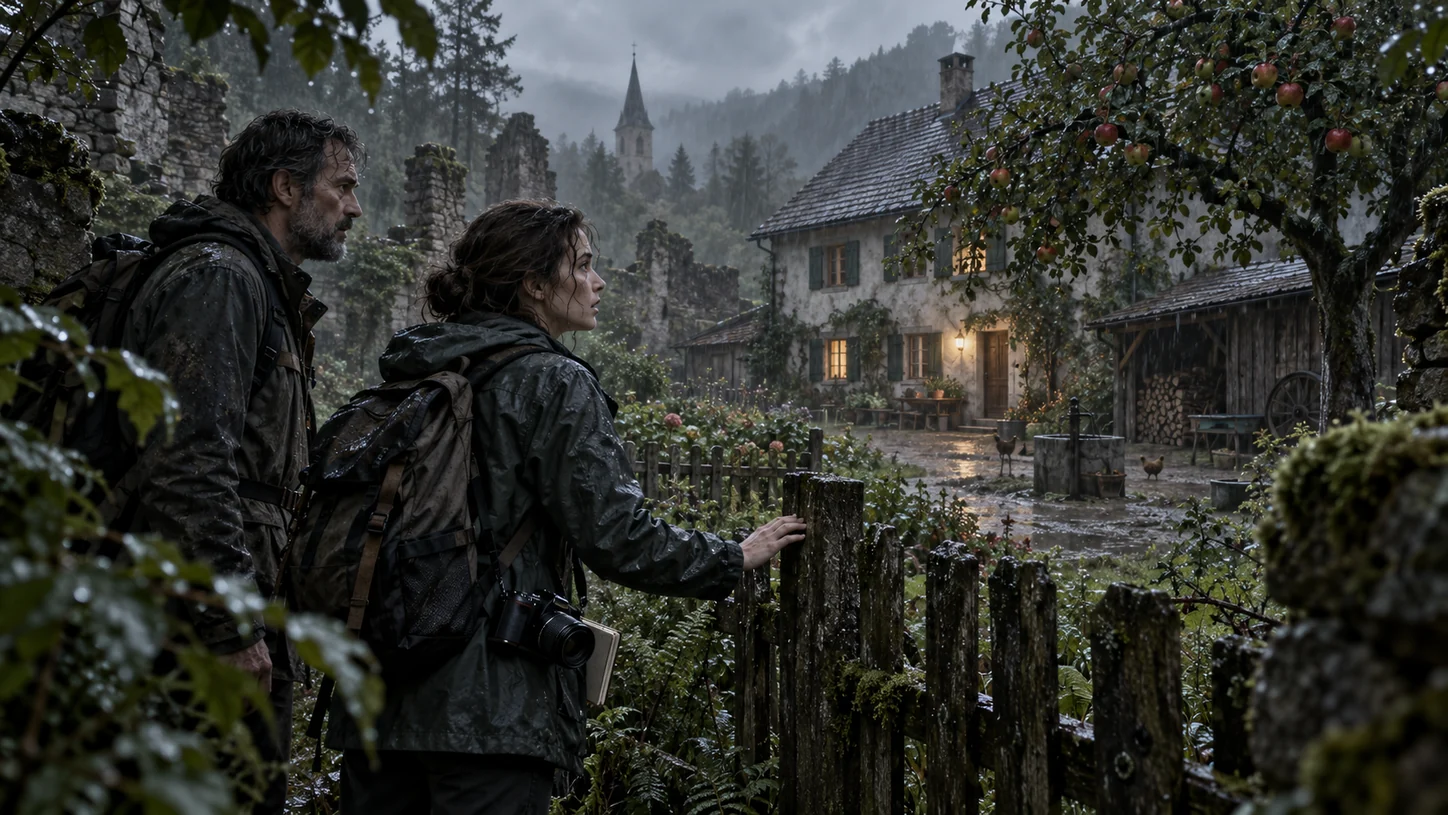
A dog barked ahead, and seconds later they heard children running along a path. Anna lifted her head without asking a question and followed Leonhard to a gap between the trees. There stood a wall that earlier had been only a knee-high foundation among the ferns; behind it rose the roof of a shed, with water running off into a well-kept yard. Leonhard did not go on, but waited until Anna stood beside him looking at the same garden.
“We didn't walk past here without seeing the house,” she said at last. She went back a few steps, searching for the angle from which she had photographed the ruins, but now the path ran between fences. An apple tree stood in the same place, while beneath it a woman lifted a basket from the ground. When she nodded to Leonhard in passing, he returned the greeting and knew no more who she was than he had on his first visit.
Anna photographed the house, then held the camera so she could see both the building and the display. At first the image showed the plastered walls, but when she opened it again, only the overgrown cellar remained. “Please stay exactly where you are,” she asked Leonhard, and moved without taking her eyes off the house. A second photograph showed the ruin again, and Anna slowly lowered the camera while reaching for the actual garden fence with her other hand.
The wood was wet and rough beneath her fingers. Anna ran her hand over it as if she wanted to commit the touch to memory, then took out her pencil. “If I can't capture what I'm photographing, I'll at least write down what I see while I do it,” she said. “You don't have to convince me, Leonhard; right now I'd rather have someone tell me I'm mistaken.” He replied that he had been looking for that explanation since his first evening and led her onward to the mill.
Maria stood beneath the mill's overhang and waited until both were in the yard. Her hair was tied at the nape of her neck, and the gray strands at her temples were clearer than on the first visit. Leonhard introduced the two women and said he had told Anna about Rosa. Maria looked at him but did not wait to hear how much; instead, she stepped aside and opened the kitchen door.
Anna remained in the doorway until Maria had taken her wet coat off a chair. “I want to hear what you know about Rosa,” she said, putting down her backpack. Maria looked at Leonhard, who had not yet sat down. “He'll have to stay, even if he doesn't like what I say.” Leonhard pulled up a chair and sat before Anna could answer.
Anna opened her notebook and set the camera beside it without trying again. She asked Maria to begin with the morning of August 26 and first inquired about their clothes, luggage, and departure. Maria said Leonhard and Rosa had set off shortly after sunrise with two backpacks; Rosa had taken the geologist's hammer from him in the yard because he had almost left it inside. Leonhard did not remember the movement, but suddenly saw Rosa's hand on the leather loop.
When Anna mentioned the pistol, Maria put down her cloth. “The two of them argued behind the mill, but I didn't go outside again,” she said. “I knew nothing about the gun.” She confirmed, in answer to Anna's question, that she had spoken to Karel about the departure afterward; Leonhard and Rosa had wanted to leave early, and she had told her brother she knew. Anna turned back to his account, underlined a line, and asked Maria to continue.
Maria lifted the pitcher from the table and refilled her glass, though she had hardly drunk from it. “Leonhard came back that same evening, August 26, after dark,” she continued. “He beat on the back door, and when I opened it, the frame was about the only thing keeping him upright. Rosa wasn't with him, and at first I couldn't get an intelligible answer when I asked about her.” Leonhard felt his body adjust to the description without giving him a complete memory.
Anna wrote the date in the margin and asked once more whether Maria really meant the evening of August 26. Maria confirmed it and moved her glass beside the pitcher. On Anna's page, several lines remained blank between that entry and the morning of August 28, when Leonhard had appeared at his lodgings.
Josef had helped get Leonhard into bed and tend the wound. When Leonhard could speak again, he told them of a stone and of Rosa lying injured outside; Maria left Josef with him and went. When Anna asked whether she had found her sister, Maria began to answer, then looked at Leonhard. “You still don't know what happened between you out there,” she said. “I've told your story for you long enough, and I don't want to do it again.” Anna laid the pencil across the notebook. “You'll still have to tell me what you found there.”
Maria rose and asked them both to come to the cemetery. She wanted to show Anna where the path back into the abandoned settlement sometimes became visible again. Leonhard followed the women across the yard and stopped in front of a garden whose doorway led nowhere; behind it, grass grew all the way to an old fragment of wall, although a shed had still stood there when they walked to the mill.
Anna stopped beside him and sketched the surviving doorframe in her notebook. Maria studied the wet hinges and said she had once brought an acquaintance to his house here and found no door the following morning. She gave no name, and Leonhard did not ask for one, but followed close behind her.
In the cemetery, a dark stone stood behind the nameless grave that had not been there that morning. Anna moved closer but could read neither name nor date through the running rain. She put her hand on the top edge and leaned forward while Maria stayed a few steps away. A muffled toll came from the village, and beneath Anna's fingers the stone suddenly gave way, though it did not fall over.
Her hand grasped empty air, and she fell to one knee. Leonhard caught her upper arm as she braced her free hand between the stones and drew a sharp breath. He helped her up, but for a moment she kept her weight against his arm and looked past him at the grass now growing where the monument had stood.
“Let me stand like this a moment longer,” Anna asked when Leonhard started to loosen his grip. Maria came closer, but Anna avoided her hand and pressed her injured palm against her own jacket. Only after several breaths did she look down again and ask Leonhard to walk with her to the firm path.
A dull thud came from the fresh grave, and Anna tightened her fingers around Leonhard's sleeve. They went the last few steps back together without turning away from the earth. At the second sound, Maria stopped in front of them; when Anna asked whether she heard it too, Maria answered that she did not want to stay here any longer.
On the way to the mill, Anna held the backpack by only one strap because her other hand hurt. Leonhard offered to carry it, but instead she asked him not to walk so far ahead. In the kitchen, she laid the notebook on the table and began writing while Maria fetched water; Leonhard saw her put the pencil down from time to time and carefully stretch her fingers.