The road to Slavonice lay empty ahead as Leonhard left the woods behind. He followed the familiar turnoffs and braked a little earlier than necessary before every rise until a delivery van appeared in front of him on the edge of a village. He followed its brake lights for several kilometers, even though the driver had tried to let him pass at a pullout.
At the guesthouse, he took a long shower and changed into dry clothes before setting the laptop on the small table by the window. Outside, a tour group stood before the facades while the delivery van continued along the lane Leonhard had just turned off. He took the field notebook from his backpack and checked the previous night's entries. Beneath Rosa's name, his writing slanted downward as though he had stopped paying attention to the line; he crossed nothing out and began searching for her.
The first results led to other people, and Leonhard realized how little he knew about a woman with whom he had apparently intended to begin a life. He knew neither her date of birth nor an address that might have been recorded outside the valley. When he narrowed the period to the late summer of 1995 and added place-names from the border region, he finally found a scanned newspaper article. It appealed for information about a twenty-eight-year-old Rosa Hadrava who had not been seen since August 26.
He read the few lines several times, then searched for later reports until he realized he was expecting the wrong thing. Nowhere was there any mention of a body being found or a death being established; Rosa remained a missing person, even in the second article, published a few weeks later. That one mentioned possible foul play and the questioning of people who knew her. Leonhard rested his hands beside the keyboard and knew that he must have been one of those people, though he could not remember a single police officer.
That afternoon, he called Markus Heller, the head of the project that had brought him back to the area. He told him about the old field notebook and a missing-person case that seemed connected to his mapping work, but left out everything that had happened during the previous night. “I need someone who knows the regional collections and can tell me whether there were other reports at the time,” he explained. “It's about a woman named Rosa Hadrava, and apparently I knew her better than I realized until yesterday.”
Heller first asked about the three stream crossings. Leonhard looked at the open map, still marked exactly as it had been that evening in Vienna, and had to admit he had checked none of them. “Then please don't leave me standing on the wrong bank later with your old sketch,” Heller said. “We'll postpone the comparison, but get in touch before you head off alone again.” Only then did he mention Anna Berger in Waidhofen, who had worked on unsolved cases in the border region; Leonhard wrote down the contact information and promised to call again that evening.
At first Anna Berger listened on the phone without showing any particular interest. Only when Leonhard gave his full name did she ask him to explain again why he was looking for Rosa. “I think I was with her back then,” he said, looking at the ragged edge of a missing page. “I've found notes I can't explain, and since coming back, individual memories have started returning.” Anna suggested a meeting at her office and asked him to bring the field notebook, without asking more about the memories over the phone.
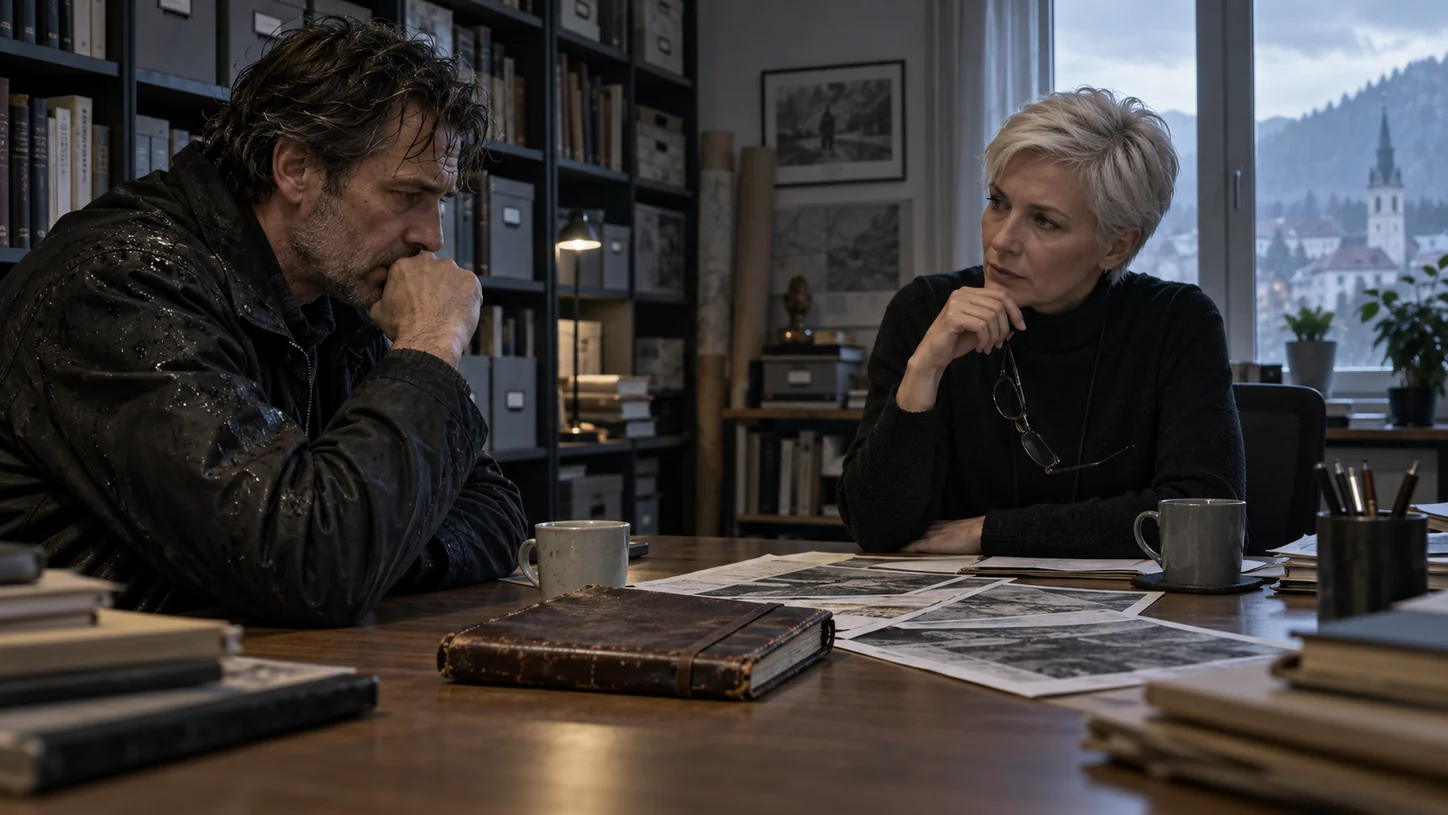
The office was in a renovated building near the center of Waidhofen. Leonhard found a practical room with bookshelves, labeled boxes, and a large worktable where Anna had set out two cups. She was about his age, wore her almost white hair short, and took her glasses from the cord around her neck as soon as he sat down. Her friendliness seemed neither welcoming nor guarded, but like the beginning of a conversation whose direction she wished to keep open.
“First tell me what you remember yourself, before I show you anything from my records.” Anna moved her cup aside and initially left the table between them empty. “I don't want you to mistake one of my phrases for a thought of your own afterward.” Leonhard told her about the mapping for his thesis, the missing entries for the three days, and the name Arnolzheim, which he had been unable to find on any of his maps. He said nothing about the mill or the women there, though every omission made him aware of how incomplete his explanation was becoming.
When he said he and Rosa had intended to leave together, Anna leaned back. “That isn't how you presented it at your first interview in 1995,” she observed, waiting for him to go on of his own accord. “Back then you called Rosa a casual acquaintance you'd met occasionally during your mapping work.” Leonhard studied the empty tabletop and said that statement could not be right; he had loved Maria and yet intended to begin a new life with her sister.
Anna let him finish but did not slide the first sheet toward him yet. “What do you remember when you say you wanted to begin a new life with her?” Leonhard began with Maria's face in an open doorway, then faltered when he would have had to explain how he knew the rest of the context. Anna waited until he admitted that not everything had come back as an image of his own, and only then made a note.
She took a slim gray folder from the shelf and explained that her research project at the time had been allowed to examine selected records and authorized extracts concerning the case. She laid three working copies in front of Leonhard, wiping a coffee ring from the tabletop with her sleeve before setting down the last sheet. “These extracts are all I have here. They should be enough to begin with, and the other questions will still be waiting for us.”
The first summary concerned Rosa's disappearance. Personal belongings and bloodstains had been found on a forest path, but neither the missing woman's subsequent movements nor the origin of all the traces had been established. Leonhard looked for a reference to the amount of blood and asked Anna about it. “There's nothing more specific here,” she said, bending over the sheet while his finger stayed at a line beneath which the next finding had already begun.
When Leonhard asked whether some of it could have been his own blood, Anna held the third sheet against the table with one hand. “So you know about your injury. When did you remember that?” He told her about a pain in his left flank and his hand pressed against the soaked shirt, once again leaving out Rosa in the cemetery. Anna waited so long after his answer that he almost continued; then she wrote something beside today's date.
The second sheet contained an extract from his interview on August 29, 1995. Leonhard recognized his former address and the signature beneath an account he could not remember. He had denied any close relationship with Rosa and initially claimed he had been mapping alone during the crucial days. Reading it, he felt ashamed of the young man whose handwriting was so familiar, although he did not yet know whether that man had lied or genuinely no longer remembered anything.
In a later interview, he had admitted to the walk together and mentioned Arnolzheim. Leonhard placed his finger on the place-name while Anna turned the sheet a little toward him. “You described a route they couldn't find. At the next interview, you said you must have gotten the name wrong.” Leonhard read that paragraph too before turning the page; his signature beneath it was scarcely different from the first.
“Which of those statements did they believe?” Leonhard asked, even though Anna had not been present at any of the interviews. She took off her glasses and laid them beside the copies. “I don't know, and I'm not going to choose the one you could most comfortably go on living with now.” He pulled the sheet toward himself again without looking at her and had to read the line containing Arnolzheim a second time.
The third extract concerned his medical treatment. On the morning of August 28, Leonhard had appeared at his lodgings and been taken to the hospital with a gunshot wound in his left flank. The summary of August 29 mentioned blood loss, exhaustion, and his incomplete account of what had happened. He looked for a continuation on the back as well, but Anna only had that one sheet.
Leonhard had never forgotten the scar on his side; only its cause had become an accident in the field over the years. He remembered bandages and pain when he sat up, without connecting those images to a gun anymore. Now before him lay the description of an injury his body had kept while his memory gave it a different history.
Leonhard looked at the two dates, which would not fit into a single journey home. Maria had spoken of his return on the evening of August 26, while the ordinary world had not gotten him back until the morning of August 28. All he said was that there was still time missing between the shot and his lodgings. Anna pushed the glass of water toward him and waited until he looked up from the papers.
“It wasn't just a matter of telling them where you'd been,” Anna said. “The investigators wanted to know what there was between you and Rosa. At first you acted as though there had been almost nothing.” Leonhard asked whether they had thought him a murderer, and Anna set the medical report beside the interview again. “Read your first answer once more. I can understand why they didn't simply believe you.”
He wanted to know what had become of Maria, and Anna's expression told him he had asked a question whose answer she had so far spared him. She explained that Rosa's twin sister was also listed as missing, since August 28, 1995; no confirmed later contact had been documented. Their younger brother Karel, however, had been living in Brno according to her research at the time. Leonhard stood and went to the window because he could not reconcile the gray-streaked woman in the mill with a disappearance thirty-one years earlier.
Anna let him look outside for a while before asking more. “You're not reacting like someone who only wanted to know where a former girlfriend moved.” Leonhard kept his hand against the window frame and admitted he was withholding an essential part of the story. “I don't yet know how to tell it without making you think everything else is nonsense too.” Anna replied that she would not promise to believe every explanation, though she at least accepted that his concern was sincere.
Anna searched for current contact information for Karel and compared an entry in an association directory with her older records. She put a question mark beside one number while Leonhard tried to recognize something of Rosa's brother on the screen. He wanted to go to Brno and asked whether Anna would accompany him. She left her hand on the mouse and looked at him over her glasses.
“I can ask whether he'll see us,” Anna said. “But I'm not coming along to explain to him why he should believe you.” Leonhard replied that what he needed was someone who would not accept everything he said, and saw that she did not simply take that statement on trust either. She copied the number and laid the pen across it. “Before I go into the woods with you, you'll tell me the rest.”
Before leaving, Leonhard also asked about the gun. Anna found no reference in her extracts to a pistol having been recovered and wanted to know whether he had an owner in mind. “I think Rosa had it with her,” he replied, but added that he could not yet remember the weapon itself. Anna did not add the name to her notes, but asked whether he wanted to discuss that with Karel as well.
She reminded him of Karel's statement that Maria had known nothing of their plans. Leonhard cited the mill's open door and the fact that Maria had seen him with Rosa, but Anna shook her head. “The fact that she saw you doesn't tell us what Karel knew about it. I want to hear what Maria herself told him.” Leonhard left the copy where it was instead of defending his claim a second time.
Outside the building, Leonhard stood in the bright daylight until he took the phone from his pocket. He called Heller, told him about the trip to Brno, and asked him to leave the three crossings unresolved for now. Heller wanted to know when he could expect a new appointment; this time Leonhard did not give one, but told him instead that Anna would be coming along. Only then did he go to the car.