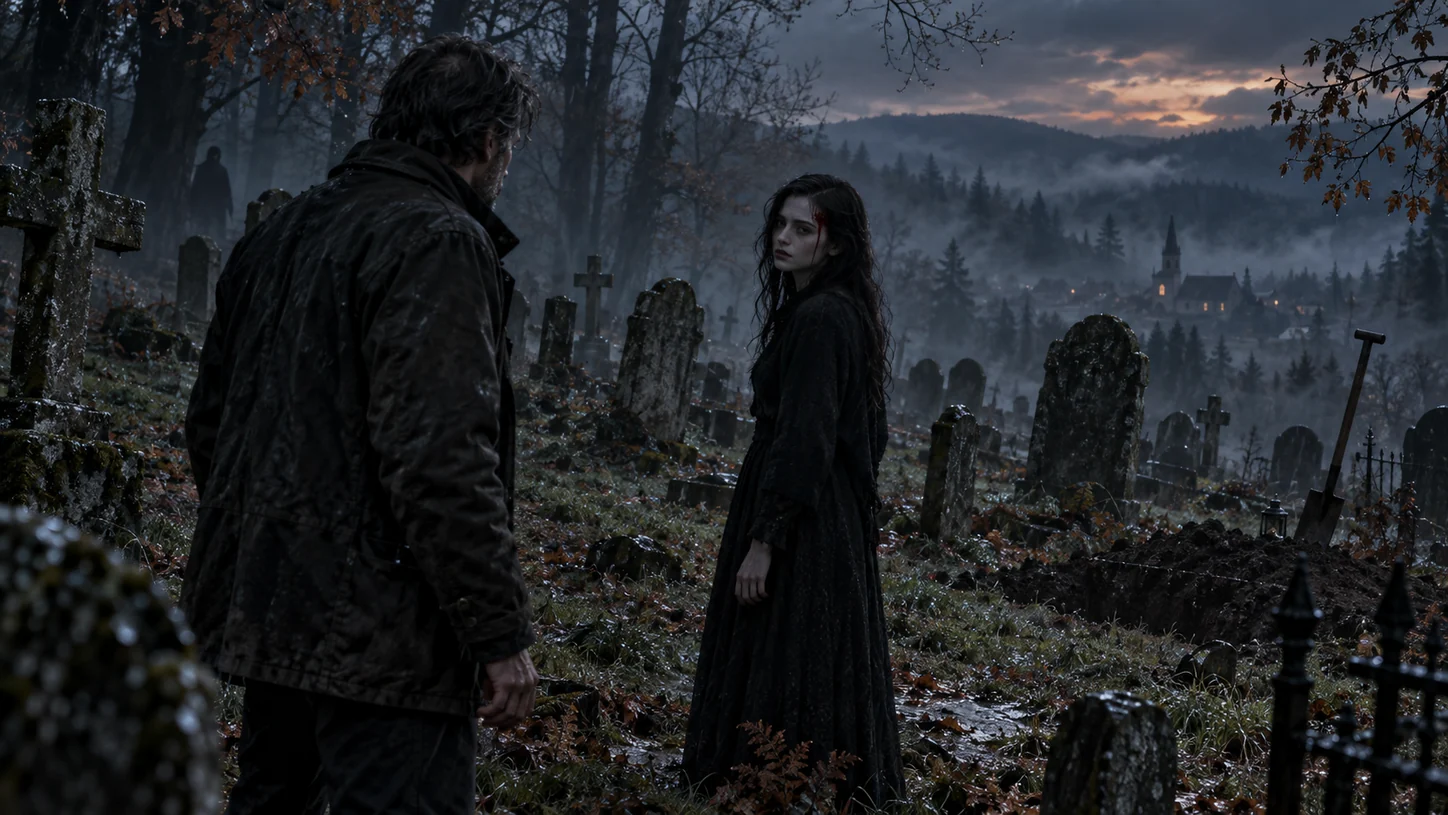
Rosa was still outside the window when the fifth toll had faded. Leonhard waited for her face to vanish when he moved his head, but the woman outside remained in the same place. Rain ran through her hair and dripped from her chin onto her pale blouse, while the dark trail of blood at her temple stayed unchanged. Her hand slid a little across the glass, leaving a narrow, clear patch in the condensation beside the first print.
Maria watched her sister with a strained composure that Leonhard now understood as a warning. He waited for her to open the door, or at least fetch a cloth for the blood, but she stayed beside him. “She doesn't want to come in, at least not like this,” Maria explained when he asked. “Rosa would use the door if she wanted to talk to me; the window is for you.”
“You talk about it as if it's happened many times before, and perhaps that's what frightens me most.” Leonhard kept his eyes on the woman outside the pane, whose hand still rested against the glass. “Your sister is hurt, Maria, and I'm supposed to stand here and be told she has different intentions from someone who needs help.” Maria replied that there was nothing more she could do for Rosa's injury, and the sadness in her voice stopped him from asking another question.
At the sixth toll, Rosa took her hand off the glass. Slowly she turned away from the window, walked a few steps across the yard, and stopped as though waiting for Leonhard to follow. He already had his hand on the doorknob when Maria caught his forearm and reminded him that there was little time left before the final toll.
“A moment ago I wasn't supposed to follow a familiar voice, and now you're letting me go out to her.” Leonhard had opened the door only a crack when Maria pushed into his hand the backpack he had left in the kitchen. “Because you'll go anyway as soon as I let you,” she answered. “But don't stay with her until the final toll, whatever she promises you.” He took her warning outside with him, not knowing whether she distrusted her sister or something else waiting for him along with her.
The village had fallen quiet. Only an older woman remained at a well, hauling up a bucket; when she noticed Leonhard, she made a hurried gesture with her hand and disappeared through a doorway. Shutters were being closed and lamps lit, and everywhere there was a sense that people were preparing not for an ordinary night but for something that had to be kept outside.
Rosa waited at the edge of the yard. Up close, Leonhard saw the resemblance to Maria even more clearly, but the most disturbing difference was equally apparent: Rosa had not aged with her sister. She looked like the twenty-eight-year-old woman in the 1995 photograph, except for the dark trail of blood at her temple. Rosa seemed slighter and at the same time more determined, her gaze more impatient, and the way she tilted her head a little forward reminded Leonhard of the woman's voice he had heard beside the apple tree.
Leonhard said he had already heard her voice by the apple tree, before Maria came to him. Rosa glanced toward the open entrance to the mill, where her sister was still standing, and for a moment the impatience left her expression. “Then more is coming back than Maria hoped,” she remarked, before crossing the yard. Leonhard followed and asked whether every explanation in this family began with a walk, making Rosa laugh quietly and glance sideways at him.
“You used to walk to the cemetery with me quite often,” Rosa said, picking a branch off the path. “Once you claimed you still had something to measure so Maria wouldn't come along. I waited the whole way for you to take out your map.” She threw the branch over the fence and walked on while Leonhard searched the young man in the photograph for something that would contradict this small deception.
A dull strip of evening light still lay above the roofs, but the lane ahead was empty now. As they passed a house, a shutter was pulled closed from inside; Rosa waited until Leonhard was level with her before continuing. He smelled the damp wood smoke and heard his soles on the gravel, while her footsteps were barely audible.
When they reached the last houses, Leonhard reminded her of Josef's warning. “He advised me not to follow everyone who knows my name, and you're not doing much to prove him wrong.” Rosa went a few more steps before stopping to ask the real reason for his hesitation. “I'm trying to understand whether I'm speaking to an injured woman or to someone who has been dead for a long time,” he answered, hardly recognizing his own voice.
Rosa brushed the wet hair from her cheek, though she only spread more blood onto her fingers. “Outside, I've been dead since August 26, 1995, and I don't intend to make that any easier for you to hear.” She watched him until he had done more than hear the year, until he had connected it to the missing days in his field notebook. “We left together that morning, Leonhard, because you had promised you would never bring me back.”
“Then I wanted to leave with you, not merely find the way to Arnolzheim.” Leonhard spoke slowly, because each word altered part of the picture he had held of that summer. Rosa confirmed that this had been their shared wish at first, stressing the qualification so clearly that he involuntarily looked at her. He thought of Maria's account of how he had stood in the mill that evening without her sister.
The path led to the cemetery. Unlike that afternoon, the wall was intact, the grass short, and small lights burned among the tended graves. Leonhard found Josef's stone in the same place as before, except that the porcelain portrait was now missing. Rosa explained that outside, Josef had a grave there; here, he did not need one. She spoke not as though this were normal, but simply as something whose contradiction she had long grown used to.
The fresh grave lay at the far edge of the cemetery, and Leonhard stopped. In this version of Althütten too, the soil was dark and loose and the wooden cross nameless. He did not like the thought of the same mound existing both in the deserted cemetery of the present and in this living village. Involuntarily, he remembered the muffled blows he had heard beneath his feet that afternoon.
Leonhard pointed to the fresh mound and said he had thought it was her grave. Rosa stood at its foot without stepping on the loose earth. “You see a dead woman beside a grave and think that settles who it belongs to,” she said, her gaze lingering on the nameless cross. “This isn't my grave, Leonhard, and you shouldn't try pulling out the cross today just because there might be an answer underneath it.”
He sat on a low stone beside the path and asked why she had needed to escape from the valley when her brother had long been living in Brno. Rosa stood in front of him and slipped her hands beneath her backpack straps as though she still carried the burden of that time. “I could visit Karel, sometimes for two nights, and I could go to Slavonice to buy things. The valley let me go as long as I knew I would come back; it was only when I wanted to stay away that I discovered leaving and staying away weren't the same thing.”
She told him about Karel's guest room in Brno, where for the first time she had not left her things in her bag. The next morning she had woken up in the mill again; the bag stood beneath the window, although the night before she had put everything in someone else's cupboard. “Karel asked why I hadn't at least told him I was going home. I didn't even know myself how I'd gotten back.” Rosa brushed the stone beside her before sitting down, without looking toward the village below.
“I wanted to have a room someday that I could pay for myself,” she said. “It could have been small, but it had to have a table by the window. At the mill I always had to clear things away when someone needed the space; even an open book was in somebody's way.” Leonhard asked whether she had told him about it, and Rosa looked at him for a long time. “You were going to give me your old desk. I was already wondering whether I'd have to unscrew the legs to get it up the stairs.”
Leonhard remembered the desk, but not offering it to Rosa. He had kept it long after college, until during a move it no longer fit through the door; now he held his hands on his knees while she sat beside him waiting for an answer. “I can't remember everything I promised you,” he said at last. Rosa moved a little farther away. “You said we'd look for somewhere small in Vienna first. I would have worked too, Leonhard. I wasn't just looking for a place to stay with you.”
He asked whether she would have believed him if he had merely shown her a way out of the valley and promised nothing else. Rosa looked at his hand lying close to hers without touching it. “I wanted to go with you even though you were Maria's boyfriend. I found plenty of other explanations for it then, but you don't have to help me with that now.” Only when Leonhard looked up did she add that his doubts had begun beyond Arnolzheim.
The seventh toll rose from the village, and Leonhard stood, remembering Maria's warning. Rosa remained seated another moment and rested her hand where he had just been. “I'm not holding you back, but don't go yet,” she asked. When he stopped, she looked up at him and only began speaking after the bell had faded.
“Don't ask Maria why we argued or how I fell against the stone,” Rosa said. “She wasn't there for what happened between us on the path; you'll have to tell her that yourself.” Leonhard wanted to know what his former girlfriend could tell him, then. Rosa looked him in the face and answered, “She can tell you how you came back and what she saw when she looked at you that evening.”
Leonhard asked what she meant, and Rosa lightly pressed two fingers against his chest. “You were covered in blood, and it wasn't all mine,” she explained, while the image of a wet forest path broke open inside him. He saw his own hand on a soaked shirt and felt a stabbing pain in his left side. The gunshot he thought he heard a moment later made him flinch so violently that Rosa withdrew her hand.
“You had a gun with you, and I think you shot me.” Leonhard caught her arm as she started to turn away and encountered solid skin whose cold seeped through his fingers. Rosa looked at his hand and asked him to let her go so quietly that he obeyed at once. Only then did he notice she was no longer looking at him, but past him among the graves.
A few rows away stood a man who had not been there seconds before. At first Leonhard saw his back and dark clothing, its fabric showing no lighter patch even in the rain. When he asked whether Rosa knew the man, she shook her head and moved closer to the path. “Go back to the mill now, and don't try to make out his face,” she said without looking at the stranger.
As the man turned toward them, the last light between the trees fell on the place where his face should have been. Leonhard could make out neither eyes nor a mouth, though the outline of the head stood distinctly against the paler stones. Rosa moved between him and the figure and urged him toward the gate with a gesture, while she herself remained in the middle of the path.
Gravel crunched behind Rosa, and Leonhard ran for the gate without reaching for her again. He heard the footsteps as he ran down the slope, slow and even while his own soles struck the path ever faster. Even beyond the first bend, the crunching stayed so close that he hunched his shoulder as though a hand might reach it at any moment.
At the eighth toll, he reached the mill yard. Maria was already waiting in the open doorway; she pulled him inside, slammed the door, and slid the heavy bolt into place. Only when Leonhard leaned against the wall, gasping for breath, did he notice how silent the village had become.
Outside, the footsteps drew closer and stopped immediately in front of the door. Maria put out the lamp before Leonhard could say anything. In the darkened room, they both heard a faint scratching over the wood, as slow and steady as someone drawing a fingernail down the door from top to bottom. The sound went on long enough that Leonhard almost forgot to breathe again, then the footsteps moved away.
Once Maria had relit the lamp, Leonhard told her what Rosa had said and about the gunshot in his memory. Maria pulled a chair up for him and waited until his breathing had eased before sitting down herself. “You came back on the evening of August 26 with a wound in your left side, and at first I couldn't understand how you'd managed the journey at all.” She watched his hand stray involuntarily toward his flank and told him Rosa had not been with him.
“You took me in anyway, even though I'd left with your sister that morning.” Leonhard waited for an accusation, but Maria only brushed the damp hair from her forehead and looked at the closed door. “I saw the man I loved, and I was afraid he would slip away from me at any moment. Everything else came later, when I could think again.”
Leonhard asked what he had told her when he returned, and Maria explained that at first he had barely been able to speak intelligibly. “You said Rosa's name and mine, and in between you kept saying you wanted to come back.” She looked up when Leonhard asked whether he had meant the valley. “You wanted to come back to me, Leonhard, and back then I held on to that sentence because otherwise I wouldn't have known what to believe.” He laid his hands on the table and began to understand that the lost days had not been taken only from him.
Before Leonhard could ask the next question, a floorboard creaked above them, and Maria froze at the sound. She lifted her head and listened as a second creak moved nearer the stairs. When Leonhard asked who was upstairs, she shook her head without rising. “There's no one up there that I let into the house today,” she said, and only then did he notice her fingers had closed around the table's edge.
The footsteps reached the hall above and stopped before the staircase while Maria reached for the lamp with her free hand. Leonhard waited for an inhabitant to call out, or for an explanation that would turn the house back into an ordinary mill. Instead, he heard the wood give beneath a weight slowly shifting onto the first step.