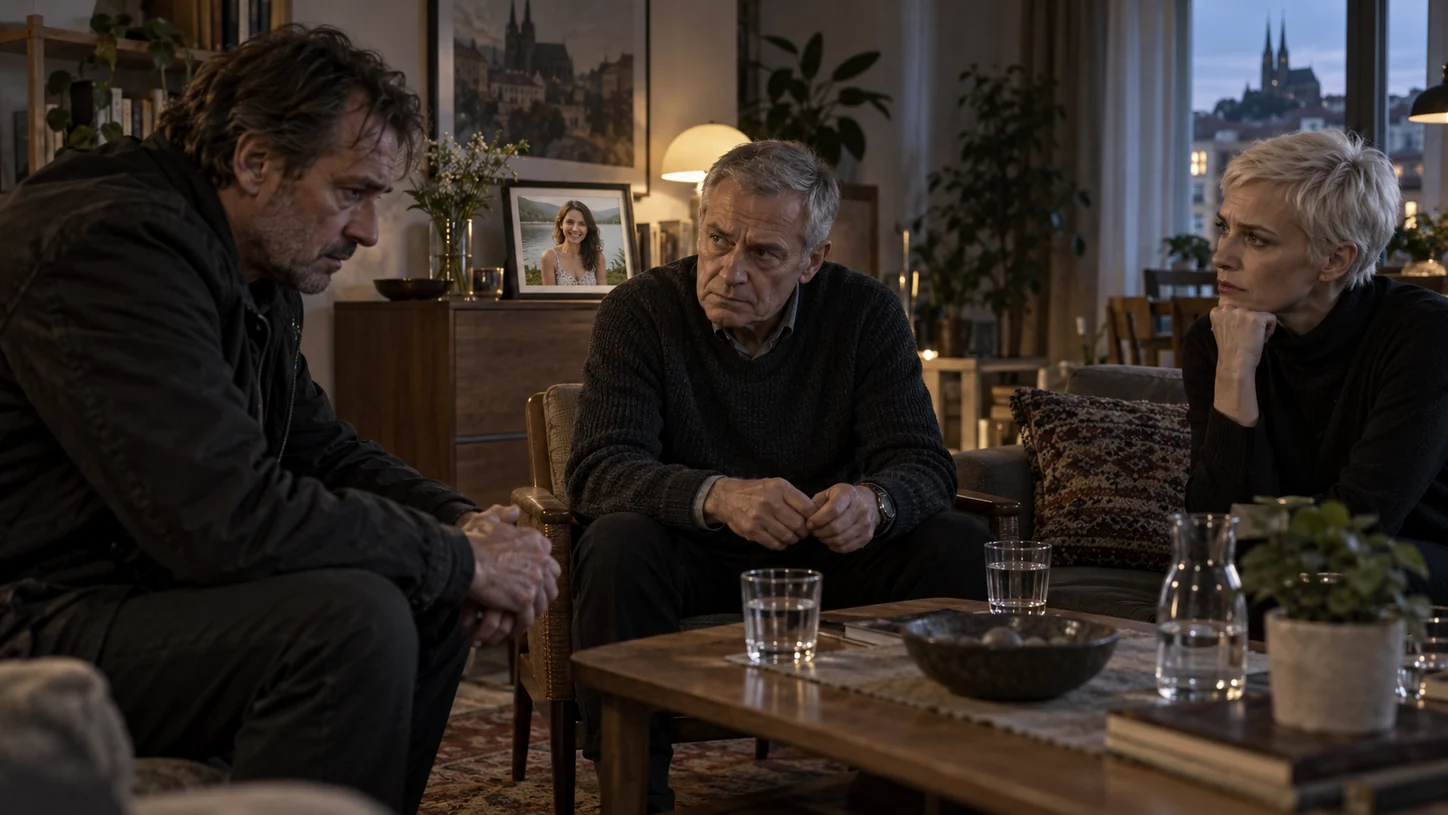
Anna called Karel Hadrava the next morning. The contact at the association had given her a current number, but she did not mention Leonhard until the man on the other end confirmed he was Rosa's brother. Leonhard sat across from her and watched Anna slowly straighten as she listened. When his name came up, she put down the pen she had been using to note the address and let Karel finish without interrupting him with soothing remarks.
After hanging up, she looked at Leonhard across the table for a while. “At first he didn't want to see you, and the gaps in your memory didn't improve his mood,” she explained. “In the end he suggested we come himself, but you shouldn't take that as a willingness to reconcile.” Leonhard had not expected a man whose two sisters had disappeared to receive him warmly after thirty-one years anyway.
On the drive to Brno, the woods grew sparser and the traffic denser, until Leonhard registered the landscape only as movement beyond the glass. He thought of Rosa outside the window and wondered whether Karel had kept a similar memory of her or merely a photograph that grew more unfamiliar every year. Anna let him sit in silence for a long time before asking what he hoped to gain from the conversation. He replied that perhaps her brother knew the part of the story he himself had lost; perhaps, though, in all those years he had merely devised an explanation that now felt like a memory.
“I want to let him talk about Rosa first,” Anna said, waiting behind a truck until the opposite lane was clear. “You don't have to answer every accusation, however difficult that may be.” Leonhard looked at the road ahead and wondered which accusation he actually had an answer to yet. When Anna passed the truck, he held on to the handle above the door and only noticed after a while that he was still gripping it.
Karel lived in a renovated apartment building whose balconies were crowded with bicycles, flower boxes, and folded drying racks. The smell of frying onions came from an open kitchen door off the stairwell, and somewhere a child was arguing with their mother about why they weren't allowed out yet. Leonhard found the ordinariness a relief until Karel opened the door and at first merely looked at him without speaking. The man was shorter than he was, with close-cropped gray hair and the appraising gaze Leonhard knew from both sisters.
Karel greeted Anna and only then let Leonhard enter. “Keep your jacket on for now. I don't know how long we'll be talking.” He closed the door behind them and went ahead without checking whether they both followed. Leonhard had been about to set his bag down and picked it up again while Anna silently took her place beside him.
A photograph of Rosa beside a lake stood on a chest in the living room. She wore a pale T-shirt, held her hair against the wind, and was laughing at something that must have happened outside the frame. Leonhard stopped before it because, since his return, he had pictured her almost exclusively with the injury at her temple. This young woman seemed to be waiting not for an explanation but for someone finally to stop taking photographs and walk on with her.
“That was the summer of 1994, a year before you came.” Karel moved the photograph aside so Leonhard was no longer standing directly in front of it. “She complained because her eyes are half closed in it. She wanted me to throw it away, but I don't like the other pictures from that day as much.” Leonhard said Rosa looked happy; Karel brushed a trace of dust from the frame and left the photograph where it was without answering the remark.
They sat at the living room table, where Karel had set out water and three glasses. Leonhard explained that he had been with Maria and had intended to leave the valley with Rosa on August 26; so far, he remembered what followed only in fragments. Karel waited until he finished, then asked how much of that was actually memory. Leonhard admitted that other people's accounts and his own images had begun to overlap, and watched Karel close his fingers around his untouched glass.
“Back then you said you couldn't remember too, whenever a question became uncomfortable.” Karel did not raise his voice, which made the accusation harder for Leonhard than an open outburst would have. “I don't know whether it's true, but I've lived for thirty years with the possibility that you know exactly what happened to my sister. Don't expect me to set that possibility aside the moment you step through my door.” Anna let the sentence stand, and only then asked Karel to tell them about the last time he had seen Rosa.
Rosa had visited him in Brno a few days before her disappearance and asked what a small room cost outside. Karel had been glad she finally wanted to know something specific instead of just talking about Vienna again; it was only later that evening that she mentioned Leonhard's name. “I knew about you from Maria,” he said. “Rosa assured me the two of you had been over for a long time. I asked why Maria was still telling me about you, then, and suddenly Rosa couldn't see what business it was of mine.”
Anna wanted to know why Rosa needed a special route at all if she could visit Karel. Her brother glanced at the photograph on the chest and explained that Rosa had come for a few days several times, but had always left again. Once she had meant to stay longer and put her clothes away, only to disappear the next morning without waking him. “I accused her of cowardice,” he said. “She just insisted she hadn't gone back of her own accord; at the time I thought it was a convenient explanation, and to this day I don't know how she got home that night.”
Leonhard remembered Rosa's words in the cemetery but did not reveal where he had heard them. Karel lifted the water bottle but refilled only Anna's glass before putting it down again. Leonhard reached for it himself, and for a while the only sounds in the room were the gurgling of the bottle and voices in the courtyard.
“Did Rosa mention Arnolzheim?” Leonhard asked after Karel had fallen silent. Her brother pushed his glass away and, for the first time, looked at him not merely appraisingly but with real attention. “At some point she used that name more often than Vienna,” he answered. “It was a family story that went back to Josef, and Rosa believed you, of all people, could turn it into an actual route.”
The stories about Josef Hadrava had been passed down through the family long after his grave was made in 1946. At first Karel had thought Arnolzheim a vanished place about which the old people had preserved more stories than verifiable details. It was only when Rosa began asking about old paths and crossings that he realized how seriously she took those stories. Leonhard thought of Josef in the mill and could not keep Karel from noticing his hesitation.
“So you found his grave too,” Karel said after Leonhard mentioned the porcelain portrait. “I remember the photograph, but I haven't been there in years.” He looked toward the window while Leonhard considered whether to speak about the encounter in the mill. Anna looked up from her notes, but Leonhard said nothing further about Josef.
Anna asked what Maria had told him about Rosa's planned departure. Karel looked at Leonhard and wanted to know whether he really remembered Maria seeing him with Rosa. When Leonhard described the open door, Karel moved his glass out of the wet mark on the table. “She spoke to me afterward,” he said without looking at either of them.
“Maria knew Rosa wanted to leave with him the next morning. She asked whether I'd bring her to Brno if she needed help out there.” Karel ran his thumb around the rim of his glass. “When the police questioned me, I said Maria had known nothing about it. I didn't want them going after her too, as though she'd done something to Rosa out of jealousy.” Anna only asked whether that had been his decision at the time; Karel confirmed it and took his hand from the glass.
Anna asked why he had visited on August 25, but Karel did not answer at first. He stood, took the bottle into the kitchen, and stayed there so long Leonhard was about to get up. When he came back, he did not sit; he stood before the chest and reached for the photograph, only to let go of it again.
“It was about my pistol,” Karel finally said to the wall in front of him. “Rosa had taken it from my apartment, and I wanted it back.” Leonhard felt the scar beneath his shirt while Karel turned around and went on. He had practiced at a shooting range and had the necessary papers; Rosa knew he owned a gun, and after her visit it was missing. Anna put down her pen before asking whether he had told anyone at the time.
Karel sat down in his chair again. “At first I just wanted to get it back without getting Rosa into trouble. Behind the mill I told her it wasn't a toy, but she didn't want to be out there without protection.” He rubbed his palms against his pants and looked at Leonhard. “I asked whether she was afraid of you too. She laughed as if I'd said something especially stupid.”
Maria had been inside the house during the argument; when Karel later spoke to her about the departure, he did not mention the pistol. “I could have waited until Rosa had calmed down,” he said. “It wasn't even dark yet, and I could have stayed all night.” He looked past Leonhard at the apartment door. “Instead I drove home and waited for her to call.”
Anna asked whether the police had learned about the gun once Leonhard's injury became known. Karel shook his head and started to explain that he had not wanted to hurt Rosa, but broke off in the middle of the sentence. “They would have asked why I'd left her the pistol,” he said after a while. “And where I'd been afterward.” Leonhard was still holding his glass and put it down without drinking.
Karel had tried to return to Althütten on August 27 because neither sister had been in touch. He had taken the usual roads and parked where he used to begin the last stretch on foot. In place of the mill he found overgrown walls, and the houses he had seen on the evening of August 25 were gone. “I went back twice and tried a different approach,” he said. “In the end I was standing in front of the same cellar again, not knowing whether I was losing my mind or whether two days were missing from my life.”
Anna asked about the possibility of a mistake without putting any particular emphasis on the word. Karel pointed at the photograph and explained that he had spent the summers of his childhood in that area and knew which side of the mill the stone steps down to the stream were on. “I found the lower steps, but above them was undergrowth that couldn't have appeared in one night.” Leonhard looked at Anna and knew she was now hearing the same impossibility from a second person who had no reason to clear him of blame.
Karel only learned of Leonhard's reappearance outside the valley later, in connection with the investigation. The morning of August 28 was given as the time of his return to his lodgings, while there was no confirmed sighting of Maria anywhere after that day. Karel had searched for both sisters and eventually done nothing but answer inquiries that grew less frequent with time. He spoke without dramatic details, as though the years of waiting had long since lost any memorable shape.
“I always believed she shot you,” Karel said as Anna turned a page of her notes. “Sometimes I hoped she'd used it to keep you away and had simply gone on. Then at least she would have arrived somewhere.” Leonhard tried to answer, but managed nothing beyond admitting he still did not know. Karel gathered the glasses together and did not ask how much longer he would have to wait for a different answer.
Anna asked whether Karel would be willing to tell the investigators about the pistol too. He turned toward the kitchen with the glasses and said he would have to think about it. She let him reach the door before reminding him that he had asked Leonhard here precisely because he should no longer remain silent. Karel stopped but did not answer, and Anna did not withdraw her request.
When Karel came back from the kitchen, Anna and Leonhard were already standing beside their chairs. Leonhard put on the jacket he had draped over the back despite Karel's greeting and looked once more at Rosa's photograph. “I don't know whether she would have been happy if we'd kept going,” he said. Karel stepped beside the chest and looked at him. “That wasn't what I wanted to ask you today.”
On the threshold, Leonhard said he would keep asking questions and would not bring Karel a story simply because it was easier to bear. Her brother listened, and only then offered his hand. Outside in the hall, Leonhard still had on his lips the unused parting phrase with which he usually ended a difficult conversation; when the door closed, he was glad he had not said it.