Someone in the yard pushed a wheelbarrow beneath the overhang, and farther down by the stream a boy was pulling a branch from the water. His mother called him back before he could lean any farther over the edge. Leonhard watched them until they disappeared between the houses; he could imagine standing at this window again the next morning, waiting to see what happened in the village.
Maria cleared the mugs from the table while her question about Karel still hung between them. Leonhard waited until she turned toward the pump before answering. “You can tell him I don't know how to explain all this.” Maria set down the pitcher but did not turn to him. “I could say the same about myself, and then he'd have no answer at all again.”
Leonhard sat in the chair Anna had left and reminded Maria that she, too, had kept silent for a long time. He heard the accusation in his voice and waited to see whether she would defend herself. Maria took the dish towel off its hook and looked at him. “I didn't tell him,” she replied. “I still know that, even without you reminding me.”
She dried the same mug a second time and set it so close to the edge of the counter that Leonhard pushed it back a little. “When I talked about Rosa back then, it was always about how I'd been with her,” she said. “I could tell people what I'd done for her, and after a while I knew the sentences before anyone asked.” Leonhard waited, but Maria ran a finger over a wet patch on the pitcher and took a long time to continue.
“I wanted her to lose,” she said at last. “That night, after I saw the two of you, I imagined you standing at the door again, alone. So she would know what it felt like.” Maria looked at Leonhard and shook her head when he tried to speak. “When I found her under the beech, that was my first thought. Not for long, but I did think it.”
Leonhard reached for her hand, but Maria returned to the pump with the towel. She had held her sister's hand as she died, Maria said, and had still thought from time to time about the man lying in her bed. Then she turned the pitcher in the water and said nothing more until Leonhard stood and came to her side.
“You didn't push her against the stone,” he said. “That was me, and I didn't even know what you'd wished for.” Maria set the pitcher on the counter and looked at him. She did not argue, but picked the pitcher up again when he reached once more for her hand.
At a toll of the village bell, Maria turned her head toward the window. She went over and pulled the shutter to while Leonhard watched. He asked whether she could sleep here at all without listening to every sound. Maria kept her fingers on the fastener and said that was sometimes the first thing she checked on waking: whether she had really closed it the evening before.
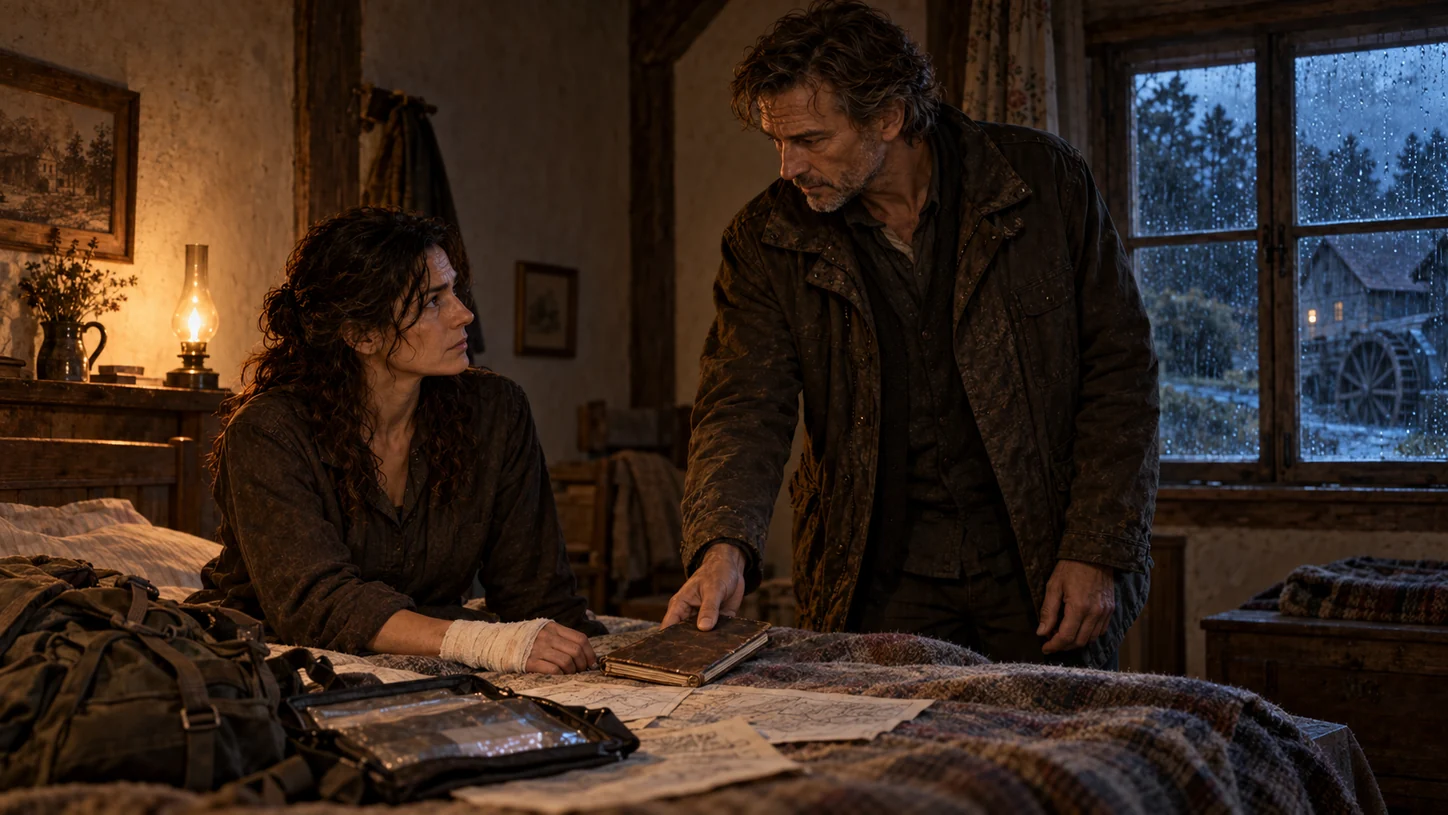
Leonhard remembered the hallway and his own voice coming out of the dark. He asked Maria about August 27, when he had still been lying at the mill after Rosa's burial. She sat down again and looked at his backpack, from which the spine of the field notebook protruded. “I took your things back then,” she began, and he pulled out the book before she could go on.
Maria laid her fingers beside the ragged edges without touching the paper. She had removed pages and later told Leonhard a simpler story, one containing neither Rosa nor the paths he had kept asking about. “You were injured and had a fever; that's what I told you. You stopped asking me about the other things, and I was glad.” She withdrew her hand when Leonhard turned the book toward her and did not deny that part of the gap was her doing.
Leonhard turned to the next surviving entry and back again. He could not tell from the torn edge what Maria had removed and asked whether she would tell Anna, too. Maria nodded and remained at the table while he closed the book and laid it beside the backpack.
Anna came downstairs as Maria lit the lamp, and set her packed backpack beside the door. She reminded Leonhard of the check-in he had promised Heller for the previous evening. “He knows where we parked, and if he can't reach either of us, he'll have someone look for us,” she said. “I want to get out tomorrow morning before anyone else gets lost here.” Leonhard looked at the backpack and wondered whether he should try once more to persuade her to stay. Anna stood by the door and waited for him.
“We promised Karel we wouldn't come back with a more convenient story,” she said at last. “I don't know how much he'll believe, but he should hear it from us.” Leonhard replied that he had no intention of lying to anyone. Anna looked at the closed field notebook on the table. “Then come with us and tell him yourself.”
Leonhard remembered Karel's hand on the threshold and how much easier his anger had been to bear. The same three stream crossings that had brought Leonhard here were probably still on Heller's computer; there, too, someone was waiting for him to return and say what he had seen. He wanted to go back to that part of his life, to the table with the map where no one thought of Rosa at the sight of his name. Anna stood in front of him with her backpack, and he still did not know what to say.
Anna went back upstairs without securing a promise. Maria took bread from the cupboard, wrapped it in a cloth, and laid a small bag beside it. When Leonhard asked whom she was packing for, she replied that she would go with Anna. “Karel should hear what I did from me, too,” she said, tying up the cloth before continuing to gather the things she meant to take.
Leonhard sat beside the stove while Maria closed the bag. “I could stay here,” he said, and for a moment thought she would put the bread back in the cupboard. Instead she set it beside the kitchen door and went to the window once more to look out at the yard. Leonhard took his hands away from the warm stove and waited for her answer.
“I'm leaving tomorrow,” Maria said after turning to face him. “Even if you're still here when I get back.” Leonhard asked whether she expected to come back, but Maria shook her head. “I don't even know whether I'll find the way out. I want to try.” She stood in front of him until he looked up, and did not take his hand as she once would have to make his answer easier.
He looked at her bundle beside the door and asked whether she would stay with him when he told people outside what had happened at the stone. Maria sat down beside him without taking back the bag. “I'll be with you, but you'll have to say it,” she replied. Leonhard stared for a long time at the floor between their shoes and finally asked her to wait for him in the morning.
Maria took a second piece of bread from the cupboard and added it to the one she had already wrapped. Leonhard stood and helped her tie the cloth again because the knot no longer held it all. Then he took the field notebook from the table and carried it to the stairs before he could come up with another question.
He knocked on Anna's door and waited for her answer. She was sitting on the bed with her notes and moved aside when he laid the field notebook on the blanket. “Please take it with you tomorrow,” Leonhard said. “I want you to have it when I tell them what I did.” Anna drew the book toward her and asked whether he was coming; he said he was, without sitting down.
Anna opened the waterproof sleeve and slid the field notebook in beside her notes. The closure caught at one corner until Leonhard straightened it with two fingers; then everything fitted into the backpack. She kept her hand on it for a moment and slowly let out her breath. As Leonhard turned toward the door again, all she asked was whether Maria had finished packing.
He slept only in short stretches that night. Once he thought he heard someone standing in the hall, but he did not go to the door or try to discover which voice was waiting to be recognized. Toward morning the rain stopped falling on the shingles, while the stream kept rushing. Leonhard lay awake, thinking of the young man in the photograph between the sisters, whose decisions belonged to him again now, much as he would have liked to leave that entire summer to someone else.
When he went downstairs, Maria was already standing at the kitchen door in her coat. Her small bundle lay on the table beside the rest of the bread, which she had left for Josef. Anna waited outside, checking the laces of her shoes, while Leonhard picked up his own backpack. Maria pulled the door shut behind her and waited for Anna to come over to them.
They walked through the awakening village of Althütten, with smoke rising here and there from the houses. Anna stayed beside Maria at first, until Maria showed her the way to the cemetery and let her go a few steps ahead. Leonhard remained at Maria's side and slowed his pace as the path narrowed along the slope. Maria took his hand and held it while the low cemetery wall appeared among the trees ahead.