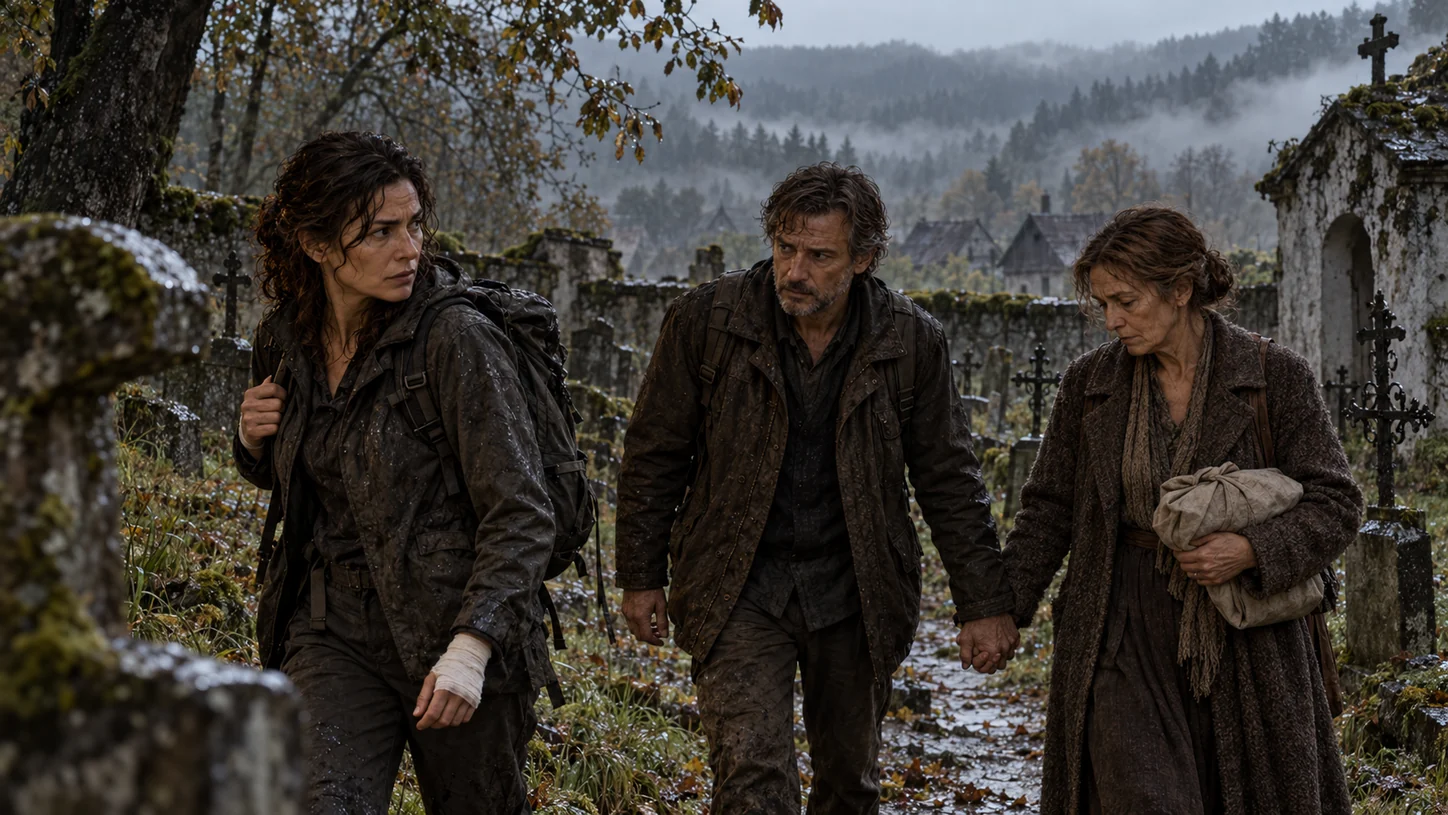
Anna had imagined their visit to the police several times since packing her backpack the evening before. In every version, Leonhard sat beside her and answered for himself when someone asked about August 26. Now she was walking ahead of him along the damp path to the cemetery, listening to his footsteps behind her. She had poured him coffee that morning without mentioning his promise again; only as they left had she noticed that she had left his empty cup on the table instead of carrying it to the pump with her own.
Her notebook and Leonhard's field notebook lay side by side in the waterproof sleeve inside her backpack. That morning she had checked that both were still there and run her thumb along the closure, although it had not jammed since the night before. Now the rigid edge pressed against her back with every step. Anna adjusted the strap and resolved not to take the books out again until she had a table in front of her that would still be standing the next morning.
Behind her, Leonhard and Maria were talking quietly. Anna could not catch every word, but she heard Leonhard ask about the rest of the route and Maria explain that first they had to reach the cemetery. The rain had stopped, and a thin mist rose from the meadows, making the village roofs look brighter than they had in the past few days. A man was leading a horse out of its stall while, in one of the yards, a child tried to scoop water back into an overturned bucket.
Anna stopped at the first bend and waited for them. Leonhard looked at his phone before putting it away again. “As soon as we have a signal, I'll call Heller,” he said. “He's been waiting to hear from me since the day before yesterday.” Then he asked Anna to contact Karel once they were out of the woods. She already had his number saved and promised she would, while Maria shifted the bundle to her other arm.
Maria was holding his hand with the small bundle hanging over her forearm. Anna asked whether she needed anything else from the house, but Maria only tightened the knot and looked at Leonhard. The edge of the bread she had packed the night before showed through the cloth. Anna walked on, taking care at the next bend to leave the pair enough room on the narrow path.
The cemetery lay above the last gardens. On the way, Anna instinctively stroked the injured palm that had reached into empty space when the stone disappeared. She knew she did not want to enter the place again and was annoyed by how much that reluctance was already governing her pace. Leonhard and Maria were walking more slowly without falling behind; when Anna looked back before the wall, Leonhard raised his free hand and motioned for her to keep going.
Even so, she stopped at the entrance. The wall was more complete that morning than in her first photograph, but some of the crosses beyond it were already leaning again as they had among the ruins. On Josef's grave was the porcelain portrait whose gaze she had compared the previous day with the face of the man at the kitchen table. Anna kept to the direction of the rear exit and tried not to study every individual grave to see whether it would still be the same when she looked again.
Leonhard paused in front of Josef's stone and said something Anna did not fully catch. Maria answered softly, and he looked at her again and tightened his hold on her hand. Anna waited beside a leaning cross and pulled the wet sleeve back from her injured hand. The two walked on together without noticing that she was still waiting for them.
“We're moving on now, Anna,” Leonhard said behind her as she turned toward the narrow passage between the graves. She nodded and led the way, the ground growing softer beneath her feet. Beyond the wall she could see the post bearing the sign to Arnolzheim. Through a gap in the trees she made out the pale face of the wood and headed for the exit that led in that direction.
The fresh grave lay to her right. Its earth was dark and loose, with no indication of who could have disturbed it since the previous day, and the plain cross still stood at its head. Anna looked at it no longer than she needed to recognize the spot. She heard Maria say something a few steps behind her, followed by Leonhard's reply, the end of which was lost in the wind.
Anna turned because she thought he had said her name. The two were no longer on the path. She could see the gate through which they had entered and the wet ground as far as Josef's grave, but neither Leonhard nor Maria was standing among the stones. For a moment she assumed they had stopped behind a taller monument and waited for the movement that would explain her mistake.
She called to Leonhard and retraced a few steps. Her voice sounded so loud in the cemetery that she lowered it the second time, as though she had to be considerate of people who were merely hiding. No one was behind Josef's stone, and the path along the wall also lay empty. Anna looked toward the entrance, through which Maria and Leonhard could hardly have gone back unnoticed while she herself had been only a few meters away.
Only when she looked at the fresh grave again did she notice the stone in place of the wooden cross. It was not crooked or half-sunken like the others but stood upright at the head, as though the earth were not yet firm enough to hold it permanently. At first Anna did not want to look, remembering the injury to the heel of her hand and fearing that this monument, too, might disappear. Then she realized there were other stones beside it, in an arrangement she had not seen before.
The first bore Rosa's name. Beneath »Rosa Hadrava« was »† August 26, 1995«, and Anna read the day a second time although she had known it since Maria's account. No sound came up from the mill anymore. When she lifted her head, there were only trees and overgrown foundations beyond the wall; she searched among them for the pale gable before turning to the next stone.
The stone above the fresh earth read »Leonhard Kern«. At first Anna read only the name and tried to connect it with the man whose voice she had just heard behind her. Then she saw the date beneath it: »† August 27, 1995«. She put a hand over her own mouth, and only the pain in her scraped skin made her realize how hard she was pressing her fingers against her face.
The third stone stood on the other side of Leonhard's grave. It bore the name »Maria Hadrava«, and beneath it »† August 28, 1995«. Anna stepped aside until she could see all three inscriptions at once, then returned to stand before Leonhard's stone. A small leaf lay on the fresh earth there, turning in the wind without moving from its spot.
Anna sank to her knees without meaning to. Her backpack pulled her sideways against the path, and she had to brace both hands in the mud before she could get it off her shoulders. She had spoken with Leonhard, touched his hands, argued with him, and in Karel's living room watched a man begin to understand his past guilt. That person could not have spent thirty-one years beneath earth that still looked as though it had been turned that very morning.
“Leonhard, I'm still here,” she said at last and waited, her eyes moving between the stones and the entrance. “You said you'd come with me, and I'm waiting for you.” She held her breath when she heard something beyond the wall, but it was only a branch dripping water. Even as she called again, she tried to imagine him answering and was afraid of his voice.
She struggled to her feet and went back to the entrance once more. Her own footprints were visible in the damp ground there, but beyond Josef's grave the jumble of impressions disappeared into the grass. Anna kept searching anyway, until her hands shook with cold and she began to feel that the next time she turned around, she herself might no longer be in the same cemetery. She found neither Maria's bundle nor Leonhard's backpack, and no track leading to another exit.
At the rear of the wall she looked toward the post. The sign to Arnolzheim had vanished, and beyond the bare wood stood dense undergrowth with no path through it. Anna walked up to the brambles and searched for a place where someone might have pushed through. She found neither broken branches nor trampled stems and returned to the wall, running her uninjured hand over its rough stones.
She went back to the graves once more and opened her notebook. At Leonhard's name the pencil point broke, and Anna studied the little piece of graphite that remained on the damp page. She searched her backpack for another pencil, but her fingers caught in the sleeve's closure until she let both hands rest on it. By the time she could finish copying the names and dates, the line beneath his name had become wet although it was no longer raining.
When she closed the notebook, she could also feel Leonhard's field notebook beneath it through the sleeve. He had given it to her himself and had even helped her fasten the closure; Anna ran her fingers over it before putting the sleeve away. She picked up her backpack and walked to the front exit, through which she hoped to find the forestry road. Only at the gate did she stop, tighten both straps, and then continue without looking back at the graves.
Beyond the wall the woods were full of ordinary sounds again. Water dripped from branches, somewhere one bird was quarreling with another, and after a while the distant sound of an engine joined them. Anna kept to the broader track whose tire marks she had photographed on her first visit, and checked her phone only when the trees began to thin. The display showed September 26, 2026, and several missed calls before she could dial Heller's number.
At first all she could manage was his name. Heller asked where she was and whether Leonhard was with her, and Anna had to stop walking because she could not answer the second question without putting the disappearance into words. “I'm on my way to the parking spot Leonhard sent you,” she said at last. “Leonhard isn't with me anymore, and I need someone to go back with me.” She did not mention the graves yet because first she wanted to reach a person who could understand where she was.
When she saw the car among the trees a little later, another vehicle was already parked there. Anna approached the people standing in front of it and raised her shoulder when one of them tried to take her backpack. She had to make sure the sleeve containing both notebooks was closed before she could let it go. The man opened the car door for her, and Anna sat down while he was still asking whether there was anyone he should contact.
Epilogue
Four weeks later, a folder lay on Anna Berger's desk whose contents grew harder to understand with every addition. She had reported Leonhard's disappearance, described the route back to the cemetery, and shown the people accompanying her where Maria and he had last walked behind her. That day's search had reached only the overgrown cemetery and the ruins. Neither the three new stones nor the fresh mound of earth, whose soil Anna had still been carrying on the knees of her pants, had been found beside Josef's old grave.
She had given a statement anyway and read the report again when it was put before her. At her request, two passages had been amended to specify who had told her something and what she had seen herself. The man taking her statement asked about the fall in the cemetery and examined her palm, which was now healing. Anna described the vanished stone and then showed him the pages on which she had recorded her observations while still at the mill.
She had also called Karel and later visited him in Brno. She told him about Rosa's injury, Leonhard's flight after the shot, and Maria's account of finding her sister still alive. During this visit they had agreed to speak less formally to each other without quite letting go of their cautious politeness. Karel stood when Anna spoke of the beech and remained in front of the dresser until she had finished her account. Only then did he ask about Maria. “I read her name on a gravestone,” Anna said. “It said August 28, 1995, but I don't know how she died.”
Karel wanted to know whether Leonhard had known the truth. Anna told him about his returning memory, his refusal, and how he had brought her the field notebook that evening. As she spoke, Karel took Rosa's photograph from the dresser and set it on the table facing them both. He had given a statement about the pistol, he said at last, and about the argument behind the mill. Then he asked Anna whether she would like another coffee, and she waited beside the photograph until he returned with two cups.
Leonhard's life after the summer of 1995 was documented by people and ordinary records. With Heller's help, Anna spoke to former colleagues, compared dated photographs, and read letters Leonhard had kept himself that had been made available to her for the search. The report of August 29 referred to his treatment after he returned to his lodgings the previous day; geological entries in the field notebook resumed on that same date, initially as additions to earlier measurements. Then came his studies, his degree, his work, and all the inconspicuous traces a person leaves without ever intending them to prove his existence.
Anna herself now belonged to those witnesses. Sometimes she felt Leonhard's hand on her arm again when she lifted her backpack or reached for something with her healing hand. She had sat across from him at meals and argued with him; on the last morning he had asked her to call Karel. In her notebook, the three dates from the graves stood in her own handwriting, and she could find no error in the transcription.
Late one evening Anna took the field notebook out of the sleeve in which she had kept it since he handed it to her at the mill. The entry for August 25 was still there, as was the sentence about Rosa wanting to leave the following morning. Beneath the sketch of the cemetery, however, the name Arnolzheim was missing. Anna tilted the page under the lamp and looked for an erasure, but found only undamaged paper with another line at its lower edge.
She recognized Leonhard's handwriting before she had finished reading the sentence: »Anna, don't come back.« For a long time she held the page open, trying to remember when she had last looked at that exact spot in the book. At last she closed it and left her hands resting on the cover while somewhere in the building water began to rush.