The voices fell silent with the toll of the bell, but Anna and Leonhard stayed beside the water. At a shallow spot he suggested crossing; Anna stopped him and pointed at the opposite bank, where the alder's roots were missing. He studied the slope, hoisted her backpack over his other shoulder, and followed her farther uphill.
Higher up Anna stopped and pointed to an alder on the opposite bank. Its exposed roots reached over a pale stone, behind which the water gathered darkly, as it had at the spot that morning. Anna held out her sketch to Leonhard and looked at the tree again. “That's where we came from,” she said, letting him enter the water first.
They made their way carefully over the granite slabs, Leonhard offering Anna his hand whenever the water deepened between two stones. On the opposite bank she had to brace her injured hand against a root and grimaced without saying anything. Leonhard pulled her onto firm ground and stood beside her until they were both breathing steadily enough again. The stream kept rushing behind them while the bluish dusk among the trees slowly grew lighter.
At first, all they found on the far bank was a row of stones set into the ground. Leonhard followed them slowly until a low wall rose out of the ferns above, with the paving of a lane beginning behind it. At the church doorway he gave Anna her backpack; she set it beneath the overhang and dried her uninjured hand on her jacket before reaching for the strap again.
Beyond the last houses they found the A stones, and around the next bend the forked beech. Leonhard pushed aside the pale branch he had shown Anna that morning and let her pass beneath it. She paused for a moment beside the trunk and looked down the descending path before following him to the first stream.
Maria was standing beneath the mill's overhang when they reached the little bridge. Anna climbed the familiar stone steps and sat on the top one while Leonhard put down his own backpack. He said they had found the stone. Maria looked at his hands before opening the kitchen door and making room for them.
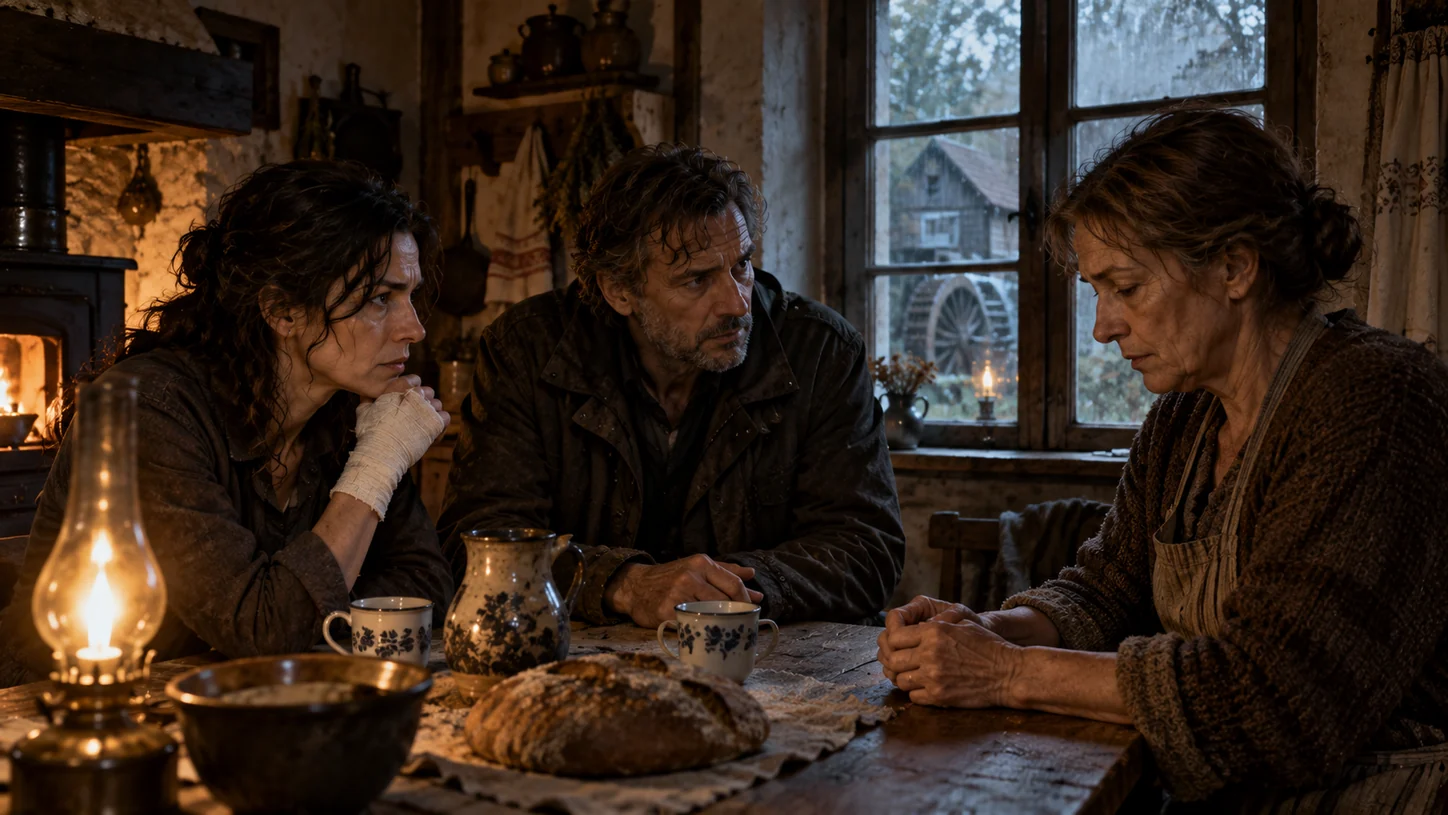
A fire was burning in the kitchen, and on the stove a pot lid was trembling softly. Josef was not there, but his chair was still by the window, as though he might return at any moment. Maria gave Anna a clean cloth for her scraped hand and set warm water beside it. Only after cleaning the wound did Anna sit down at the table with her notebook and ask Leonhard to begin by telling Maria himself what he had remembered at the stone.
Leonhard described Rosa's grip on his sleeve and the shove while Maria sat across the table. She did not interrupt, looking away only when he said Rosa had still been calling after him. Anna left her notebook open beside her but added something at only one point; she had already recorded his first account at the stone.
“Rosa said you weren't there during the argument,” Leonhard said to Maria at last. “She told me to ask you how I came back, and by now I think you found her afterward.” Maria wrapped both hands around the mug in front of her and confirmed it. “I found her alive, and she told me what had happened between you.” Leonhard looked at the window because for a moment he could face neither Rosa's sister nor Anna.
Maria began with the evening of August 26. After the two of them left, she had tried to work at the mill, but eventually every ordinary task had begun to feel like an insult. She had left the bread dough standing and kept looking out at the path, although she did not know whom she was actually expecting to return. Only after dark had someone pounded on the back door, and Maria found Leonhard clinging to the frame, the left side of his shirt soaked in blood.
“You said my name and then Rosa's, but at first I didn't know whether you even recognized me.” Maria gripped the mug so tightly that her knuckles paled. “I'd spent the whole day imagining what I would say to you if you ever stood in front of me again, and when it happened, all I wanted was to keep you from falling to the floor.” She had called Josef, who helped get Leonhard into bed and do what they could to staunch the bleeding. Both could see that he was badly hurt, but neither knew what had happened inside his body.
As he became more lucid, Leonhard spoke of Rosa, a stone, and a path beyond the second stream. He tried to stand and said she was lying out there alone, but collapsed again at the edge of the bed. Maria left Josef with him and took a lantern and a coat outside. “I was afraid I wouldn't be able to find the crossing in the morning,” she explained. “It was still the same evening, and I didn't want to wait and leave Rosa lying out there for another night.”
The journey through the rain was harder than Maria had expected. At one point she returned to the same stream although she thought she had just walked away from it, and only on her second attempt did she find blood on a stone beyond the crossing. She followed the tracks for as long as she could still make them out in the mud and called Rosa's name without getting an answer. A pistol lay beside the low granite boulder, and the sight of it explained for the first time why Leonhard had been shot.
Rosa was sitting a few meters farther on beneath a beech, her back against a root and her legs half covered in leaves. Maria set down the lantern so that its light did not shine straight into Rosa's face and knelt beside her. Her sister took a while to recognize her, then twisted her mouth and said, “Of course it would be you.” When Maria opened her coat, Rosa caught her sleeve and would not let go.
“I tried to get her on her feet,” Maria said. “She was hanging on to me, and I couldn't even get the coat properly around her shoulders. We had to sit down again.” Rosa had vomited, and Maria pushed aside the wet leaves beneath her knees before reaching for her hand once more. When Maria tried to get up to look at the route to the road, Rosa closed her fingers around hers. Maria stayed beneath the beech.
Rosa had told her of Leonhard's decision and how she had tried to hold him back. Sometimes she started the same sentence again before Maria understood which part of the argument she had reached. “She said you'd pushed her away and afterward looked at her so shocked that she had almost helped you,” Maria explained. Leonhard lifted his head, but she went on without waiting for his answer.
Rosa had also spoken of the pistol. “She said she wanted you to stop and hadn't expected to hit you.” Maria ran her thumb over the mug before adding that she had told her sister Leonhard was still alive. Rosa wanted to know whether he was very angry with her; soon afterward she asked again how Maria had found her at all.
Later Rosa had asked about Karel and whether he was asleep already. She was afraid their mother would see her good shoes all wet, and drew her feet under the coat even though Maria asked her to keep her legs outstretched. “I told her I'd clean the shoes when we got home,” Maria said. She paused, glanced at the kitchen door, and added that she had repeated the sentence to her sister whenever Rosa asked.
“Once she was quite clear again and wanted to know whether you would stay with me.” Only now did Maria look at Leonhard. “I told her Josef was with you. Then she said you'd wanted to get back to me, so at least you ought to make it.” Leonhard took the hand he had been bracing himself on off the table, and Maria waited until he was sitting still again.
When Rosa stopped answering, Maria stayed with her beneath the beech and held the coat closed around her shoulders. She had looked at the small watch on her wrist; it was still before midnight, August 26. Even afterward she kept talking, until the oil in the lantern ran lower and she had to turn down the flame. Only after tucking Rosa's hand beneath the coat did she stand and search in the dark for the way to Arnolzheim.
Josef and two men brought the body back into the valley that same night while Anton stayed with Leonhard. Maria went ahead so that they would not miss the beech on the narrow stretch of path. She had left the pistol beside the stone; on a later attempt she had been unable to reach the spot again. Anna asked about it and wrote down the answer before letting Maria continue.
Before the burial at first light on August 27, Maria had washed her sister's hair and cleaned the blood from her temple. She dressed her in the dress their mother had saved for special occasions, which Rosa had only ever worn under protest. “She always said it made her look like someone who arrives at a wedding too early and has to set out the chairs,” Maria recalled. A smile passed across her face before she closed her eyes; Anna pushed the untouched mug closer to her, and for a while no one spoke.
Leonhard laid both forearms on the table and tried to imagine Rosa in the dress. But he saw her shoes among the leaves again and the stone beside her head. In his memory she was struggling upright while he was already backing away, his hand pressed to his bleeding side. When Maria opened her eyes, he looked at her. “I murdered Rosa,” he said so quietly that he did not know whether Anna had understood him.
Maria held his gaze, but when he tried to go on, she turned toward the window. Anna left her notebook beside her and waited while Leonhard slowly took his hands off the table. “I could still hear her calling, and I kept running anyway,” he said without taking his eyes off Maria. She did not turn back, and he could not bring himself to say the apology he wanted to offer her.
Only after a while did Leonhard ask about the nameless grave. Maria turned to him again and explained that Rosa did not lie beneath it. Her gaze lingered on the hand he had pressed against his left side. “I can show you Rosa's place, but I don't know what you'll see there today,” she said. Anna replied that she would record the location Maria had described anyway, and marked the spot beside Josef's grave without identifying it as the fresh mound of earth.
Anna asked whether Maria could show them the burial place the following morning. After that they would have to go back out and speak about what they now knew. Leonhard stood and went to the window; when Anna said she would also give the police his account from the stone, he turned to face her.
“I'm not going with you,” he said. “You can tell them what you wrote down, but I won't stand beside you and pretend I can explain this story.” Anna waited until he started to turn back to the window and asked whether she had understood correctly that he intended to stay. Leonhard confirmed it and took his hand off the window frame.
Anna closed her notebook and said she would leave in the morning. Leonhard did not argue, and Maria waited until Anna had left the kitchen. Then she pushed Anna's chair in to the table and asked him, “What am I supposed to tell Karel when he wants to know why you didn't come with us?”