Quiet movements could be heard from Anna's room until late that night. Once she went down the hall and returned without knocking on Leonhard's door. He lay beneath the heavy blanket, listening to the stream behind the house until he could no longer distinguish its sound from the water in his Vienna apartment; only when he turned over did the smell of the mattress remind him where he was.
In the morning Anna was already in the kitchen, writing with a pencil she had sharpened over a saucer. The heel of her hand was scraped where she had reached into empty space at the vanished gravestone. Maria was cutting bread and avoiding any questions about Anna's hand, while Josef stood at the window studying the swollen stream. Rain fell steadily on the yard, where water collected in shallow channels.
Anna put down her pencil when Josef turned around. She recognized him without Leonhard's help, yet glanced at Leonhard as though she needed confirmation before addressing the man. “Your gravestone gives 1946 as the year of your death, and I photographed the portrait myself yesterday,” she said. “I don't know how to ask politely under the circumstances, but do you remember dying?” Josef regarded her with a seriousness that left no room for a joke.
“I remember that my wife no longer answered when I called her,” Josef said after a while. “Whether that was the moment you mean, I couldn't tell you.” He pulled out a chair and remained standing behind it while Anna picked up her pencil again. When she tried to ask another question, he finally sat down and pushed the breadbasket toward Leonhard.
Maria set coffee on the table, and Leonhard sat beside Anna. Anna watched Josef's hands close around his mug before looking up at Maria and asking about the way to Arnolzheim. Maria set the pitcher down so carefully that Leonhard at first thought she had burned herself; then she picked it up again and placed it beyond Anna's reach.
“Only yesterday you came in here with blood on your hand,” Maria said to Anna. “And today you want to go with him into the woods beyond Arnolzheim, where no one will hear you?” Leonhard replied that he had to see the path now, before everything slipped away again. Maria turned to him. “You're always saying you have to do something. Back then you said you absolutely had to leave, too.”
Anna drew her injured hand off the table and pushed back her chair. “I'm going with him,” she said, and Maria did not answer at first. “Believe me, I'd rather turn back. But if all I do today is go home, tomorrow I'll be sitting in front of those same three sheets of paper, wondering what I failed to ask here.” She found the zipper of her backpack, which she could only close slowly with her aching hand.
Maria turned to Leonhard and asked what he would do if he did not like the image that came back to him. He looked at the hands with which he had worked all those years without remembering a single person in this kitchen. “Then I won't claim it must have been someone else just because I'm older now.” The sentence was harder to say than he had expected, and Maria looked away for a moment.
Josef said that he had been able to make out the path behind the cemetery early that morning. Maria listened and finally looked at Leonhard, who was waiting for her answer. “I'll take you as far as the second stream,” she said. “I'll stay there, but you're not going any farther without taking a good look at the crossing.” She got up to fetch her coat while Josef took the pitcher from the table.
They set off through the village soon afterward, passing inhabitants who went about their work despite the rain. A man was fixing a jammed hatch on a shed, a woman emptied a bucket beside the mill, and cows with dark flanks stood in the meadow below the houses. Leonhard might almost have found these ordinary tasks reassuring had he not noticed how rarely anyone looked over at the three walkers. Maria greeted a few people, received a nod in return, and continued as though determined not to give anyone an opening for conversation.
The narrow path behind the cemetery was open again. At the edge of the woods they reached the old post, with the sign to Arnolzheim hanging in the rain, and Anna stopped without taking out her camera. Instead she described the lettering in her notebook and recorded that the distance was still given as three kilometers. Leonhard showed her the cuts below it, where he had remembered his own hand holding the knife.
“Do you remember when I carved that?” he asked Maria. She studied the letters longer than necessary before explaining that she had been there, but not on the morning he left with Rosa. “You were afraid you'd forget where you'd been again,” she said. “By then you couldn't explain to me what you were trying to hold on to.” Leonhard took his hand off the wood and let her words stand, because the few words that remained were just enough to make him stop accepting the gaps in his memory without resistance.
Beyond the next bend, the stream had overflowed its usual bed. Flat granite slabs lay among the brown currents, and Maria tested them one by one before letting the others follow. Anna kept her shoes on and placed her feet carefully on the stones, because the water was running faster than it appeared from above. Leonhard paused on the near bank and noticed that the path on the other side was already more distinct now that Maria was waiting there.
As he crossed, the sound of the rain changed first. The rushing behind him seemed to recede, although he had moved only a few steps from the water, and the woods grew lighter without a break in the clouds. Anna also looked back and noted the point where the sounds had changed. “The trees are still there, but they look as if they no longer all belong to the same forest,” she said, while Maria asked them both to stay on the visible path.
Two old wheel ruts ran through the grass, with low stones bearing carved markings along the edge. On the first Leonhard read an A and the number one; farther ahead, the pale branch of a forked beech reached across the path. He showed Anna the tree and waited for her to add it to her sketch before they followed Maria.
At the next rise Leonhard instinctively reached up to touch his shoulder, as though he could once again feel the pressure of the backpack strap from that summer. He remembered Rosa bending over a wet map and carefully separating the folds that had stuck together with her fingernail. When Maria noticed he was falling behind, he told her about the memory, and she slowed her pace as she listened.
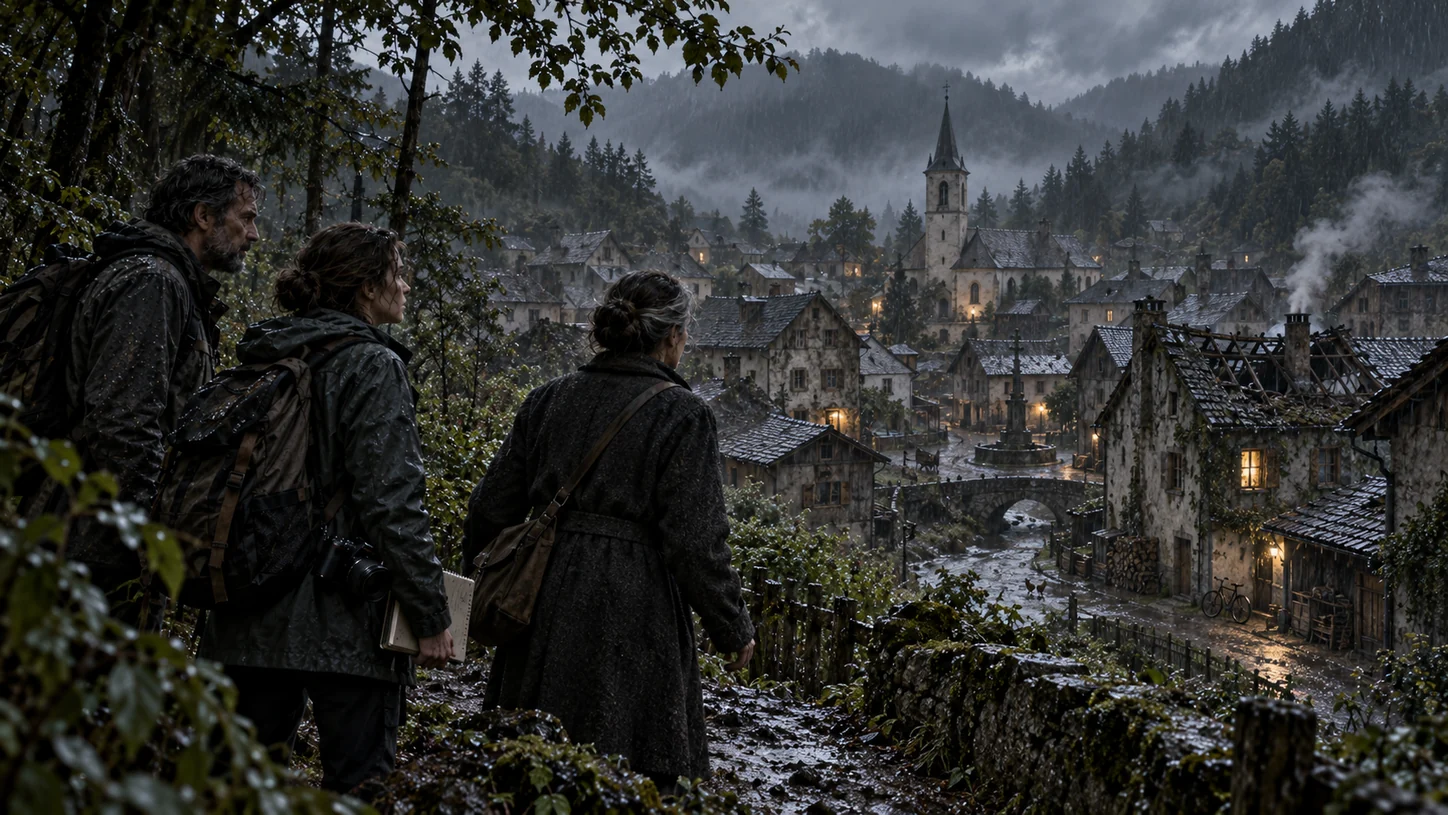
After another bend, the woods ended on a slope above Arnolzheim. About two dozen houses stood around a small church whose tower barely rose above the higher roofs. Some facades were freshly plastered, others had boarded-up windows, and smoke rose from a chimney although the roof beneath it appeared to have collapsed in several places. Anna stopped beside Leonhard and studied the street, where an old bicycle leaned against a wall.
Anna paused in front of a house with boarded-up windows and pointed at the smoke coming from its chimney. Maria walked past her and said only that she should not try to ask about any particular year here. The clatter of dishes could be heard from inside the house, but there was no light between the boards, and Anna caught up with the others.
They entered a narrow lane where water ran down the walls of the houses. In front of a workshop, two men broke off their conversation as soon as they saw Maria; one stepped back inside, while the other remained where he was and studied Leonhard. Leonhard turned around again after the next corner, but from there he could no longer see the entrance.
At the church, Anna read a weathered date and the name Arnolzheim above the doorway. She recorded the letters in a sketch while Leonhard waited under the overhang, listening to water drip from the gutter. Then he noticed two people at the far end of the lane whose movements seemed more familiar than their still-indistinct faces. The man wore a backpack and a plaid shirt, and the woman had a geologist's hammer resting over her shoulder.
Anna also raised her head, and Maria asked them both to step aside. The young man approached without noticing them, while the woman beside him reached for his map with her free hand. Leonhard recognized himself at twenty-five and knew at the same time that Rosa was about to speak. His own memory began a moment before her mouth moved, so that he could not tell whether he was actually hearing the words.
“You'll measure the apartment the same way, won't you?” Rosa asked, holding out the folded map, which he tried in vain to take. “Your desk is going by the window; we agreed on that. I don't want to need a lamp every time I read.” The young Leonhard laughed and said she could at least move the flowers out of the way, at which Rosa gave him back the sheet. “I don't have any flowers yet. You're thinking of the ones on Maria's windowsill.”
The pair walked past them without stepping out of their way. Anna stayed close to the wall and asked Leonhard why he had smiled. When he repeated Rosa's remark, she shook her head. “I saw her give you the map, but all I heard was the rain.” Leonhard watched the figures go; to him their voices were still clearer than the water dripping from the roof right beside him.
Maria let them go ahead and followed only when the figures grew less distinct at the end of the lane. For a moment Leonhard caught the scent of Rosa's hair and had to turn his head, although the woman beside him was Anna. The memory broke off; the lane lay before him again, and Rosa was rounding the next bend with the young man.
Beyond the last houses, a sunken lane led to the second stream. The water flowed more shallowly over pale granite slabs than at the first crossing, and an ordinary woodland path began on the other side. In Leonhard's memory, Rosa stopped on the bank and took off her shoes while the young Leonhard folded the map. “Once we're across, we keep going,” she said, taking his hand. “I don't want to have to ask at every path whether you've changed your mind.”
The young Leonhard promised that they would go on to Vienna, and Rosa stepped into the water before he could add anything. She turned to him and held out her free hand because the current was pushing against her legs. For a moment the present-day Leonhard felt the cold water around his feet, though he was still standing on the bank; then he saw Maria's face in the open doorway while Rosa waited in front of him for the next step.
Anna touched his sleeve, bringing him far enough back into the present to see Maria standing beside the stream. She would wait at this spot, Maria explained, provided the path did not carry her away too. “If you hear voices on your way back, keep looking for the water and the stones you've seen,” she said. “Don't follow someone just because they claim to know you; even my voice wouldn't be reason enough.” Anna repeated the warning so that Maria knew she had understood.
Leonhard committed the old alder on the near bank to memory, its exposed roots stretched over a pale slab of granite, before stepping into the water. Anna followed, her backpack high on her shoulders, and both kept their eyes on the granite slabs. When they looked back from the far bank, Maria was no longer standing among the trees. The sunken lane to Arnolzheim had also disappeared, but the stream kept flowing, and on the opposite bank the alder's exposed roots were still visible, just as Leonhard had memorized them before the crossing.
On the woodland path ahead, the two young figures appeared once more between the trees. Leonhard heard Rosa ask why he had stopped and heard his own reply that he was thinking of Maria. Rosa withdrew her hand from his and hitched her backpack higher, while Anna stood beside the present-day Leonhard, waiting for him to go on.