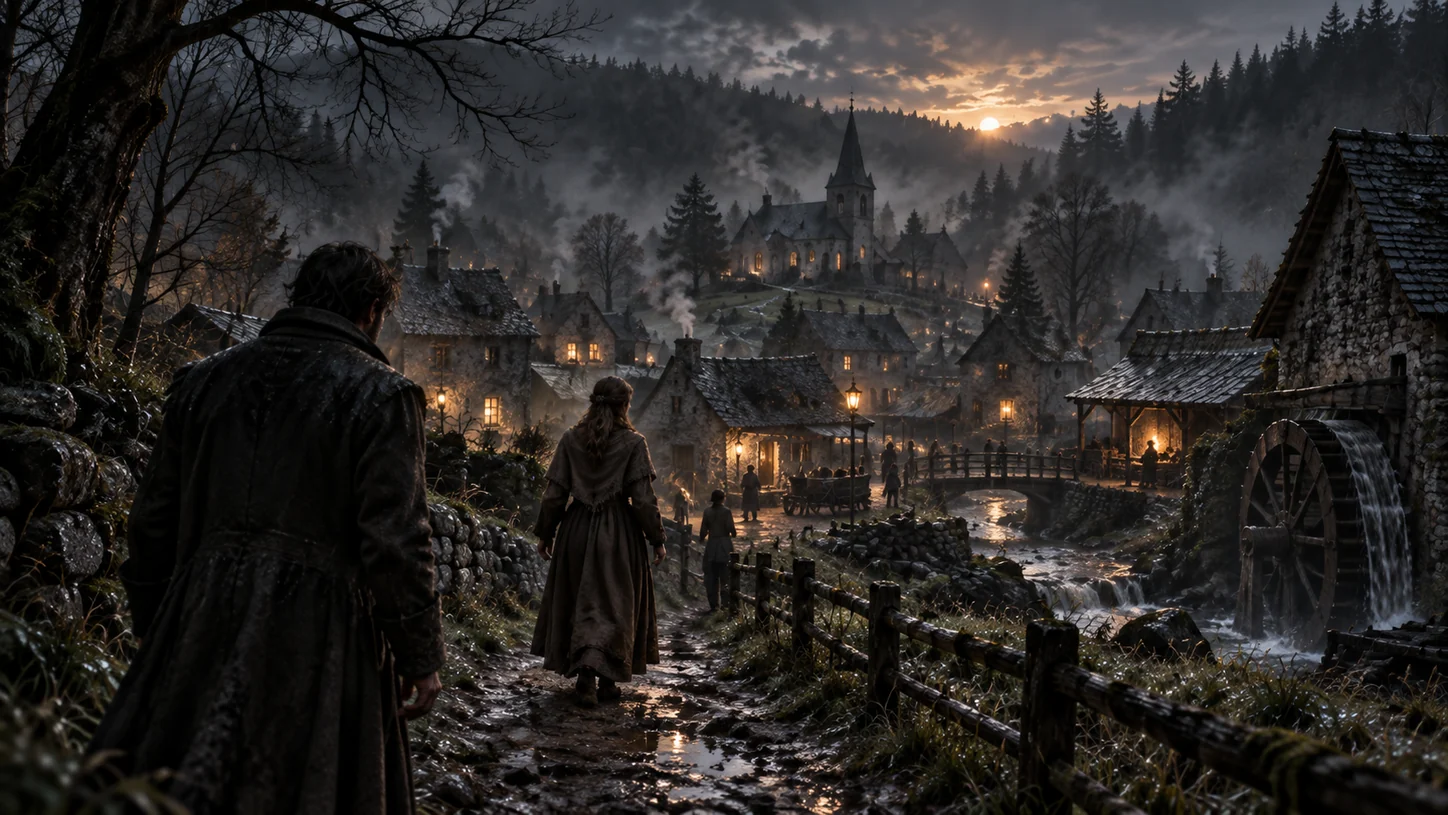
Maria walked ahead without looking back at Leonhard again. The path dropped out of the woods into a shallow hollow, where the rain hung like a fine veil between the trees. Leonhard followed a few meters behind, forcing himself to observe the changes around him as dispassionately as possible. It was an old habit from his work: what could not be explained could at least be described. At first there had only been sounds—a dog, children's voices, the low rumble of a wagon—then he had seen smoke among the treetops, and now the first intact houses were appearing where overgrown foundations and collapsed cellars had stood that afternoon.
The farther they went into the valley, the harder it became to dismiss what he saw as a mistake. A house whose ruined walls Leonhard had photographed only hours earlier was back in its place; its facade was covered in white plaster, its shutters open, and beneath an overhang a man was stacking wood. Laundry hung heavy with rain from a line. Two children ran between the gardens, a boy pausing to look at Leonhard curiously before following his sister. There was nothing theatrical about the scene. No one seemed to be waiting for the stranger to marvel, and it was this very matter-of-factness that finally made Leonhard stop in the middle of the path.
Maria took several more steps before noticing that Leonhard had stopped, then came back to him. He pointed at the house whose cellar he had entered that afternoon and searched for a sentence that would not make his observation sound ridiculous. “I climbed down in there because I wanted to see the old walls. There was sky above me, Maria, and now someone is drying wood under a roof I most certainly didn't overlook.”
“Outside, only the walls are left,” she replied, lowering her voice as though the man beneath the overhang might overhear. “I know that as well as you do, but you won't surprise anyone here by pointing it out.” Leonhard noticed her quick glance to make sure no one was coming toward them, and for the first time he felt angry. The people in the village seemed to share some knowledge they were unwilling to tell him.
“You know my name and claim you helped me forget,” he said, shifting the backpack on his shoulder. “Now I'm supposed to believe that I was outside this afternoon and I'm here now, even though all I've done in between is follow a forest path. I don't need an explanation for the whole world, but at least give me one for what's happening to me.” Maria listened without looking away, and he sensed she did not think his anger unreasonable.
Maria stepped closer until he could see the fine droplets on her eyelashes. “Did you recognize me before I told you my name? Not just my face, Leonhard, but me?” He told her about the room in summer sunlight and the hands tying back her hair, and she briefly lowered her gaze. “That should have been the first thing I thought of,” she said, and when he asked what she meant, she took his wet sleeve between two fingers. “At least come inside with me. I don't know how to begin, standing here in front of you.”
A low cart came toward them, drawn by a brown horse. The man on the driver's seat tipped his cap as he passed and greeted Maria by name. Leonhard examined the cart, harness, and driver's clothes so openly that the man turned to look at him again. None of it established a particular era, but neither did Leonhard see anything that unmistakably belonged to the year 2026.
Once the cart had passed, Leonhard asked what year it was for the people in the village. Maria waited until the horse disappeared at the end of the lane before answering. “I can tell you how long I've been waiting for you. I don't know about the others.” Leonhard was about to press her, but noticed he was no longer cold; a summery warmth lay between the houses, and in a meadow plants were still in bloom that he had not seen on the way here.
“It feels like August,” Maria said when she saw him bend over the meadow. “Sometimes this summer stays with us longer than I can bear.” Leonhard asked whether she meant August 1995, but she merely looked at the houses ahead and said that much more time had passed for her since then. He let the question rest, because her streaks of gray hair fit no better into an unchanged past than his own hands did.
The mill stood at the lower end of the village, where the stream ran among great granite stones and broadened in front of the building. A wooden channel diverted some of the water to a large wheel that turned slowly with a regular creaking. The house had two stories, white plaster walls, and a roof of dark shingles; laundry hung between it and the shed, and outside the door stood a table and two benches where small puddles had gathered.
Leonhard stopped on the path, for this time it was more than a feeling of familiarity. Without having entered the house, he knew there was a kitchen on the left beyond the front door. To the right, a narrow hallway led to a staircase whose third step creaked underfoot. Behind the house, a series of uneven stone steps must lead down to the stream, and upstairs there was a window that could only be forced shut in damp weather.
“I know this house,” he said quietly. Maria stood beside him and confirmed that he had often stayed here before. With that certainty came a memory, this one longer than the others. Leonhard saw a narrow hallway in summer light and himself standing in it, younger, slimmer, with two glasses in his hands. Behind a door, two women were laughing, their voices so alike that at first he could not tell which had spoken. As he went to open the door, the image broke off.
When the memory of the hallway faded, the certainty remained that two women had been laughing there. “You lived in this house with Rosa,” Leonhard said, startled that the name had come to him without any searching. Maria confirmed it and added that their younger brother Karel had also lived here for a time. Leonhard silently repeated Rosa's name until, for the first time, the single letter in his field notebook acquired a face.
The kitchen was on the left, exactly as Leonhard had known. The room was almost entirely as he expected: a heavy wooden table, an iron stove, shelves, a tall glass-fronted cupboard, and pots of herbs on the windowsill. The smell of damp wood and bread, together with a barely perceptible metallic trace in the water, was so familiar that for a few seconds the present lost its solidity.
Maria set a pitcher on the table, but Leonhard remained standing and looked through the open door into the hall. “Does Rosa still live here, or will finding her take as long as finding you?” His impatience sounded strange even to him, while Maria held the pitcher in both hands, apparently considering how to answer. “You'll see her, Leonhard, but I don't know whether you'll like it.” Before he could ask more, the front door opened outside the kitchen.
An older man came along the hall and stopped in the kitchen doorway. He was tall and very thin, with gray hair and dark suspenders over a white shirt. When he saw Leonhard, he took his hand off the doorframe and spoke his full name as though he had last seen him yesterday.
Only when the man came closer did Leonhard remember the face in the porcelain portrait. His phone could be switched on again, and he found the photograph of Josef Hadrava's grave, the dates still unchanged beneath the portrait. “I photographed you an hour ago, though it was in a cemetery,” Leonhard said, holding out the screen. “It says you died in 1946, and I don't know what reasonable explanation you intend to offer me for that.”
Josef bent over the phone and studied the picture with an interest that confused Leonhard more than open dismay would have. “The picture is older than the grave, and I didn't like looking that way even then,” he remarked before pulling out a chair. “You won't change the date, Mr. Kern, even if you photograph me again. I'm still sitting in front of you, and Maria will confirm that I don't come into her kitchen merely to annoy visitors.” He sat down and laid his slender hands on the table while Leonhard searched in vain for some resemblance he might explain away as coincidence.
Leonhard sat because he realized he could hardly remain calm while standing. He searched for an explanation that would remove Josef from this kitchen without also turning the creaking floorboards, his wet clothes, and the taste of the water into an illusion. Instead of an answer, all he noticed was that the old man was picking at a torn fingernail and stopped as soon as Maria set the bread on the table.
When Leonhard drank the water, the metallic taste lingered on his tongue, and he involuntarily grimaced. Maria slid the loaf toward him, and he held it while she cut a slice; without thinking, he then turned it so she would not have to saw through the hard patch in the crust. Only when her knife rested did he notice she was looking at him. “You always used to demand beer and claim that half the geology of the hillside came out of that pump,” she said. He set the loaf on the board but kept his hand against it, as though waiting for her next cut.
After a while Josef rose and picked up the basket he had left beside the door. “If someone calls your name outside this evening, don't go straight to them,” he said, while Maria looked over from the stove. “The bell doesn't count hours here, and there can be more time between its tolls than you'd like. By the last one at the latest, you should be back in a house whose inhabitants you know.” Leonhard asked whether Josef meant living people or the dead as well, but the old man merely replied that he should first learn not to mistake a familiar voice for a familiar person.
After Josef left, Leonhard asked Maria for something that was not as contradictory as the dead man at the kitchen table. She moved the bread basket out of the way between them and seemed almost relieved at the question about her family. “Rosa and I are twins, though we've grown less alike as we've gotten older. Karel is our younger brother, and of the three of us, he was the first to build a life outside this valley.” Maria told him about the two little girls who had initially worn identical dresses and later done everything they could to at least be seen differently.
Karel now lived in Brno, while Rosa had stayed in the valley and searched for a way of her own with growing determination. When Leonhard asked what part he had played in that, Maria brushed a breadcrumb from the table and looked at him for a long time. “At first you came because of your mapping, but after a while your hammer would stay hanging by the door, and you'd forget to take it for hours. That was when I thought you were coming to see me.” Leonhard remembered Maria in the stream behind the mill, barefoot in the shallow water, laughing at him because even while flirting he wanted to explain the granite beneath her feet.
The memory left a familiarity that would not reconcile itself with their estrangement at the signpost. “We were together. I wasn't just visiting you now and then,” Leonhard said, looking at the hands on the table. Maria confirmed it and told him she had begun looking forward to the evenings long before she was willing to admit why. “It wasn't a long life together, but back then I thought it might become one.”
Leonhard went to the window because he did not want to face her directly for his next question. Outside, a woman shook out a blanket while two children skirted the puddles in the yard. “And Rosa fell in love with me too,” he said at last, without disguising the sentence as a question. Maria waited until he turned back to her and answered, “You didn't stop her, Leonhard, and after a while you didn't want to anymore.”
Leonhard returned to the table but did not sit down. The slice of bread Maria had cut for him still lay there, and he moved the plate aside to brace his hands against the tabletop. “So I wasn't just there by chance when something went wrong between you,” he said, but Maria did not answer.
Maria put more wood on the fire, pushing one log so far into the stove that Leonhard instinctively reached for the tongs. She was quicker, and afterward set them on the other side. “You were going to leave after the summer. We both knew that,” she said without turning around. “I always thought we still had time to talk about it. Rosa must have asked you sooner.”
The word summer reminded Leonhard of the entry in the field notebook, and he asked when he and Rosa had decided to leave. Maria took a shallow wooden box from the cupboard, set it in front of him, and removed a photograph. It showed Leonhard in front of the mill, Maria on his right and Rosa on his left; one of his hands rested at Maria's waist while Rosa held his other arm. On the back he had written »August 22, 1995 — Maria, Leonhard, Rosa«.
“Karel took this photograph three days before I saw the two of you together.” Maria placed a finger on the white border without touching any of the faces. “You'll have to ask him yourself whether he suspected anything by then; afterward, I spent too much time trying to see things in this picture that I hadn't wanted to see before.” Leonhard studied the young man between the sisters and could not remember why he had smiled at the camera so carelessly.
While he was still looking at the photograph, the mill's open door came back to him. Maria had been standing in the hallway while Rosa stood close in front of him and his hand rested against her face. “You saw us and didn't say anything,” Leonhard said, and Maria carefully returned the photograph to the box. “At that moment, I didn't know which of you ought to explain first what I was looking at.”
Leonhard asked why she had not stopped him before they left the next morning. Maria slid the box into the cupboard but left the door open, as if she meant to take something else out. “Because I thought I'd already lost you if I had to ask you to stay.” She waited with her hand on the handle until Leonhard looked away, and only then closed the cupboard.
For a while, all they heard was the rush of water behind the mill, until Leonhard asked about August 26. Maria sat down again and told him that he and Rosa had set out with their backpacks shortly after sunrise. “You came back that evening, but Rosa wasn't with you,” she said, holding his gaze. Almost at the same moment, a heavy toll rolled through the village, and across the way a woman pulled her child indoors while a man shut his window shutters. Maria took the kerosene lamp from the shelf and asked Leonhard to keep away from the open window until she had secured the shutters.
Leonhard wanted to know what had happened to Rosa, but a knock on the glass interrupted him. Maria caught his forearm before he could check whether a branch had struck the window. “Please stay with me and don't answer right away,” she said, as a woman's voice outside forced its way through the sound of the stream. The stranger spoke his name with a familiarity to which his body responded before his memory could give her a face.
A handprint slowly appeared on the misted outer surface of the pane. Behind the hand, a face became visible whose dark hair and delicate features resembled Maria's so closely that Leonhard looked involuntarily from one woman to the other. Then he noticed the trail of blood beginning at her right temple and running down her cheek.
Maria let go of his arm as though she no longer had the strength to hold him. “Rosa, what do you want from him today?” she asked so quietly that Leonhard was not certain her sister could hear her outside. The woman behind the glass looked only at him as the fifth toll crossed the yard. For the first time since opening the field notebook, he remembered her full name and how naturally he had once spoken it.